STAY CURIOUS
Keep reading to find the excellency out of perfection and skill.

By: Milestone 101 /
2026-07-17
hollywood
The Show Before the Clothes: How Brands Turned Runways Into Spectacle
Fashion runways have evolved into full-blown spectacles, with icebergs, waves, mushrooms and mock supermarkets often overshadowing the clothes themselves. This piece traces that shift through Manish Malhotra's Paris debut, Louis Vuitton's controversial wave, Chanel's iceberg, Fendi's Trevi Fountain show and decades of theatrical runway history, weighing creative ambition against backlash.
What if the moment audiences remember from a fashion show has nothing to do with the clothes?
Fashion shows have evolved constantly since their inception, moving from simple presentations for buyers to theatrical, architectural spectacles built around the clothes. Today, the ambience and aesthetics are becoming as much a part of the storytelling as the garments themselves.
The backdrop now matters as much as the clothing. Conversations that once centred on hemlines and tailoring now revolve around icebergs, fountains, snowdrifts, mushrooms or waves built to dominate the conversation. The runway has become a stage in its own right,
with clothing serving as one prop within it, a shift that has only accelerated in recent seasons.
This article explores similar theatrical runway moments across the industry, weighing the creative ambition behind them against the backlash they sometimes generated.
Manish Malhotra's "Maa" and Indian Couture's Global Moment
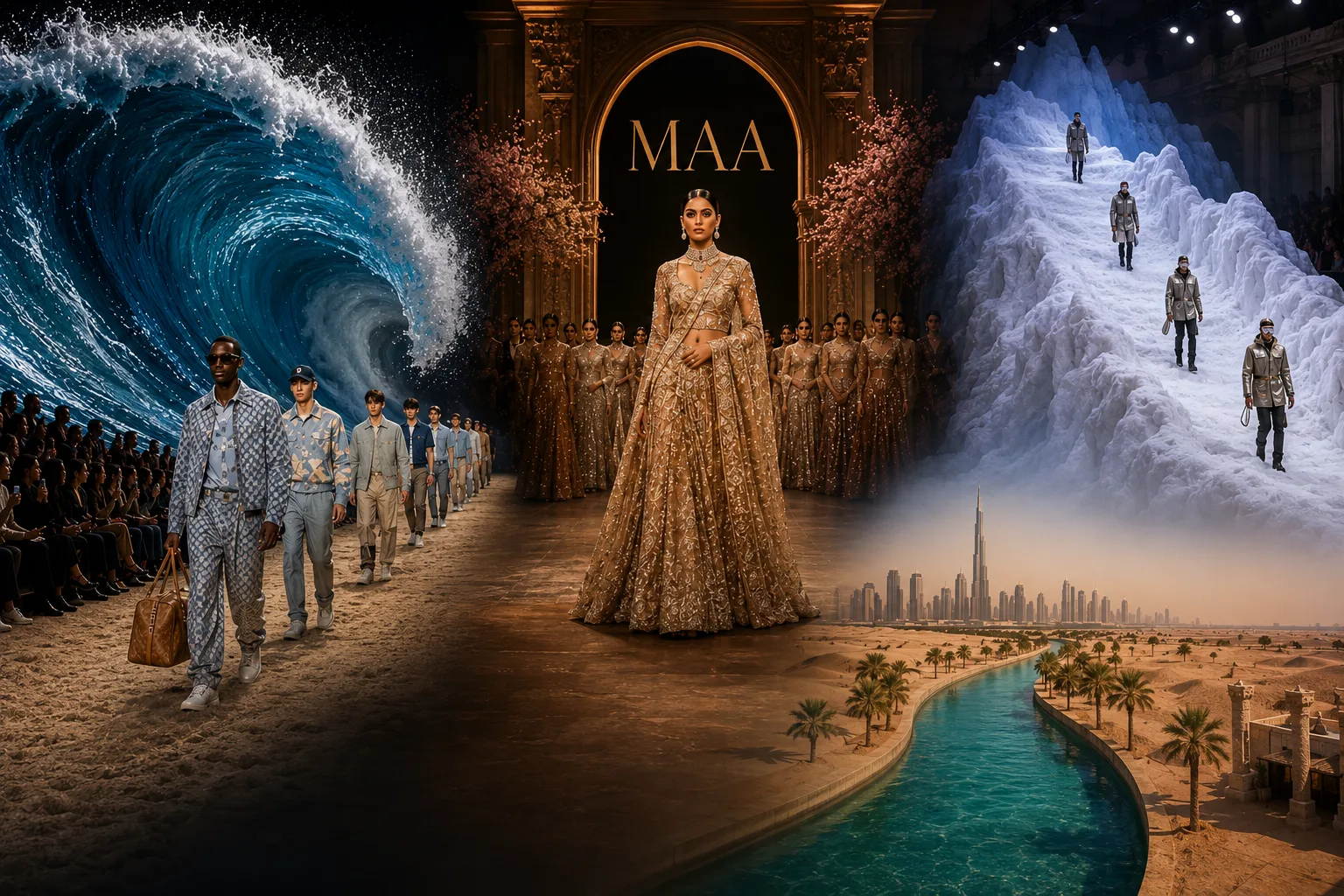
The catwalk has been more than a stage for presenting fashion; it has become a source of discussion and controversy, too. One of the greatest stories of the newly held Paris Haute Couture Week was that of Manish Malhotra, who, for the first time in an official fashion show, presented his collection named Maa. The collection is named after Manish's mother, who is deceased, and consists of four parts: Cocoon, Bond, Becoming, and Abundance, which stand for different stages of motherhood and nature in general.
The distinguishing features of the fashion show were the beautiful shapes of the garments, the coats and jackets adorned with ornaments, beautiful saris, and dresses in various precious colours.
This is the very example of a narrative-driven showcase discussed in the article: the experience centres on garments. It ensures that, rather than burying Indian craft, India receives due attention on the international stage. It also serves as a reminder that investing in an experience connected to one's clothing is generally a win-win thing for the audience, who are prone to accepting what is produced.
Louis Vuitton's Wave and the Paris Backlash
The newest example of this arrival comes to Paris, with men's creative director Pharrell Williams creating Louis Vuitton's spring-summer 2027 menswear collection, unveiled alongside a seven-foot-high, thirty-seven-foot-long artificial wave structure to represent the surf culture that inspired the entire collection. The structure was built at the cité internationale universitaire de Paris.
The Artificial wave used water from Eau De Paris (the City of Paris' Public Water Supply), cycling around, not through, the structure before capturing excess water and returning it to the sanitary sewer. It is important to note that the sand that the models stood on was donated to the university volleyball courts.
The show occurred on the hottest day ever recorded in Paris, which immediately reshaped the narrative around it. LVMH wanted to meditate on the ocean and performance wear; however, due to the extreme heat and water shortages in other parts of Paris, many consumer interactions with LVMH saw the brand staging a glorious show amid an ocean of extreme heat.
Social media reaction was swift and unflattering, with commentators pointing out those cooling their children in shuttered municipal pools even as a private wave crashed through the Trocadéro area for a fifteen-minute show. LVMH responded publicly, insisting the water was recycled responsibly and the set's materials would find a second life, but the criticism had already outpaced the clarification.
It is a pattern this industry knows well: build something breathtaking enough to dominate headlines, then spend the following days explaining why it was not wasteful.
Louis Vuitton is far from alone in discovering that spectacle is a double-edged sword. Fashion history is full of moments when the staging overwhelmed the story that the clothes were meant to tell.
Diesel's Snow Mountain in a Warming World
During a previous Milan Fashion Week, Diesel created an indoor ski slope with fake snow, using artificial mountains to stage a winter-wonderland-themed fashion show.
The sight of all this snow banked high enough to create visual framing for the runway, on the look of an actual slope, inspired awe. However, not everyone had only positive things to say. Environmentalists raised questions about how much energy it takes to freeze an entire indoor ski slope and keep it ready for filming, especially given that the latitude where Diesel was having their winter wonderland had experienced above-normal temperatures throughout the European winter.
When you see how long it took for Diesel to manufacture all this fake snow while the actual winter weather was doing everything possible not to produce any real snow, the question of why Diesel would create and manufacture so much fake snow becomes impossible to ignore.
St. Regis Dubai's AI-Generated Desert Canal
While St Regis Dubai's marketing campaign had an overarching theme of indulgence and fantasy, using AI-generated graphics of a canal traversing the desert, it received overwhelmingly unfavourable responses from online users. Water and opulence are not themes today due to global climate anxiety and scarce water supplies; therefore, many users accused the hotel's campaign of being out of touch or tone-deaf.
Additionally, the St. Regis property is on the Dubai Water Canal itself, illustrating that the hotel created a false, embellished portrayal of luxuriant excess. At the same time, an authentic, significant story lay at its doorstep.
As a result, multiple marketing researchers have identified an overarching trend towards decreased value in AI-generated luxury image portrayals by many brands, and the audience's perception of hollow versus aspirational depictions compromises the very nature of these campaigns' exclusivity.
Chanel's Iceberg at the Grand Palais
An outlandish example of environmental spectacle gone bad was when Chanel shipped a 265-tonne iceberg from northern Scandinavia to Paris as the centrepiece of its show at the Grand Palais.
While it displayed a real piece of Arctic ice melting under harsh, bright lights and looked fantastic, its transport used a tremendous amount of resources. It produced a huge carbon footprint over a long distance for an event that lasted only a few minutes.
Consequently, there was considerable public condemnation from environmental organisations, who felt the carbon cost of shipping the iceberg overshadowed any aesthetic experience that might result from seeing it in person.
The Chanel iceberg has become an important case study in how a specifically designed visual (the iceberg) can influence an entire collection (the new Chanel collections), for both positive and negative purposes.
Fendi and the Trevi Fountain Question
Fendi chose to preserve its heritage rather than promote environmental sustainability. To celebrate its 90th anniversary, Fendi restored the Trevi Fountain in Rome with a multimillion-euro investment and hosted a runway show on it.
The runway event was not contrived like Chanel's Iceberg installation or Louis Vuitton's Wave installation, but exposing the public to the newly refurbished monument improved the condition of the fountain.
However, this event reignited an ongoing debate over how many commercial access points to global brand owners can have to shared cultural sites, and whether restoration funding is sufficient reason for a global brand to use the site for an evening as a private catwalk.
More Recent Theatrics: Mushrooms and a Football Stadium
Chanel returned to the theme of scale and nature again this year, filling the Grand Palais with towering, swollen mushroom sculptures for its couture presentation, an image so surreal it briefly overshadowed the actual garments on show.
Around the same time, Colm Dillane's KidSuper label took the opposite route from ice and water, staging its Spring Summer 2027 collection inside a Miami football stadium, sending models down the pitch alongside child models as a nod to football's mascot tradition, folding sport, spectacle and fashion into a single, ambitious gesture.
The Older Playbook: McQueen, Lagerfeld, Moschino and Balenciaga
Fashion has come a long way from its humble beginnings, and many designers have made their mark on this industry with their unique theatrics. Fashion shows from the 1990s and early 2000's are good examples of the types of showcases that create lasting impressions.
For example, Alexander McQueen staged several iconic fashion shows in London, such as one that used a rain machine on the runway to create a dramatic presentation, versus another that featured Kate Moss's hologram "floating" in a pyramid of light. These examples are often cited as proof that runway presentations can create their own style or folklore after the actual garments have been forgotten.
While at Chanel, Karl Lagerfeld used his creativity and theatrical skills to create many infamous fashion presentations. He transformed the Grand Palais into whatever he desired for each collection.
He turned the Grand Palais into a giant supermarket filled with Chanel-branded groceries one season, and the next season, he converted it into a rocket-launching pad with elaborate props and set pieces built specifically to generate headlines and create social media buzz well after the fashion press coverage ended.
Similarly, Jeremy Scott has used the same concept with his Moschino "runway" presentation staged inside a mock grocery store. In this instance, he placed his models on a runway, with exaggerated packaging lining the aisles, as they transitioned from the high-fashion context of the runway to the mundane context of the grocery store.
Last but not least, Balenciaga's runway show featured its models trudging through actual mud, creating an uncomfortable yet visceral representation of a design's exclusivity and a focal point for critics to analyse.
Gucci, Dior and Off-White: Spectacle Without Scale
During Alessandro Michele's tenure as creative director, Gucci explored the surreal in its Spring/Summer 2017 presentation, featuring models carrying replicas of their severed heads. While the show was intended to evoke science fiction and cloning, some felt it went too far in seeking shock value for its own sake, raising questions about the limits of shock in fashion.
Dior has often used nature itself as a theatrical environment, such as when they created an entire forest inside a Paris exhibition hall, allowing models to emerge from the trees and creating an experience that critics spent as much time discussing as the actual tailoring of the clothing.
Virgil Abloh's Off-White developed sets for his presentations that incorporated industrial materials, police tape, and everyday signage to challenge the notion that fashion is either irreverent or formally elegant, proving that a presentation can be an exercise in taking something familiar and presenting it in a way that makes it feel abnormal again.
The Takeaway
The commonality across these scenarios is a straightforward calculation that brands seem increasingly open to. A single-clothing-only show may produce favourable trade coverage, a single action creates a wave (or an iceberg or a snow-covered mountain or revitalised fountain) that may generate interest around the globe, create viral conversations and, most importantly, generate a high-quality image that lasts longer than the presentation of clothing for the purpose it was intended to.
As demonstrated by Louis Vuitton through the summer this year, shows and the spectacle of being a consumer can often create waves of either adoration (which is what they want) or negative backlash (which the fashion industry typically wants to avoid), particularly when the theatrics of the show come close to any real-world issue (i.e. water shortages, climate change or the ethics of using public treasure). In these instances, the clothing becomes almost an afterthought in the discussion of whether the ambition itself is worth the effort.
Perhaps, this is where the evolution of the fashion world is occurring. The runway was once simply a stage for clothing; nowadays, it is becoming a stage unto itself, and the clothing is merely one part of what is taking place.
2022 © Milestone 101. All Rights Reserved.