STAY CURIOUS
Keep reading to find the excellency out of perfection and skill.

By: Milestone 101 /
2026-02-12
hollywood
Bad Bunny's Moment in the Legacy of Iconic Super Bowl Halftime Performances
Bad Bunny’s 2026 Super Bowl halftime show marked a cultural shift, not a crossover moment. This article traces his performance alongside the long legacy of iconic halftime shows, exploring how artists from Michael Jackson to Rihanna turned fleeting minutes into lasting cultural history.
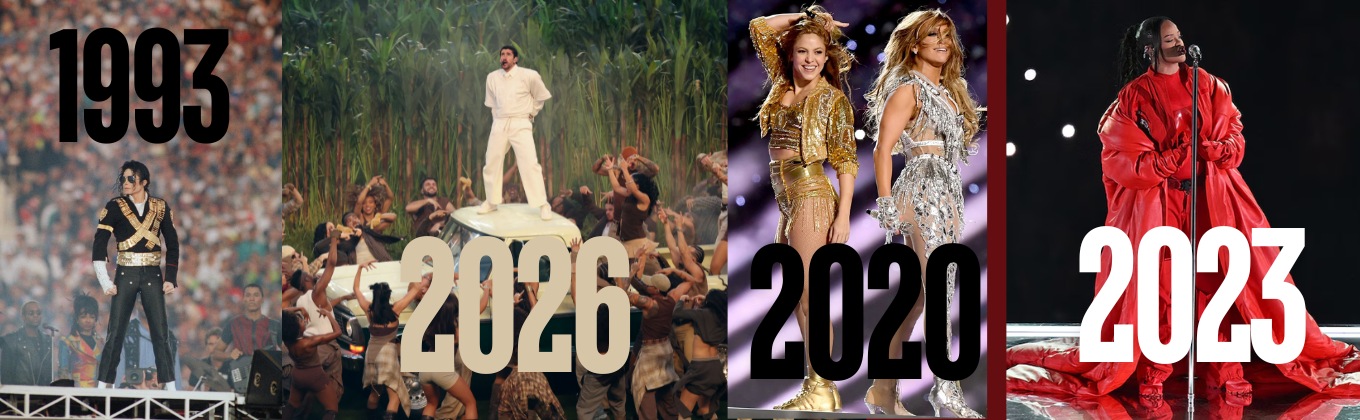
Bad Bunny had just 13 minutes on the Super Bowl halftime stage, but to the people of Puerto Rico, that time would be a defining moment. Social media posts at a breakneck pace, trying to match what was happening outside with what they were posting online. In just a few hours, Bad Bunny completely cleared his Instagram, and the only remaining message was the performance. All of the cameos created massive online buzz, including Cardi B's appearance, and this would ultimately surface in tabloids and sports media for weeks to come. Not only did the viewership numbers explode in the United States, but they also did so globally, making the show one of the most-watched halftime shows in history almost overnight.
The scale of the production was enormous, the precision of execution was flawless, and the reaction was instantaneous. This was so much more than entertainment; this was about presence, self-belief, and the weight of culture. Bad Bunny did not create the iconic halftime show; he built on it.
What Actually Makes a Super Bowl Halftime Show Iconic?
The term “iconic” is often used incorrectly; however, the Super Bowl halftime show meets the requirements necessary to fulfil this definition. There is not other musical performance out there that shares all four attributes — size, magnitude, symbolism, and consequence — quite to the same degree.
To begin, the Super Bowl halftime show is unparalleled; it is the world's largest live musical stage. The Super Bowl viewership is not limited to the stadium or to North America; it has an extremely large global audience, averaging over 100 million viewers. Additionally, after the show, video clips of the performance will continue to circulate on social media. As a result, the performance reached people who had never heard of the artist before, or at least did not know the artist's songs.
Second, there is a sense of confinement surrounding the performance. Artists have a limited amount of time to perform, typically between twelve and fifteen minutes. Therefore, the artist cannot allow slow pacing, vocal fatigue, or any technical blunders to interfere with the show's success. If any of these items occur, there are no opportunities to redo a song after the show. As a result, this "pressure cooker" creates the line between a memorable performance and a legendary one.
The halftime show exists because football needed a pause, but it survived because culture filled that space. Over the decades, it evolved from filler entertainment into a proving ground where pop history gets written in real time.
From Pageantry to Pop Domination
At the beginning of the Super Bowl, halftime shows were practical rather than aspirational. Marching bands, displays of patriotism, and local entertainers filled this period until players were able to regroup; therefore, halftime shows were ceremonies rather than spectacles, and although music was part of them, it was not the emphasis.
In comparison to how Michael Jackson would impact things in 1993, who was able to hold the audience’s attention when he stood still for almost two minutes before beginning to perform, with television ratings soaring during the same time as Jackson performing at Super Bowl, Michael Jackson created an entirely different expectation for how halftime and create an opportunity for halftime to be equal with game time.
Since then, halftime has become a recruiting tool for top pop stars — while also providing new ways to tell stories through performance — with artists, such as U2 and Janet Jackson, bringing star power as well as narrative ambition; however, it was Prince's rain-drenched performance that truly signalled the merging of musicianship and mythology with mass spectacle.
The 2010s have taken the progression of halftime one step further, with social media instantly creating worldwide conversations around their performances, performances being broken down frame by frame, visual storytelling having just as much significance as sound, and the stage itself becoming increasingly complex and cinematic every year.
By the time hip-hop artists headlined in the 2020s, the halftime show had become a cultural checkpoint. Who was invited mattered. Who wasn’t mattered just as much. These performances weren’t just about music. They were about legitimacy, inclusion, and whose stories deserved the biggest platform in American sports.
This evolution explains why modern halftime shows face harsher scrutiny than ever before. They are no longer novelty acts. They are expected to reflect the cultural moment with precision. When they succeed, they become timeless. When they fail, they are unforgivingly exposed.
Performances That Defined Eras
Michael Jackson: The Template
Michael Jackson took halftime to its highest level in 1993 with his performance at the Super Bowl. Until then, the halftime show was a filler. He created an atmosphere of anticipation by standing on stage, without moving for two full minutes and proving that you could have just as much impact by being still as you could through choreography or through spectacle. When the music finally began, every action of his was purposeful; every beat was controlled. This resulted in the highest halftime ratings ever on television, demonstrating that people were no longer tuning out. This was the first time the NFL realised it had an opportunity with its halftime shows. From then on, every single halftime show was measured against Michael Jackson’s standards of control, universality, and presence.
Prince: Rain, Guitar, and Myth
Prince's halftime performance at Super Bowl XLI in 2007 is remembered for two reasons: one, it was great. Two, the weather conditions were almost cinematic. As rain continued to fall heavily throughout the game, Prince chose to embrace its presence and ultimately made a moment that will remain in history as one of the most memorable times he played Purple Rain live.
Rather than a heavily produced event with specific timing for each song, the weather created real-life moments in which each song had no set start or end time, allowing the event to feel real and in the moment, not produced. Ultimately, this was an example of how live performance should be when it embraces both risk and imperfection. While others may have relied on spectacle or guests to create the moment, Prince relied on his musicianship, stage presence, and confidence to prove that being a master musician is enough to dominate the world's biggest stages.
Beyoncé: Politics Meets Precision
With her 2016 halftime performance, Beyoncé changed how much of a political statement a Super Bowl halftime performance could be by creating a performance filled with militaristic choreography and Black Panther-inspired visual elements while blending immaculate pop performance with unfiltered social criticism. There was an immediate and polarising reaction to the performance, as many praised it while others criticised it.
The split reaction to the performance only solidified the moment's power. Beyoncé revealed that the halftime performance space did not have to be ideologically neutral to succeed, and that it could be thought-provoking and challenging while also drawing a large audience. The performance raised expectations, showing that pop spectacle and political expression can coexist, even on America's most-watched television space.
Lady Gaga: Spectacle Without a Net
Lady Gaga's 2017 NFL halftime performance was exceptional because it lacked standard elements. No additional guests appeared at home, nor were there any throwback moments for fans, nor were there any added elements to distract from the performances. Lady Gaga was solely responsible for her performance (i.e., her set list consisted only of her songs). It was up to her to provide vocals, choreography, and a consistently committed theatrical approach to her performance, which produced impressive results.
Lady Gaga's show is a testament to the principle that being disciplined and prepared for a performance will (more so than anything else) outweigh any type of gimmick used during a performance. Lady Gaga's performance also demonstrates that one can command the largest stage in the world without using extravagant (over-the-top) elements; rather, by exercising absolute control over the performance.
Shakira and Jennifer Lopez: Global Pop on Display
Embracing both languages and global pop culture, Shakira and Jennifer Lopez's performance during the 2020 halftime show did not dilute or soften their identities as Latinx artists for an American mainstream audience. Their performance put Latin music, dance, and symbolism front and centre, making it a place to celebrate heritage while also challenging the unequal double standards of women on the Super Bowl stage.
Criticism about whether or not Latina artists were acceptable performers only emphasised the biases being challenged. This performance was not only a showcase of hits but also a catalyst for a dialogue about who determines what is considered family-friendly in entertainment. The performance signalled cultural confidence without compromise, making it one of the most-watched performances in television history.
The Weeknd: Concept Over Crowd-Pleasing
For the 2021 Super Bowl halftime show, The Weeknd presented a radical alternative to traditional approaches, which rely heavily on visual spectacle as the driving element. He created a precisely organised series of visual components that form a cohesive and captivating narrative using distorted mirrors, darkly lit stage settings and constricted camera work to immerse the audience in his artistic vision. By using this narrative structure, The Weeknd focused the show on creating a mood and building a concept rather than aiming for a broad audience.
Some people felt uncomfortable watching this show, while others appreciated The Weeknd's higher level of creativity. This tension was indicative of The Weeknd's desire to prove that a Super Bowl halftime show is an extension of an individual artist’s creative vision, not merely a collection of many artists’ previously popular songs. The Weeknd paved the way for future halftime performers by demonstrating how to tell a personal and/or difficult story through creative expression at a Super Bowl halftime performance.
Rihanna: Confidence Through Restraint
Rihanna’s 2023 performance at the Super Bowl was remarkable because it demonstrated a high level of self-restraint. She showcased her pregnancy as part of the performance, displaying confidence and control throughout the event, allowing her to shine. Her show consisted of very minimalistic presentations; she did not have elaborate changes in costumes, etc. She also commanded a lot of attention without wearing flashy clothing or using many dramatic gestures. She was an example of how much power can exist at this level, especially for women, when they can project such a presence. Rihanna created the impression of dominance without much energy, her massive presence suggesting that true power does not come from fireworks but from knowing precisely how much is necessary and being able to refuse that amount.
Hip-Hop’s Coronation: Dre, Kendrick, and Company
Hip-hop finally got the limelight at Super Bowl LV in a way that was not nostalgic or a novelty, but instead viewed through the lens of its contribution to world culture. The halftime performance by Dr Dre, Kendrick Lamar, Snoop Dogg, and their supporting cast offered a way to celebrate a genre of music that has positively influenced culture over the past 40 years, yet has historically been marginalised by many of our mainstream institutions.
The performance was carefully constructed, full of referential material to their predecessors and replicate the work of a genre that for too long has been asked to justify its contributions to world music. Performing on the most conservative stage in American sport was a message to all, that hip-hop has earned its place in the pantheon of American music (and therefore society) and has the right to be recognised as such; that this performance was part of an ongoing movement to establish hip-hop as legitimate music rather than simply a concession, and finally to elevate the status of hip-hop to that of a historically legitimate form of musical expression.
Each of these performances changed the rules. They expanded what halftime could mean, who it could serve, and how long it could live in public memory.
Bad Bunny’s Place in That Legacy
Bad Bunny has arrived. The Spanish language is not just a statement or a risk; it is the bedrock of Bad Bunny’s performance. This is significant because it represents a radical shift from privilege to power. This performance was never intended to explain itself to anyone other than its intended audience. Its creator had every right to create it however he wanted, and he expected everyone else to keep up.
People across Puerto Rico had the opportunity to view someone from the island take control of the United States’ most-watched television program without watering down his roots or modifying his identity. The cultural implications could not be clearer. Latin culture has taken its rightful place and will no longer wait for its space.
The setlist reinforced that confidence. Bad Bunny moved through a sharp, kinetic medley that included Tití Me Preguntó, Yo Perreo Sola, Safaera, Eoo, Baile Inolvidable, NUEVAYoL, Lo que le pasó a Hawaii, El Apagón, CAFé CON RON, and DeBÍ TiRAR MáS FOToS. Each song flowed into the next without pause, creating momentum rather than nostalgia. The choices weren’t about pleasing a casual audience. They reflected range, politics, humour, and joy, all packed into a tightly controlled fourteen minutes.
Bad Bunny included surprise elements throughout his performance but stayed focused on his show. The unexpected appearance of Lady Gaga during the performance included her dancing a salsa-infused interpretation of "Die with a Smile" alongside Bad Bunny in an unplanned, fun way. Ricky Martin joined Bad Bunny during his performance, linking multiple generations of Latin pop artists together while allowing Bad Bunny to shine.
None of the guest stars detracted from the performance's focus. Guest stars were mostly used as accents to the performance rather than as anchors.
In addition to Lady Gaga and Ricky Martin appearing during the performance, there were several more surprise appearances of stars in the choreography and among the crowd. Pedro Pascal, Cardi B, Karol G, and Jessica Alba were seen among the dancers and on-set props and costumes. Several athletes, such as Ronald Acuña Jr., Emiliano Vargas, and Xander Zayas, were interspersed throughout the performance. None attracted an extraordinary amount of attention to themselves while they were at the performance. Instead, they blended into the community that Bad Bunny was creating rather than putting on a spectacle.
The most talked-about moment of the performance occurred quietly. Bad Bunny was performing a brief "wedding" sequence during his performance when, in reality, a couple from Ontario, California, was being wed live on the Super Bowl stage. At the same time, Bad Bunny sang Baile Inolvidable and danced past the couple. What began as a joke invitation sent to Bad Bunny ended in a Zoom call, then a once-in-a-lifetime moment. The intimacy of it stood in stark contrast to the event's scale, grounding the spectacle in something human.
From a production perspective, they intentionally limited the staging to achieve clean choreography, uncluttered visuals, and a camera that follows the music's beat rather than detracting from it. The now-famous wipe on Instagram at the end emphasised that belief for the whole show: the performance itself was all that needed to be given.
While the audience numbers ranked the halftime show among the highest-viewed halftime performances ever, they were not the reason for the performance. It was not meant to prove the market value of Latin music — that had already been established; rather, Bad Bunny delivered cultural confidence in Latin culture by not changing the structure of the halftime show; he changed the centre of The Halftime Show.
The Takeaway
While most Super Bowls start to blend into each other as years go by, the actual scores, matchups, and great plays will eventually fade from memory. Where there will be a lasting impression, however, will be from the halftime entertainment. Rather than relying on statistics, these performances aim to create an emotional experience for every spectator as they unfold. They are not based on yards gained or trophies, but rather on how the performance made you feel. In just a few short moments, the halftime show can capture something that cannot be measured, but rather something that will last, the mood of a moment.
Unlike championships, the ageing process of a halftime show is more likely to endure because it is at the crossroads of culture, technology, and identity. Halftime shows create a snapshot of a specific moment in time when music, politics, spectacle, and the public's desire for entertainment briefly converge. Many performers have experienced apprehension when performing during a halftime show; the stakes are high. A performer who makes an error during a halftime show has to worry that the mistake will live forever online. However, if a performer gets it right, the performance can be thought of as an embodiment of the era, referenced long after the game has been played and the whistle has blown.
Bad Bunny’s halftime show belongs firmly in that lineage, not because it shattered records, but because it felt inevitable in retrospect. Like the most powerful performances before it, it didn’t seek validation or permission. It arrived fully formed and unapologetic. Years from now, people may struggle to recall who lifted the trophy that night, but they will remember exactly how the halftime made them feel.
2022 © Milestone 101. All Rights Reserved.