STAY CURIOUS
Keep reading to find the excellency out of perfection and skill.

By: Milestone 101 /
2025-07-22
bollywood
Beyond Poo and Geet: Kareena Kapoor Khan’s 25 Years of Risk, Range, and Reinvention
Kareena Kapoor Khan celebrates 25 years in Bollywood with a journey marked by risk, range, and reinvention. From Poo to Jaane Jaan, she’s defied stereotypes, balanced blockbuster fame with critical acclaim, and remains a cultural icon redefining stardom, acting choices, and longevity in the Indian film industry.
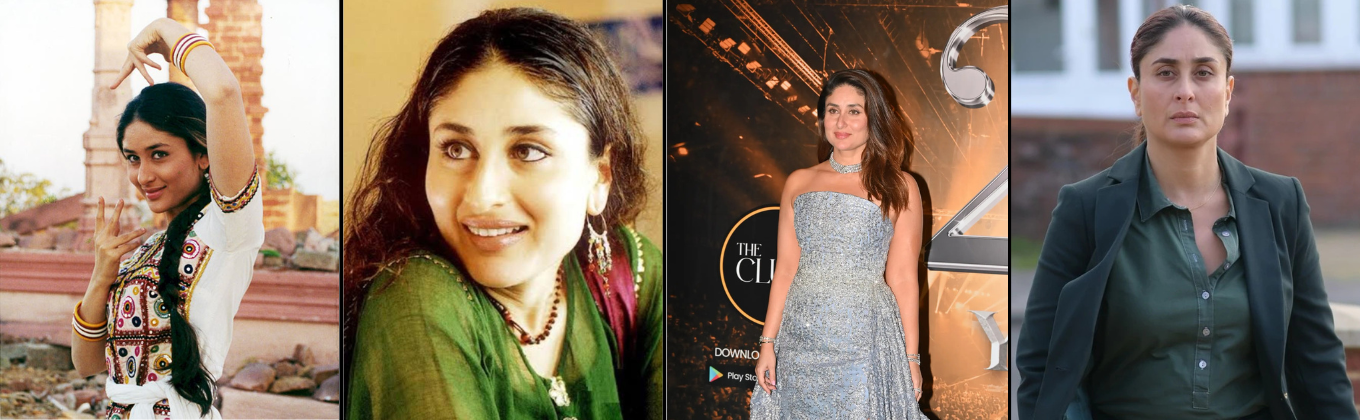
Beyond Poo and Geet: Kareena Kapoor Khan’s 25 Years of Risk, Range, and Reinvention
The one who quipped “Mein apni favourite” has been an audience favourite for 25 years. Kareena Kapoor Khan, armed with two of Bollywood’s most powerful surnames, has appeared in over 60 films, and she’s far from slowing down. Affectionately called 'Bebo', she has defied the odds, pushed back setbacks, and emerged as a Bollywood star who is no longer defined by the nepotism tag.
What was meant to be a glamorous debut with 'Kaho Naa... Pyaar Hai', turned into something more unconventional when Kareena instead opted to work in the romantic drama 'Refugee', directed by J. P. Dutta, with another debutant, Abhishek Bachchan, released in 2000. Critics praised her performance, highlighting her natural beauty, raw innocence, and effortless confidence. While some noted her nervousness, they also acknowledged her charm and the impact she made as a newcomer. Many critics compared her favorably to established actresses, noting her potential and comparing her to actresses like Dimple Kapadia.
Two-and-a-half decades later, she is not just a star but a force, one of Bollywood’s most bankable and admirable actors. As Karan Johar aptly put it in the Koffee With Karan Season 6 finale, "She's ageing like fine wine," and with every new role, she continues to evolve, surprise, and captivate.
Here's an in-depth article on Kareena Kapoor's silver jubilee and the risk-taker, the chameleon of the silver screen, and the icon beneath the surface glitz who never ceases to amaze cinegoers.
Breaking the 'Kapoor Girl' Mould -
Playing a Sex Worker in Chameli (2004)
In an era in Bollywood where heroines were being cast as clean, virtuous leads, Kareena shocked audiences by playing Chameli, a street-smart sex worker with raw vulnerability. Before Kareena, Chameli was stereotyped as the glamorous, rich girl with a thick, fine accent. Then came along this little black and white movie where she played a street-smart sex worker in Mumbai. Directed by Sudhir Mishra, Chameli stripped Kareena of her glittery persona and left audiences with a raw, earthy, and empathetic woman faced with difficult circumstances.
It was a bold choice, and not many women at the time, in the mainstream space, were willing to play sex workers, unless there was also some level of glamour attached to a pretty film. The film was well received, both critically and commercially, and Kareena won her first Filmfare Special Performance Award. With this, she showed the industry and audiences that she was capable of much more.
A Politically Charged Performance in Dev (2004)
In Govind Nihalani's stunning political drama, Dev, Kareena played Aaliya, a woman negotiating the moral and communal crisis of post-riot Mumbai. Aaliya wasn't glamorous, wasn't romanticised, and didn't have the superficiality of a conventional Bollywood heroine. In a cast with heavyweights like Amitabh Bachchan and Om Puri, Kareena held her own, adding empathy, nuance, and fire to her role. Dev was neither a blockbuster nor a movie intended for universal audiences, but it was one of her most layered performances. Oh, she was also credited as a playback singer for the “Jab Nahin Aaye The Tum” song.
Flipping the Gender Script with Aitraaz (2004)
Kareena was not the risk-taker—the public wouldn't perceive her that way—Aitraaz had its context. She played the moral centre of the film, the wife of a man falsely accused of sexual harassment. What made Aitraaz risky for her was the context. A movie in which Priyanka Chopra dominated as the predatory boss, and yet, Kareena still made an excellent case for silent strength, at a time when heroines were either vamps or saints, and she was neither. She was intelligent, restrained, and real. She could have got lost in it, but she did not.
An Underrated Supporting Role in Yuva (2004)
Kareena Kapoor had a small role in Mani Ratnam's Yuva. But the innocent and charming way Kareena paired with Vivek Oberoi in the film had a certain magic that was hard to overlook. Her character was not glam - she was a simple, small-town girl dealing with her partner's political aspirations. She stole the scenes in a film that was largely male-dominated and contextualised India in a complex landscape about its social and political challenges. Yuva also showed Kareena's ability to adapt to serious, layered storytelling with her character being part of an ensemble where the narrative didn't focus exclusively on her.
Navigating Melodrama in Kyon Ki... (2005)
Kareena played Dr. Tanvi, a psychiatrist who gets involved with her mentally unstable patient, in Kyon Ki.... It was melodramatic, tragic, and utterly alien from Bollywood normalcy. The premise had significant flaws; however, Kareena committed to it gladly. The film allowed her to work with grief, hindered emotions, and a sense of inner turmoil. Critics did not universally embrace the movie; however, collectively, one of the few redeeming qualities was Kareena's performance.
Comedy Without the Flash in Chup Chup Ke (2006)
In Priyadarshan's comedy Chup Chup Ke, Kareena played Shruti, a mute woman whose only means of communication was expressions or gestures. Not many actors take on the challenge of playing a character with no dialogue. However, Kareena displayed innocence, mischief, and heartbreak with complete ease. Even though the film itself was a light-hearted caper, Kareena's performance was refreshingly subdued, demonstrating that an actress does not need to participate in grand monologues or dramatic scenes to make an impact.
The Mid-Career Reinvention -
Haunting Vulnerability in Omkaara (2006)
Kareena Kapoor Khan's character, Dolly Mishra, in Vishal Bhardwaj's Omkaara references Shakespeare's Desdemona. Dolly is innocent, devoted and tragically oblivious to the treachery and jealousy ensnaring the men around her. The tragedy of the film is that her innocence is mistaken for disloyalty, and Kareena plays this character arc with subtlety. What you see in her performance is restraint. There are no grand emotional gestures or lengthy monologues; instead, her vulnerability emerges in silences and fleeting expressions, with her eyes registering love, confusion and despair.
As the film reaches its tragic denouement, you can feel her heart break, agonising in the presence of cruelty that is incomprehensible to her. She removed any sense of glamour associated with her identity for this role and melted into Bhardwaj's dark and unforgiving world. Omkaara served as a career benchmark for her, showcasing her depth as an actor. Saif Ali Khan's Langda Tyagi arguably gets top billing, but Kareena is emotionally at the film's core, truly demonstrating her serious acting chops.
The Anti-Fairy Tale in Ek Main Aur Ekk Tu (2012)
Kareena's part as Riana Braganza in Ek Main Aur Ekk Tu was one of her most underappreciated jewels. She was a free-spirited hairstylist who simply didn't fall in love with the hero - imagine that! Bollywood does not typically have a space for female characters who don't have happy endings in love, but Kareena owned that element of surprise with effortless grace; she was relatable, delightful, and this was simply her story: no drama, no breakdowns, no grand romance - just real.
Playing a Ghost in Talaash: The Answer Lies Within (2012)
In Talaash, Kareena stepped into the world of psychological thrillers with a performance that was eerie, sensual, and oddly comforting. She played Rosie, a sex worker with a mysterious past, who becomes the key to unlocking the protagonist’s trauma. The film hinged on her ability to walk the line between being real and being supernatural. Kareena gave Rosie a haunting presence without turning her into a trope. It’s one of her most under-discussed but brilliant performances.
An Unforgettable Performance in Udta Punjab (2016)
Udta Punjab (2016) features Kareena Kapoor Khan in a subtle but powerful role as Dr. Preet Sahani. Playing an earnest doctor fighting large-scale drug addiction in Punjab, she brings innate honesty and down-to-earth qualities to the role, serving as a humanising, loving anchor and an integral character in an otherwise chaotic film. Although it is not a central role, her charm and the tenderness with Diljit Dosanjh provide the audience a moment to breathe before the shocking trajectory of her character. Kareena's performance as Dr. Preet is amazing - both strong and vulnerable - and her evolution of the character makes their journey quietly unforgettable.
Playing a Cop in Crisis in Angrezi Medium (2020)
In Angrezi Medium, Kareena did not play a central role, but she made an impression as Naina, a London cop with personal problems of her own to deal with. It was nice to see her as a professional woman rather than just a woman associated with romantic or household issues. While Kareena cannot take all the credit since she likely had a limited time on screen, she added nuance and layers to a role that could have easily been flat. Naina was there to add substance, not sparkle.
The Late-Career Evolution with Bold and Unconventional Choices:
An Anchor in Chaos in Laal Singh Chaddha (2022)
Although Aamir Khan's Laal Singh Chaddha has received mixed reviews, Kareena's acting in the role of Rupa provided a quiet power to the narrative. The character Rupa had a loose model based on the Jenny character of Forrest Gump; she was complicated, loving, damaged, and hard to locate in rigid terms. Kareena didn't glamorise her character, yet as an actor, she still showed the flaws, ambitions, selfishness, and heartbreak of Rupa. She was the emotional link that tied Laal's journey to something more than just nostalgia.
OTT Debut with Netflix's Jaane Jaan (2023)
With Kareena's entry to the OTT space on Jaane Jaan – a medium that is fast becoming the saviour of a whole generation of Indian actors who have long formless storytelling – she acts as Maya D’Souza, a single mother, a suspect for murder, in a rustic Himalayan location: not a Poo, nor a Geet, just a woman with burdensome secrets, trying to protect her daughter. It was understated, an internal portrayal, a performance that asked us to see into her, not at her. With Jaane Jaan, Kareena reminded audiences and critics that she is not merely pursuing stardom and fame, but rather the tangible pursuits of sincerity and truthfulness.
A Charismatic Scene-Stealer in the Glam Heist Comedy Crew (2024)
Kareena Kapoor Khan in Crew (2024) is a revelation as Jasmine, a street-smart and determined flight attendant. She has a natural balance of sass and vulnerability, bringing a fun twist with spot-on comic timing and an impeccable style. Jasmine's desire for a better life allows Kareena to flex her abilities, providing humour and emotion that keeps the storyline (and the plane!) in the air. Reviews continue to recognise that she is the standout — her glamour, expressions, and chemistry with Tabu are the most celebrated aspects of the film.
A Global Stretch with The Buckingham Murders (2024)
The Buckingham Murders, directed by Hansal Mehta, features Kareena as Jas Bhamra, a detective grappling with the loss of her child while investigating a murder in the UK. Shot in English and Hindi, it is a cold, slow-burning crime film that feels more Nordic noir than Bollywood. This particular role was Kareena at her most stripped-down: no makeup, no embellishment, no pandering to the camera. No performance. Just pain instead. This was a career high for Kareena, not because it was big, but because it took courage. It was a grim, moody film with emotional depth, and Kareena's understated performance was a departure from her previous work, demonstrating that she has truly evolved as an actor, understanding that silence, glances, and pauses can carry power and weight.
Why Poo and Geet Endure
Very few Bollywood characters have made as intense and unforgettable an imprint on pop culture as Kareena Kapoor Khan's Poornima N. Singh or ‘Poo’ from Kabhi Khushi Kabhie Gham and ‘Geet’ from Jab We Met. Both of these performances not only forged eras of cinema, but also reconfigured definitions of human agency, style and accessibility for a younger generation. Long after their release, these characters and their cultural weight continue to resonate in the popular imagination, shape fashion and debate, and encourage ongoing conversations about representation and stardom.
Poo's unfiltered one-liners and Geet's buoyant spirit have become embedded in the popular lexicon, with quotations being fractured on social media and reproduced in memes, gifts, and everyday conversation. Poo's "Good looks, good looks and good looks" and Geet's "Main apni favourite hoon!" have become commonplace, cited and referenced by both fans and celebs alike.
Both Poo and Geet forged an escape from the trappings of archetypal Bollywood heroines. Poo's diva-like confidence and rejection of rules signalled a new kind of femininity on-screen - one that was aspirational yet accessible. Similarly, Geet's infectious self-love and unshakeable positivity modelled a celebration of self-acceptance and being true to oneself.
Poo, in particular, transformed Y2K Bollywood fashion—her shararas, hairbands, and shimmery outfits continue to serve as fashion inspiration contenders unabashedly. Stylists and publications sometimes refer to her in comparison with sensibilities to Western pop culture icons, such as Cher Horowitz (Clueless) or Elle Woods (Legally Blonde), recognising her identical cross-cultural resonance.
For newer audiences, however, the characters continue to remain relevant and recreate their most recognisable moments for social media and event looks. Bollywood stars like Alia Bhatt and Ananya Panday have given homage to Poo's looks, and many notable fashion houses still reference Poo's style legacy, including Kapoor's hair in ‘Geet’.
Kareena herself admits that these roles provided her with a platform to cultivate fame, but also made it hard for her to escape from being typecast: "As an actor, you want to try and do something different every time. For me, it is difficult because I’ve been known for playing Poo and Geet… This thing has been fixed in people’s minds." She notices how these characters remain true to someone, and in such a way, not just because of their goals, but because they have real emotions and desires, and that her opening makes them either aspirational or relatable.
It’s Rocking, Indeed: How Kareena Kapoor Khan's Every Dance Number Has Turned Into A Blockbuster Moment
In addition to her performances, Kareena Kapoor Khan's filmography is marked by iconic dance numbers that exemplify her stardom, versatility, and screen presence. Whether it's the jazzy, retro vibes of "It's Rocking (Kya Love Story Hai)" or the sultry energy of "Marjaani (Billu)", Kareena steals the scene every time with her confident moves and expressive charm, combining playfulness and sensuality. She never just danced, but always added her flavour, attitude, and expressions to every last song. In Chinta Ta Ta Chita Chita (Rowdy Rathore), her brief moment with Akshay Kumar sets the screen on fire, adding glam to an otherwise masala track.
Then we have Fevicol Se from Dabangg 2, where she completely redefined the Bollywood item song as bold, cheeky, and unapologetically fun, delivering it with sass that no one could replicate. Mera Naam Mary Hai (Brothers) continued the trend of flashes of restrained sensuality and striking screen presence. However, these tunes stay popular not just because of their beats, but rather because Kareena takes glamour and charisma to a level that not many achieve. It doesn't matter whether we're at a traditional assembly or a modern club scene; Kareena's dance numbers are spectacle-like events. The mere presence of Kareena makes even the most by-the-numbers songs a part of dance history in Bollywood.
Kareena’s Over-the-Top Moments on Screen
Kareena Kapoor Khan, notwithstanding the charisma of her career, has performed in films where she took the acting to a farcical level. In Ajnabee and Khushi, she relied on heightened, exaggerated gestures and dramatic acting, reminiscent of early 2000s Bollywood films. Main Prem Ki Diwani Hoon remains infamous for her frenetic, almost cartoonish portrayal of Sanjana —a role she (humorously) regrets, too. Then, she went on to do Golmaal 3 and Singham, where her performances favoured being shrill over charm.
However, the apex of Kareena's over-the-topness was the film Kambakkht Ishq, where the glamorous, fiery character often came across as loud and brash, and failed to radiate any genuine sensibility. They were performances that looked more commercially designed than a genuine claim to her nuanced potential. Fortunately, Kareena became more cognizant of being a more subtle and layered actor in later years. All that said, it is lazy, but we can all enjoy these films and performances, which also serve as a reminder that, given the right conditions, even the best can sometimes go off the rails.
Breaking Stereotypes: The Trendsetter Who Rewrote Bollywood’s Rulebook
Kareena Kapoor has regularly been a trendsetter in Bollywood, not just as a star but also as a brand. She was one of the early mainstream actresses to take on unconventional roles early in her career, including Chameli and Dev, when most leading ladies of the time stuck to safe, commercial films. Kareena also made several headlines with the size-zero trend during Tashan, sparking nationwide conversations about fitness and body image. At the height of her second career ascent, she married Saif Ali Khan, countering the industry stereotype that marriage ends an actress's prime as an actor.
In 2009, Kareena became Bollywood's first star to have a song named after her — 'Bebo' in Kambakkht Ishq — and further solidified her prominence in pop culture. In 2016, she broke even more barriers by confidently showing off her baby bump in public, attending events, shooting ads and walking the ramp while pregnant, thus normalising and glamorising the idea of being pregnant, and living life freely. Kareena has also openly addressed controversies — whether it was the outcry over the names of her boys, Taimur and Jeh, or the constant discussion surrounding nepotism and her previous relationships. She added a touch of honesty while also often turning the criticism back on herself with her unmistakable confidence. Kareena is not just an average star; she is an icon who has become a cultural force, redefining the game for actresses, showing that making personal choices does not have to impact one's professional life.
Kareena Kapoor Khan's Legacy
Kareena Kapoor Khan’s silver jubilee in the movie industry is not simply a personal achievement, but rather a case study in how to survive - and evolve - through the changing fates and fortunes of the Indian film industry. While many of her contemporaries faded from popularity after a decade in the industry, Kareena is as visible in the cultural conversation now in her 40s as she was in her 20s.
She has worked as an actress on her terms and has consistently demonstrated an unwavering fearlessness in the roles she takes on. While many of her peers (especially her contemporaries - all roughly within the same age range), settled into typical heroine roles - she embraced unconventional choices - whether that was taking on the role of a sex worker in Chameli to portraying the antagonist in Fida to the bereaved mother in The Buckingham Murders - she was never going to be fashioned ‘the heroine’ and was always going to focus on characters where she was being challenged.
The fact that Kareena has worked on both high-grossing box office films and lesser-seen (yet critically acclaimed) films is even more impressive. While she was filming commercial blockbuster fares like 3 Idiots and Bajrangi Bhaijaan, she was also quietly making films like Dev and Chameli, proving to herself and producers that she could be successful at any angle. Reinventing herself has been pivotal to her staying power in the industry.
From the bubbly Geet in Jab We Met to the enigmatic Maya in Jaane Tu... Ya Jaane Na, Kareena has evolved alongside the times and storytelling methods. In an industry well-known for showing women the door once they turn 30, she continues to ride the wave, refreshing her image with each advance in celebrity-dom.
Kareena's appeal spans generations as she gracefully manages box-office draws, challenging roles, and a likeable character off-screen. The industry and the millions that admire her welcome not only a performer but a movement, an outlier, who navigated a personal path.
2022 © Milestone 101. All Rights Reserved.