STAY CURIOUS
Keep reading to find the excellency out of perfection and skill.

By: Milestone 101 /
2026-07-11
bollywood
Bollywood’s Legal Revolution Is Happening Behind Closed Doors
Bollywood's biggest power shift isn't happening on screen but in conference rooms, where lawyers now shape everything from casting to copyright. As legal budgets soar and litigation becomes routine, this piece explores how the film industry moved from handshake deals to structured contracts, and what that means for its future.
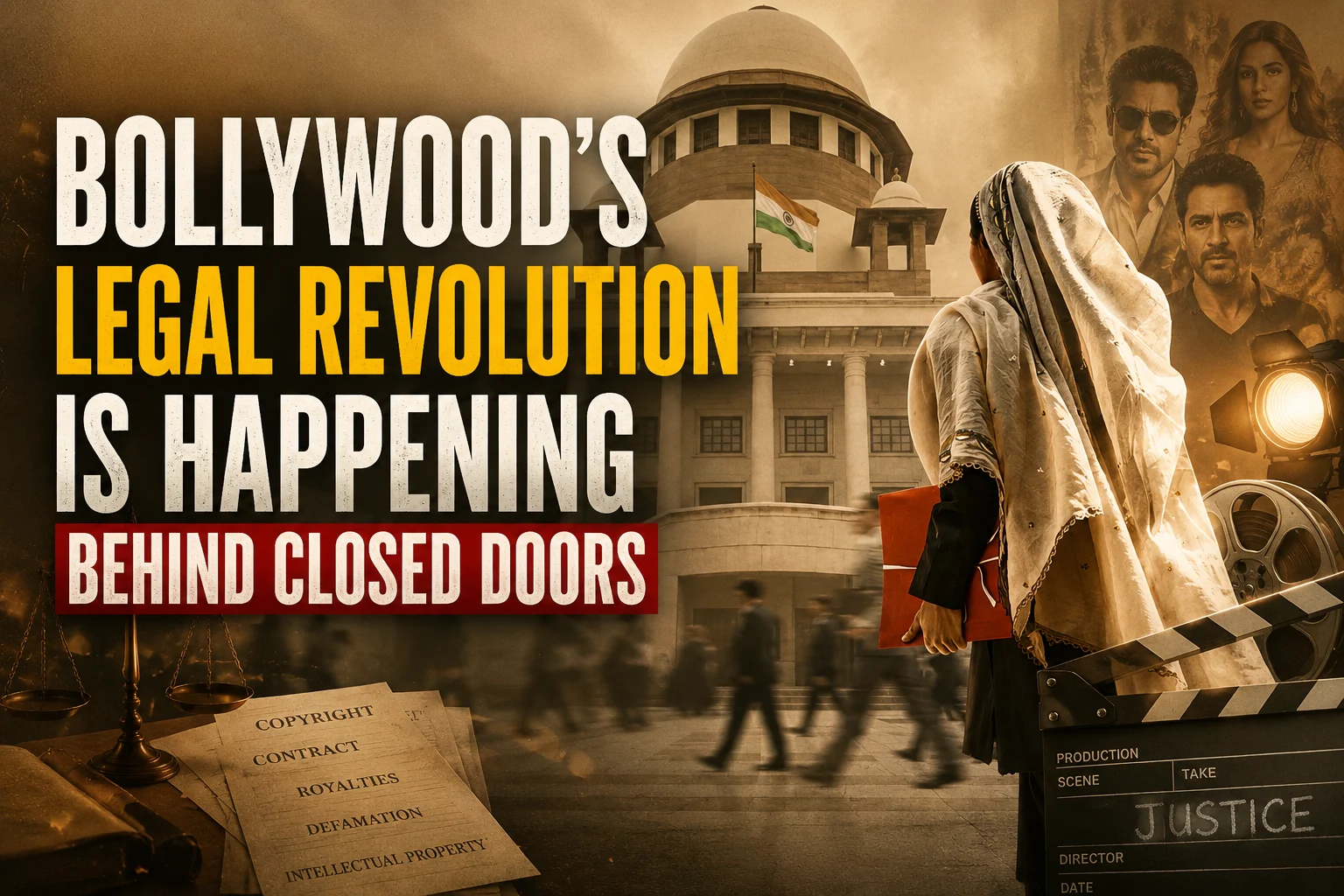
What if the biggest threat to a Bollywood film wasn't a box-office flop, but a clause buried on page 40 of a contract nobody read closely enough?
Bollywood has always operated on the faith of its participants and their informality. The scripts are not legally recorded as ownership, the contracts are issued on average months after they're placed, and payments are made slowly. There is little or no power given to the writer concerning the control and fate of their own written work.
Film producers have created greater value and opportunities for creative work by relying more on personal networks than on the legal system; as a result, the film industry in India has thrived, with the highest level of creative energy, though it lacks the legal stability to support it.
As billion-rupee streaming contracts, copyright issues from around the world, political issues, and global compliance issues become more prevalent, the law will become one of the main sources of power in the Bollywood film industry, and its operation will have a greater influence at every stage of the filmmaking process.
According to data from the last four years, legal expenditures for India's top filmmaking companies (Dharma Productions, Yash Raj Films, Excel Entertainment, Maddock Films) have increased significantly, from ₹23.7 crore in FY21 to ₹66.5 crore in FY25. This article explores what happens behind conference-room doors, where lawyers increasingly shape the future of cinema itself.
The Death of Bollywood's Handshake Culture
For many years, the ambiguity that defined Bollywood's ecosystem kept it thriving; however, this same ambiguity has led to some of the worst legal disasters in the industry's history. When there were no clearly defined agreements concerning the sharing of profits, ownership of films, or other rights such as copyright, many issues arose long after the films were successful.
Historically, writers have fought to receive appropriate credit and compensation for their work, especially when many producers viewed scripts as ordinary, commodity-like items rather than as works protected by intellectual property law.
Music companies have also faced issues due to disputed copyright ownership; remake rights were often freely borrowed from one company to another, and verbal promises often fell apart when money was involved. As films became bigger businesses, the cost of not having a formal structure became too large to ignore.
Many cases have shown Bollywood's vulnerability to copyright issues, e.g., the copying of Krrish by Hitch and the copyright violations in Raabta & Magadheera, to name a few. Also, many of the writer-credit disputes involving veteran screenwriters highlight the extreme lack of documentation of authorship.
Today, legal scrutiny surrounds nearly every component of a film, including scripts, songs, remakes, adaptations, distribution rights, talent agreements, merchandising clauses, and overseas licensing. Entertainment lawyers now insist on detailed "chain of title" documentation that establishes who legally owns every creative element attached to a production. Aarushi Jain of Cyril Amarchand Mangaldas noted that robust documentation and properly negotiated contracts are now essential from the earliest stages of production. Bollywood is no longer operating on memory and trust. It is operating on paperwork.
OTT Platforms Changed Everything
The arrival of global streaming platforms fundamentally changed the legal landscape of Bollywood more than any censorship body, trade union, or studio reform ever could have. These new platforms, like Netflix and Amazon Prime Video, introduced new ways of distributing content but also imposed new global compliance demands on a previously loosely regulated industry.
Bollywood films were now evaluated according to global legal standards for intellectual property rights verification, insurance coverage, completion guarantees, sensitivity reviews, risk assessments for defamation, and contract obligations that traditional producers had not previously considered.
According to Priyanka Khimani, founder of Khimani & Associates, the OTT era created the practice of legal budgeting using "production packs", where companies that are producing multiple productions have retained law firms to provide comprehensive legal oversight to their entire content slate. In addition, international streamers are much more worried about lawsuits, reputational harm, and political consequences than traditional Bollywood producers ever were. As such, legal review takes place before filming rather than after public controversy has erupted.
The intense scrutiny of Sacred Games represented an early indication of the legal complexities surrounding OTT platforms. At the same time, the political fallout from Tandav illustrated how streaming content can lead to litigation and FIRs across the nation within days of release. Additionally, IC 814: The Kandahar Hijack raised the bar for how stories dealing with charged political topics must be legally prepared well in advance.
Films with theatrical runs are also increasingly receiving prior legal screenings to help them assess the likelihood of social outrage, religious outrage, or defamation arising from their theatrical runs. For example, PK faced religious outrage and public protests before its release, and the film was entangled in legal issues stemming from these protests and political opposition. In another example, Adipurush was not only publicly criticised for its depiction of dialogue and religion, but also became the target of multiple FIRs and legal complaints. Modern Bollywood productions are no longer released haphazardly; rather, they undergo extensive legal scrutiny before the public can see them.
In another example, Adipurush was not only publicly criticised for its depiction of dialogue and religion, but also became the target of multiple FIRs and legal complaints. Modern Bollywood productions are no longer released haphazardly; rather, they undergo extensive legal scrutiny before the public can see them.
Lawyers Are Now Bollywood's Power Brokers
Today's entertainment lawyer functions as more than just a backstage problem-solver who comes into play only after a lawsuit is filed. Still, instead they are now shaping the very architecture of Bollywood and influencing how films and film-based businesses operate globally — whether that means developing casting agreements, facilitating the acquisition of rights for remakes, negotiating endorsement agreements, assisting in managing reputational crises for celebrities, advising on the risks associated with censorship or structuring the commercial framework for making money off of films around the world.
In effect, we have witnessed a significant shift in the power dynamics within Bollywood, with true power moving away from producers and distributors and towards legal strategists with an in-depth understanding of intellectual property law, media law, and reputation risk management.
The full service law firm sector has developed to include now major firms such as Cyril Amarchand Mangaldas, DSK Legal, ANM Global and Naik Naik & Company that work very closely with production houses, streaming services, talent agents and celebrities; while, at the same time, notable smaller law firms performing a variety of boutique style legal services related to crisis management, contract negotiation, IP licensing and mediation of disputes.
The evolution of reputation management strategies, previously discussed in multiple reports on "reputation laundering" in Bollywood, demonstrates the growing use of legal notices, takedown requests, defamation threats, and the suppression of online content as basic tools celebrities use to manage their images.
The ecosystem of Shah Rukh Khan is an example of how modern celebrities operate within a framework of extensive brand and IP protection, including trademarks, advertising regulations, digital licensing of IP rights, and reputation management. Salman Khan has been involved in numerous media-related defamation lawsuits; Kangana Ranaut has emerged as one of the most litigious celebrities in Bollywood, having received multiple notices and complaints and engaged in many court-related disputes.
The legal dispute between Javed Akhtar and Kangana Ranaut is a perfect illustration of how personal feuds in Bollywood can be transformed into long-term legal battles. Filmmakers such as Anurag Kashyap must also contend with censorship and political backlash, which often require legal assistance to navigate institutional scrutiny.
Lawyers no longer wait to respond to Bollywood's messes after they have happened; they are now an integral part of the process, determining in the first place which risks are acceptable and, thereby, what can be done.
The Lawsuits That Defined Bollywood
The legal atmosphere in Bollywood has reached a level where nearly every major business or creative decision is influenced by the fear of litigation. The departure of an actor from a franchise is no longer merely a change in casting; it now has wide-ranging effects, including breach-of-contract claims, industry-body involvement, and non-cooperation directives, all of which can dramatically impact production timelines.
The back-and-forth between Ranveer Singh and Don 3, as well as Paresh Rawal's exit from Hera Pheri 3, demonstrate how easily a personal or creative decision can become embroiled in a legal and financial conflict.
In many instances, ownership of intellectual property rights has become a battleground. Both the dispute over the Dhurandhar-Tirchi Topiwale and the ownership of the Hera Pheri franchise exemplify how numerous decades-old agreements, often undocumented or poorly worded, are being tested in today's commercial environment, where the stakes run into crores of rupees.
Issues that used to be resolved by mutual agreement or common practice are now resolved in court. Even celebrity rivalries, such as between Kangana Ranaut and Hrithik Roshan, no longer exist solely as tabloid stories. Rather, they become part of formal litigation, demonstrating that managing one's reputation is a legal function today, not just something handled by PR. Taken together, these flashpoints don't just reflect isolated conflicts. They reflect an industry where legal exposure is now a built-in cost of doing business, one that shapes decisions long before a film reaches the screen.
Copyright Wars and the Cost of Creativity
Copyright disputes are becoming more hostile and financially significant as Bollywood capitalises on nostalgia, franchises, streaming libraries, and remakes. Films today generate revenue through theatrical shows, digital streaming, satellite licenses, merchandising, gaming, music, and worldwide distribution; as a result, intellectual property is treated less as a secondary business issue than before. The value of owning intellectual property has surged, as has the number of legal disputes regarding ownership.
The discussions about remakes and heritage surrounding Bhool Bhulaiyaa and the franchise's subsequent evolutions illustrate that the laws governing adaptations and franchise continuity now require increasingly complex contracts. The Don franchise further demonstrates that legacy intellectual property can develop into a long-term, commercially successful ecosystem through sequels, remakes, and streaming rights.
Sholay has faced copyright litigation and disputes over characters, dialogue, and derivative use of the film; the authorship of Deewaar parallels the cultural legacy of the Salim/Javed duo.
Ownership issues related to music copyrights remain a hot topic in discussions of music rights. There has been an explosion in the catalogue rights, streaming royalties, and archival licenses created by companies like T-Series; these provide substantial revenue streams. There is now competition between Bollywood and South Indian cinema over the rights to remake films, create dubbed versions, and distribute films nationally, as the film industries in each region have increased in size and scope.
There will likely be even more complex challenges in the future, given the number of questions currently being raised about AI-restored films, archival film footage, and digital film distribution technologies. While Bollywood will continue to be inspired by creativity, it has now transitioned into a high-stakes intellectual property business where everything produced will have legal value rather than just be viewed as an expression of creativity.
The Takeaway
Bollywood is known for putting justice on display with courtroom battles, ethical heroes battling corrupt institutions, and morality vs immorality as one of its iconic narrative elements. However, for decades, Bollywood employed a "loosely organised" informal system in which the law was not applied to the entertainment industry's contract and agreement processes. This resulted in a disconnect between the Courtroom and how Bollywood worked.
The main change occurring in Bollywood at present is not a technological, visual, or even creative one – it is a change in structure. The core of power in the film industry has now moved from instinctive producers to institutional compliance, from verbal contracts to written contracts, and from unstructured improvisation to structured legal planning. Lawyers are now part of the creative engine of an industry, influencing how stories are financed, protected, distributed, defended, and preserved.
In modern Bollywood, every film begins not only with a script, but with a legal strategy. And increasingly, the future of Hindi cinema may depend as much on contracts and intellectual property frameworks as it does on stars, songs, and storytelling.
2022 © Milestone 101. All Rights Reserved.