STAY CURIOUS
Keep reading to find the excellency out of perfection and skill.

By: Milestone 101 /
2026-02-13
hollywood
Cliffhangers in 120 Seconds: The Bite-Sized Drama Revolution
Micro dramas are rewriting the rules of storytelling. Built for vertical screens and endless scrolling, these 120-second cliffhangers prioritise emotional spikes over narrative closure. This article explores how platforms, algorithms, brands, and creators are reshaping drama across China, India, and the global digital ecosystem.
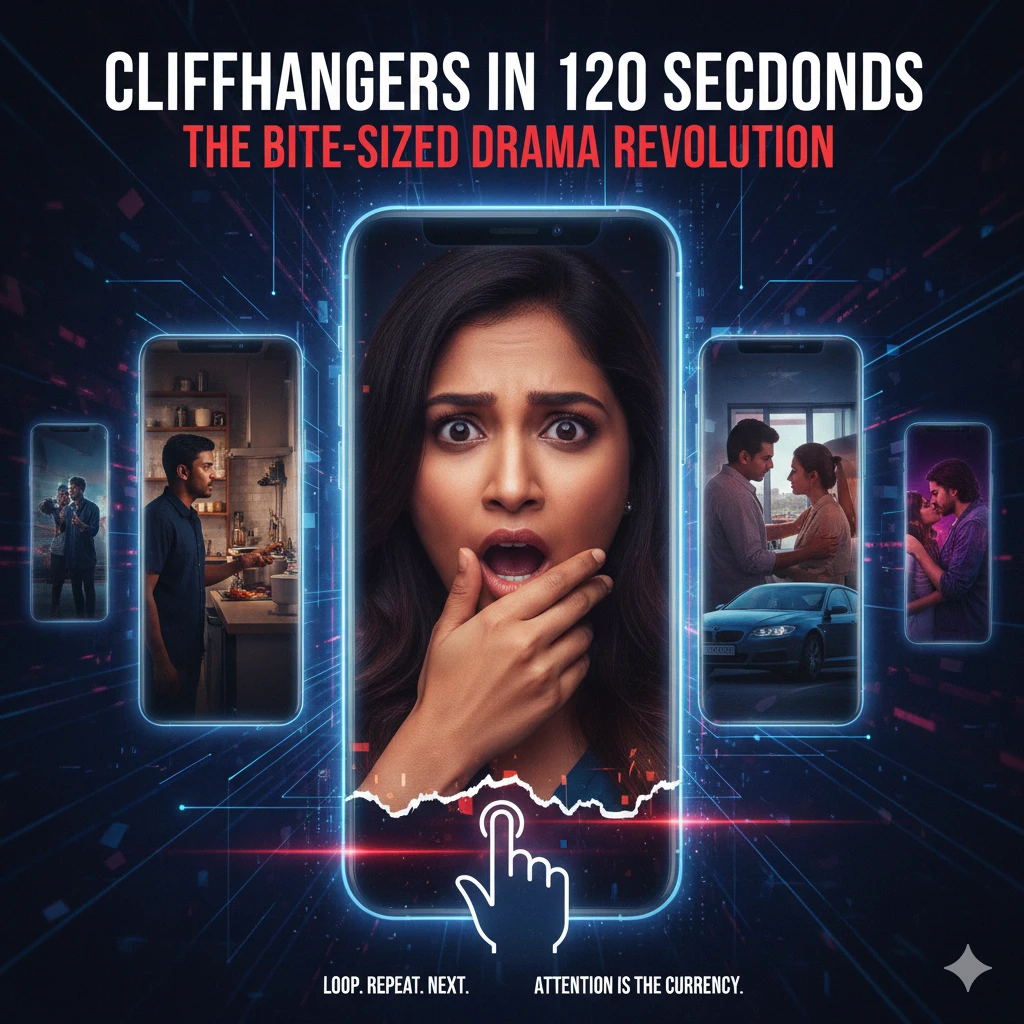
The frame is consistently vertical and close to the top half of the actress’s face; thus, the framing creates a great deal of tension between the character’s actions and emotions, along with an almost kinetic feeling in the audience. Although the character has already made an error, the viewer will never learn what it was, as the video immediately transitions from tension to frustration to shock, then abruptly cuts off before providing any resolution. The viewer is left with the promise of additional information in future videos.
Micro dramas leave their audience hanging, preventing them from contemplating either the actor's performance or the writer's work. Instead, micro dramas create an irritating itch that compels viewers to watch the next video. In contrast, platforms such as Instagram Reels and TikTok do not prioritise storytelling; they prioritise cultivating habits and providing immediate gratification with no delay for viewers. People are attracted to the behaviour rather than the video's quality. Even people who do not watch long dramas will binge on micro dramas, raising questions about what compels viewers to enjoy these fragmented, broken stories over structured ones.
Mutated Cliffhangers
Serialised storytelling has always depended on anticipation and emotional payoff, with cliffhangers at its core. Long before binge-watching, radio shows, soap operas, and episodic dramas used unresolved moments to keep audiences returning, sustaining tension over time while promising eventual closure. Soap operas refined this through familiar archetypes, settings, and recurring conflicts, shifting audience expectations from character growth to the comfort of repetition. Scholars describe this as narrative elasticity, where stories stretch without breaking.
Telenovelas and later Korean dramas added cultural depth and polish, but their reliance on suspense remained intact. Streaming platforms changed the rhythm by collapsing waiting into binge sessions, yet cliffhangers survived, now engineered for immediate continuation. Micro-dramas push this logic further by stripping stories down to the hook alone. Plot becomes secondary to immediate emotional impact, creating repeated trigger points shaped by mobile-first viewing habits rather than long-form progression.
Where It Started And Why China Cracked The Code
The micro-drama economy is not a product of coincidence. It is created in response to the flood of content into our media, but time is limited. All new forms from China were highly organised and designed to deliver short-form serial narratives via mobile devices as the primary medium. As reported by CNBC and analysed by WARC, Chinese Platforms were among the very early adopters of innovative ultra-short serial narratives, specifically designed for mobile consumption. These were not promotional clips and did not represent merely shortened versions of longer-form productions. Each episode was created as an independent work of art, with a focus on relevance and on shaping content explicitly designed for mobile platforms.
The success of the micro-drama model stems from the application of industrial discipline to its production. From posting stories in dozens of episodes per story to many hundreds of episodes per story, micro-dramas were made in 1-2 minutes of production time. Micro-drama production was fast; micro-drama production was manageable at reasonable costs, and micro-drama stories were built upon narrative forms as part of a micro-drama discipline. Audience members could buy subscriptions and pay a small fee to unlock new batches of episodes as they became available. The goal was to create a retention ratio, not to produce an image of artistic success, and to keep viewers engaged.
The success of melodrama on platforms such as television is due to its universal appeal. The emotional resonance of melodrama is palpable regardless of the medium in which it is presented. The exaggerated conflicts in melodrama require little explanation or understanding for viewers to grasp, thereby allowing them to transition in and out of the narrative without losing track of the storyline. Additionally, as discussed in LinkedIn essays comparing China, the MENA region, and India, the success of micro dramas is more a matter of efficiency than of cultural preferences. The survival of melodrama as a compressed format is due in part to its repetitive and intense nature.
Platform Logic Over Story Logic
When micro dramas began appearing on a global social media platform, the logic of storytelling shifted away from traditional narrative priorities. While completing an Instagram Reel or a YouTube short was rewarded based on completion and re-watch rates, the emphasis was also placed on emotional spikes.
As a result of this new environment, the way stories are told has changed fundamentally. For example, one can often see episodes that end mid-sentence or mid-reaction because algorithms prioritise disruption. When you provide a clean ending, audiences are more inclined to leave. But when you give an unresolved moment, audiences are more inclined to continue onward.
Character traits are created as archetypes because, in this new world, nuance takes time, and time is limited. For instance, we have the "betrayed wife," "scheming relative," or "silent lover." These archetypal characters communicate instantly, eliminating the need for exposition.
The use of repetition, which critics might label laziness, is a strategic choice. Algorithms can learn more quickly from familiar patterns and have been shown to evoke predictable responses from audiences when they see repeated emotional cues. The purpose of every clip is to reinforce the previous one, to create a habit, not to advance the story.
In this environment, the logic of storytelling has been replaced with the logic of platforms; emotional interruption, not narrative satisfaction, serves as currency.
The Global Patchwork
Micro dramas' structural DNA is stable across regions. However, cultural influences have modified the series' tone without significantly changing its overall structure. China's production of micro dramas is high, both in volume and in monetisation, as they are treated as an independent entertainment medium rather than merely as an experimental break from traditional television programming. On the other hand, South Korea has taken a core microdrama concept and enhanced its visual quality through higher production budgets, expanded romantic themes, and stylised aesthetics, while maintaining the rapid episodic development characteristic of most other regions.
Micro dramas originating from the Middle East emphasise moral conflicts and social tensions, as in the established themes of long-running television serials. In contrast, Southeast Asia has combined humour and melodrama in micro dramas, creating hybrid products that seamlessly blend elements of both parody and realism. Although the western micro-drama landscape is still in its early stages, approaches to developing micro-dramas tend to emphasise their role as marketing tools or creative challenges rather than as a viable production format.
According to The Hollywood Reporter and Screen Daily, despite these variations, the fundamental structure across all micro-dramas remains the same. Rapid ascension, vertical framing, and never-ending cliffhangers are universal narrative markers of the micro-drama format. No matter where a microdrama is produced and distributed, its mechanics will remain the same. Therefore, micro dramas are not as challenging to culturally translate as long-form narrative formats. To adapt the content of a micro drama, alter only the tangible elements, such as set design or costumes, to suit the local culture.
India’s Late Entry And Sudden Explosion
India's entry into the world of micro drama came late compared to other countries, but when it arrived, it brought its own set of instincts, already established and mature. In particular, the Indian nation had been developing a culture of serialised TV for many years, so they already had a well-defined narrative style. Saas-Bahu serials, daily soap operas and family drama were all extremely popular in India. They had developed audience habits of accepting circular stories, a tendency towards the exaggerated representation of reality, and a rapid cycle of iterations that would eventually lead to resolution.
According to Republic World, the Indian Express, and MediaBrief, there has been a substantial increase in micro-drama consumption, primarily driven by the rise of vernacular languages and the growth of smartphone-only consumers. Smartphones are a very recent technology in India, and as a result, the majority of these consumers do not have any prior experience with OTT platforms. Therefore, many of them have experienced subscription fatigue, language issues, or simply do not have enough time to invest in long-form streamed content. The micro-drama format presents consumers with familiar elements without the commitment or expectation of ongoing viewing.
The Economic Times and Inc42 present a highly ambitious projection of this market's growth, with estimates of a market value of ₹80,000 crores (USD $13.33 billion). However, while it is clear that a significant number of new consumers are joining the market at an impressive pace, monetising them is much less predictable. Currently, there are competing monetisation models, including advertising, brand integrations, and microtransactions. Additionally, many unanswered questions and unclear pathways remain regarding the sustainable monetisation of micro dramas. The market's excitement could outpace infrastructure development.
What is clear is that micro dramas are not replacing television so much as absorbing its leftovers. They inherit television’s narrative habits while shedding its scheduling constraints. India Today and Exchange4Media point out that this format thrives in regions where bandwidth is uneven, attention is fragmented, and storytelling traditions already favour melodrama. The question is not whether micro dramas will grow, but what they will displace, and at what cost.
Creators, Brands, and the Money Question
The reason Micro Dramas have become a phenomenon is not that creators had a "eureka moment" and found a new artistic expression; it's that brands identified a format that was finally used to create content that matched the needs of Advertising—short, repeatable, measurable, and optimised.
Micro Format Storytelling and Marketing, as reported in publications such as Afaqs and ET Edge, has consistently emphasised the same theme. It allows For Attention without Distraction. Micro Dramas enable brands to enter a story quietly, rather than interrupting your viewing experience with pre-roll or mid-roll ad breaks. For example, the Phone Brand becomes a ‘device’ in the story, and the beauty label becomes a ‘simple character trait’ that fosters an emotional bond with the audience and a seamless connection between the Product/Brand and the Story. It is a form of Native Storytelling, not interstitial Advertising. The audience has not begun to "opt in" to the message; they are already there.
The mathematical calculations behind Micro Dramas from the Brand's perspective are straightforward. Micro Dramas provide brands with the opportunity to gain High-Frequency Exposure, minimal production risk, and Scalable Localisation of their content. Regional Creators in Hindi, Tamil, Telugu, Bengali, and Marathi are strengthening their positions of power as Regional Creators and, as such, are developing Cultures of Cultural Fluency, Loyal Audiences, and Algorithmically and Preference-Favoured Status. A Campaign that does not gain traction on Pan-India Television would gain traction when "embedded" in a 90 Second Reel shot in a familiar area, using common language and Emotional shortcuts.
Brand equity here is not built through recall. It is built through repetition without friction. The brand appears so often and so naturally that it stops feeling like messaging and begins to feel like an environment.
But this is not creator freedom. It is creator optimisation. Scripts are reverse-engineered for retention curves. Emotional beats are placed at drop-offs. Cliffhangers are timed not for narrative rhythm, but for watch-time spikes. Creators still create, but within invisible guardrails shaped by dashboards, briefs, and brand safety decks.
The Cultural Cost of Infinite Cliffhangers
There comes a point when speed becomes central to the story. In the past, both academic research on the economic aspects of attention and the evolution of OTT content have warned of the potential impact on narrative consumption when a person's relationship to it shifts from an immersive to an interrupted experience. Micro-dramas exacerbate this issue; they are not only not short on patience, but often teach their audience to expect disruption to their viewing experience by anticipating it.
As micro-dramas typically end in cliffhangers and do not resolve suspense, emotional payoffs in these stories are postponed. A typical micro-drama does not resolve. It simply loops indefinitely. This raises serious questions about the nature of narrative memory when no resolution is ever possible. What occurs with emotional depth when closure is continually delayed?
OTT platforms historically provided users with a way to experience long-form storytelling with slower story-arc development and character evolution. Micro-dramas effectively negate this promise. They condense the emotional response into a small fragment of the overall narrative and, rather than allowing reflection on the narrative, reward continual re-engagement. In addition, both discomfort and ambiguity are eliminated before the viewer has time to digest them.
The question of patience is also an area of study. Research studies on digital fatigue show that, due to the consumption of short-form content, audiences' perceptions of time have changed. For example, after watching short-form films for an extended period, three minutes of video can seem like a long time; likewise, during the same period, a quiet moment in a scene can feel as though it is wasting an audience's time and/or be perceived as a failure to keep the story moving forward.
This is not a moral argument. It is a structural one. When interruption becomes the dominant pleasure, even long stories begin to fracture. Viewers reach for their phones mid-scene. Writers start to seed artificial peaks. Platforms reward motion over meaning. Micro dramas are not destroying storytelling, but they are reshaping the muscles with which audiences consume it. And muscles, once trained, are stiff to retrain.
Where India Goes From Here
India is approaching a period of change. There is a significant market for microdramas in the country, but regulations governing them are not yet fully developed. Regulatory uncertainty and the absence of disclosure regulations will result in limited transparency in this area. At the same time, Copyright legislation for microdramatic works is lacking in India. Ideas can be produced and delivered to the market in a much shorter amount of time than a creator can give credit to them, so original works can quickly lose their creators’ rights and become copies of each other.
While the number of creators and the demand for their output are increasing, there is also a significant emotional toll on creators as they produce more work more frequently and must maintain consistent performance while adhering to algorithms. While the creation of new content was once seen as the pinnacle of success, in today’s microdrama market, creating successful content has become less important than creating sustainable content.
In the future, the further development of micro dramas will require more than marketers' predictions. Microdrama has the potential to evolve into episodic content for OTT platforms or be retrained into a more formalised microdrama. This will be no different: the opening reel still plays, someone hesitates, someone looks into the camera, the cut arrives, the scroll never stops… that is the point.
The Takeaway
An alternative form of storytelling, micro dramatisation, has emerged as a way for brands and creators to navigate changing Consumer habits via a faster-paced environment. As many platforms have cultivated a culture that rewards rapid-fire content creation rather than in-depth exploration, micro dramatisations serve as an effective tool for brands seeking to reach consumers with shrinking attention spans.
Contrary to popular belief, micro dramatisation does not represent a decline in storytelling but rather an evolution of the art form, driven by changing consumer behaviour and the rapid pace of technological advances over the last century. For example, radio serials, soap operas, and streaming video services have all changed the way people consume stories. Micro dramatisation offers another representation of modern culture's constantly moving cycle; when viewed in this way, it is not about advertising; it is another representation of contemporary culture's rapidly changing media.
Future storytelling will combine elements from all formats. Creators will continue to adapt as consumer attention diminishes; this will enable Brands to invest in micro dramatisation as long as numbers outweigh memories. In between swipes and screen refreshes, storytelling will continue to find its place as a mode of negotiation in the constant flux of our culture.
2022 © Milestone 101. All Rights Reserved.