STAY CURIOUS
Keep reading to find the excellency out of perfection and skill.

By: Milestone 101 /
2026-05-25
bollywood
Digital Stardom: Bollywood's New Launchpad for Star Kids
From Riddhima Kapoor to Navya Naveli Nanda, Bollywood's star kids are rewriting the rules of fame. Instead of waiting for a film debut, they're building loyal audiences through social media, podcasts, and personal brands — turning digital presence into a powerful launchpad that the industry can no longer ignore.
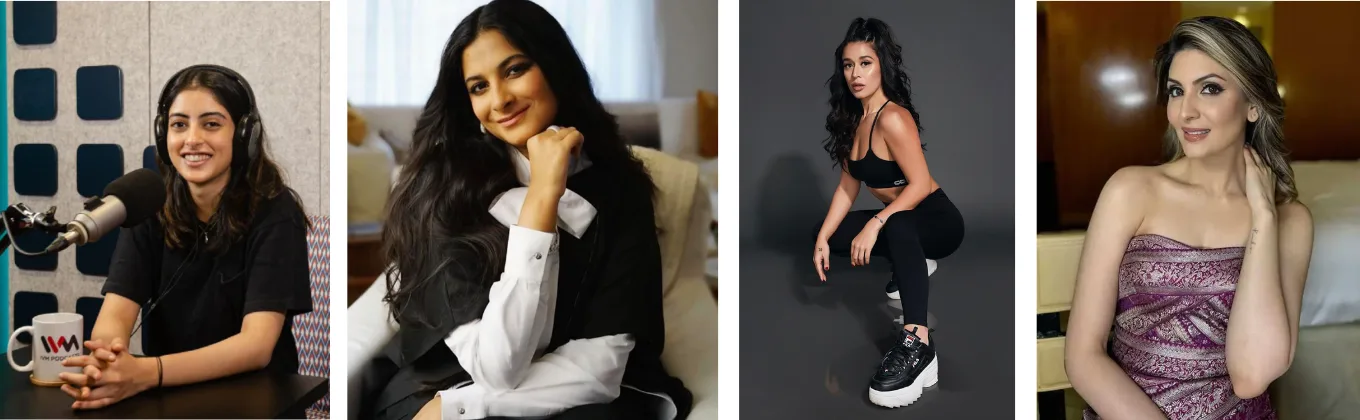
What if the most powerful move in Bollywood today is not landing a film — but refusing to wait for one?
Long before she announced an upcoming movie project, Riddhima Kapoor had already created one thing much stronger than any single movie: a loyal audience. By sharing her life with us, through fashion advice to family time to candid conversations about her life growing up as a member of the Kapoor family, she has built a following that most newcomers could only dream of owning.
For years, the Bollywood debut of an actress or actor has been regarded as the pinnacle of a career: from the launch party to the magazine cover shoot to the well-planned premiere. However, for today's celebrity relatives, the pathway to fame has changed entirely. Fame is being cultivated not via movies, but instead by using their devices to share content via various media channels - social media, video reels, podcasts and brands.
The New Wave: Who Is Doing This and How
These names represent an emerging trend evident in how these women have shaped their identities in both the online and offline worlds. Riddhima Kapoor is the daughter of the late Rishi Kapoor and sister to Ranbir. For a long time, she created a personal brand through lifestyle and fashion, accumulated a following, and developed a portfolio of brands she works with, all before she had ever had her name on a film poster.
On the other hand, Krishna Shroff is Jackie Shroff's daughter. She followed a very different path, creating a persona through fitness, reality TV, and discussions about entrepreneurship to build her image as an independent, credible figure outside her father's fame.
Ira Khan, the daughter of Aamir Khan, has used her platform to discuss mental health issues. In this space, where authenticity matters more than lineage, she has proven highly credible. Navya Naveli Nanda, the granddaughter of Amitabh Bachchan, has chosen to pursue entrepreneurship and co-hosts a podcast that discusses health, culture, and the real lives of young Indian women.
Rhea Kapoor built her identity around her love of fashion, and Sameeksha Pednekar has developed hers digitally by consistently producing content that reflects her personality.
The different formats (vlogging about your lifestyle or fitness, writing a newsletter, creating a podcast, launching a direct-to-consumer product, advocating for sustainability) produced by those who have become well-known are just as varied as the ambitions behind them. In the past, becoming an actor was the end goal for almost everyone in the public eye, but today, many of these same people are building careers unrelated to acting.
All of the aforementioned examples are people doing their own thing, and these projects are destinations, not stepping stones to something else. All of these projects have been created and/or maintained via digital media, using democratised access to tools that provide public visibility.
The one thing that ties all of these examples together is that they have chosen to create their own paths and stories for the public to see on their terms and have already built their audiences.
The Strategy: Why It Works
The reason is simple, as noted by some industry experts: a glowing online presence is not only a flattering asset but also a valuable business tool. Producers and brands no longer have to guess whether their newest cast member will reach an audience; the concrete evidence of their following clearly demonstrates this.
As stated by Harikrishnan Pillai, ceo/co-founder of the digital marketing company TheSmallBigIdea: "These are people that have not made it as household names in the world of acting and filmmaking; however, they have the business advantage of having access to money, connections, and a famous last name." The barriers to creating and distributing content are much lower than before, and they are capitalising on that.
However, there is something much more interesting that Pillai said about this group of people: For many people in this sector, social media is not an audition to become an actor — it is just another way to market themselves (and make money). "They may be opening a restaurant, creating a clothing line, or starting some other business, and this marketing would then be a great way to expand their brand," he said.
The celebrity family connection, even when the star parent stays firmly in the background, amplifies content in ways that no conventional advertising budget can replicate. An A-lister grandmother in a passing Instagram story does, as Pillai puts it, ten times the work of traditional brand content.
The Industry View: Producers and Brands Are Paying Attention
The change in approach to project approvals has been noted by those who approve projects and sign endorsement contracts. Producers and studios have gone from relying on intuition (or, to be more honest, the appeal of an established name) to using new data as reference points.
"What social media activity has done is given producers and studios a real-world way to see how much social media engagement a family member can expect if they are selected to act or if they start a career as an actor," says Ekshita Arora, senior copywriter at the digital marketing agency BC Web Wise.
"Producers are being empowered to make data-driven decisions rather than relying solely on intuition, which greatly reduces the amount of pressure on production companies to create hype for a project before it starts. There is already a visible and engaged audience that production companies can market to."
Brands also face the same kind of decision-making opportunity. Developing the overall trend as a strategy to "repackage" the talent's legacy for relevance in today's market is "strategic repackaging," according to Supriya M. Kalla, an assistant marketing professor at IMI Delhi. "These people have a significant social media presence and attract a lot of paparazzi attention. Therefore, there is no shortage of earned media being generated," she points out. They cultivate a personal brand that feels more relatable and accessible than traditional A-list celebrities, resonating with Gen Z audiences."
It is, in other words, a two-sided market: celebrity relatives gain visibility and income independently of the film industry. In contrast, producers and brands gain pre-validated talent with built-in audiences. Both sides benefit from the transaction.
The Flip Side: What Fame Online Cannot Buy
The social-first approach has inherent limitations,s and people need to recognise them. Simply having a large following will give a brand reach, but not necessarily improve its performance. As Arora states, "To put it bluntly, if the goal of having a large following is actually to transition smoothly into an acting career, then a large following will give you access to a larger audience but will not give you the experience." Viewers may be willing to watch an actor they know, but if that actor doesn't deliver a compelling performance, they will lose interest very quickly.
As the discussion of nepotism takes place on Instagram, that conversation does not get much better under the shade of a filter. In fact, because these individuals are appearing in a more highly visible capacity, the images they project become more pronounced.
As individual members become more exposed, they also become more scrutinised regarding the conditions of their privilege. There is also the added pressure of the "family brand"; if one member c uses a problem, it can affect the entire family unit. When becoming famous by association, an individual must be accountable to the family brand.
The Takeaway
Before Riddhima Kapoor announced her film, the industry already knew the most pressing issue: Will anyone care? The answer to this question was a definitive yes, and it had been built over years of audience-building through a regular digital presence, with no footage of the movie shown at all.
This is a representation of where the cultural shift in Bollywood is happening. In the past, Bollywood was a business based on attention — who received it, who controlled it, and who could monetise it. Now, the nature of how that attention is being created has shifted to who is benefiting from it.
A smartphone, point of view and discipline of being consistent online are now as valuable an entry point to the film industry as any studio introduction or industry godfather.
The launchpad has changed, the audience has changed, and for a generation that grew up native to the scroll — fluent in algorithms, comfortable on camera, and unbothered by waiting for permission — the definition of what it means to be a star has changed most of all, because stardom no longer requires someone else's spotlight, else'se else's set, or somelse'slse's carefully telse'snnouncement to make it real.
2022 © Milestone 101. All Rights Reserved.