STAY CURIOUS
Keep reading to find the excellency out of perfection and skill.

By: Milestone 101 /
2026-06-07
bollywood
Direct vs Spiritual Sequels: Same Soul, New Story?
A critical examination of how Bollywood franchises handle continuity, exploring the line between direct sequels that honour character memory and spiritual sequels that retain only the brand name, using examples from Hera Pheri, Don, Drishyam, Bhool Bhulaiyaa, and more.
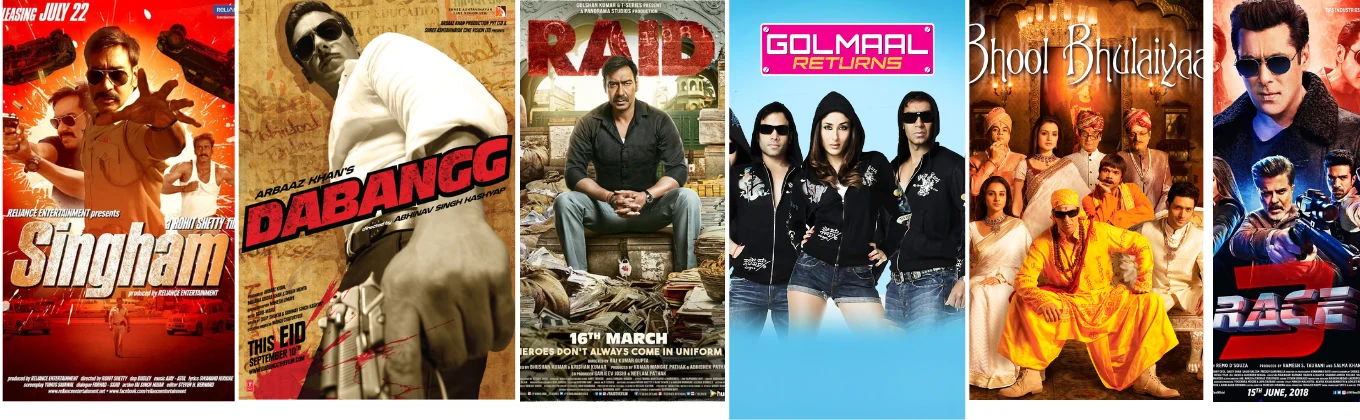
What truly makes a sequel feel connected: the story, the characters, or just the title? In Raid 2, the audience was shocked to find that Ajay Devgn's wife was Vaani Kapoor instead of Ileana D'Cruz, even though both films had the same plot and featured Saurabh Shukla as Tauji in a cameo role. The audience's strong association of continuity with emotional connection was evident in their reactions to D. Cruz not being in the sequel due to a scheduling conflict after having a baby.
Modern franchises are characterised by an unresolved conflict between two factors: the continuity that is historically maintained by direct sequels (such as Hera Pheri and Phir Hera Pheri) and the convenience that spiritual sequels (such as Bhool Bhulaiyaa, Bhool Bhulaiyaa 2 and the Golmaal franchise) provide as the only effective way to maintain the corporate identity associated with one of these franchises.
As can be seen in the examples outlined above, Bollywood (India's Hindi-language film industry) has put little if any effort into creating original and unique stories with a broader arc than simply recycling recognisable names; thus, it is worth asking if Hindi cinema is creating shared universes or merely rebranding previously established properties.
Defining the Difference: Continuity vs Convenience
As Hindi cinema begins to explore what it means to create sequels, an uncertainty has developed about sequels, including what they should add to the story of an original movie, and whether it is acceptable to avoid those responsibilities by calling them "spiritual sequels", making it impossible for someone to know whether or not continuity exists.
It's important to examine how we define both direct sequels and spiritual sequels to judge the films fairly. The difference between these two types of sequels is more than just a matter of language. They exist as distinct structures and have different emotional impacts.
A direct sequel typically has the same lead characters; it refers back to events from a preceding movie; it carries over the emotional repercussions of those events; and it provides a broader context for the sequel's events.
In contrast, a spiritual sequel does not incorporate any of these qualities; it treats characters as though they are in an entirely different world from the one depicted in the original movie, thus creating a different experience for viewers. A spiritual sequel often retains the brand name, sometimes the tone or thematic flavour, but frequently introduces new characters, shifts genres, resets emotional arcs, and treats continuity as optional, suggesting that what truly survives is not story but market recall.
This suggests that the importance of remembering is diminished when viewing a movie sequel in a different context; therefore, the viewer of a sequel is not assessing the significance of belonging to a shared universe.
Consider the difference between Hera Pheri and its sequel Phir Hera Pheri, where the same trio remains trapped in cycles of financial desperation and comic misadventure, versus Aashiqui and Aashiqui 2, where the latter borrows the musical-romance aura but introduces an entirely new couple, new emotional conflicts, and a drastically different tonal universe.
The first pairing extends a story; the second inherits a mood. Neither approach is inherently inferior, but they operate on different narrative ethics. When audiences buy tickets to a sequel, are they seeking the continuation of character memory, or merely the comfort of a familiar title that promises a familiar emotional experience? The answer determines whether franchises take root or float freely, unanchored by consequences.
Direct Sequels: Continuity as Commitment
When direct sequels work, they do not merely repeat; they expand, allowing characters to accumulate history in ways that make their choices feel heavier and their worlds richer, even if the tonal register shifts or the spectacle grows larger.
Hera Pheri: Comedy with Memory
In Hera Pheri, the trio of Raju, Shyam, and Baburao stumble into accidental fortune through absurd circumstance, but their defining trait is not luck; it is chronic instability, a sense that prosperity will always be temporary. Phir Hera Pheri leans broader, louder, and at times more chaotic, yet it does not discard that instability; it begins with the men having tasted success and then losing it again through greed and gullibility, which feels like a natural extension of their personalities rather than a reboot.
Humour is enhanced, stakes are increased, and storylines become more absurd; however, the emotional impact of the first film remains so that when they fall into trouble again, you feel it's comically tragic instead of a mechanical reproduction. The characters still live in the same world and remain flawed individuals who do not gain any greater wisdom from one film to the next, so we have consistency of character, even though they are poorly developed.
Koi… Mil Gaya to Krrish: Generational Expansion
The development of a franchise can be tracked along the path of 'Koi... Mil Gaya', through to 'Krrish', and on to 'Krrish 3'. Koi... Mil Gaya began as an intimate science fiction story about a man with intellectual disabilities who, through friendship with an extraterrestrial being, found a sense of identity. At the same time, Krrish expands the story into a grand superhero journey, building on the emotional DNA bond between father and son.
Rohit Mehra's naivete and curiosity drive the story in Koi... Mil Gaya, establishing both the genetic and emotional basis for Krishna's masked heroism in Krrish and Krrish 3. While the emphasis shifts to visual spectacle as we move through the trilogy, the emotional resonance of each film is retained, as each extraordinary accomplishment is based on the bond between father and son. This is mythmaking, rather than simply branding, evolving as a natural extension of the character's personal history, so that the audience perceives the entire trilogy as additive in their experience rather than as alternately substitutive.
In "Drishyam," the moral ambiguity of Vijay Salgaonkar committing a morally fraught act to protect his family ultimately creates an uneasy sense of victory for the main character, but also leaves the audience with unresolved tensions that are likely to carry over into the next film. "Drishyam 2" does not imply that the past will be forgotten; it recreates it with both legal and emotional clarity, transforming what was originally a conspiracy to cover up a crime into an arena in which the two films engage.
The sequel plays by the same rules of the grey zone that characterised the original, inviting consequences back into play and forcing its lead character to confront the fact that all his lies, carefully constructed over time, are ultimately fragile. The sequel also delivers on its narrative obligations by appropriately demonstrating that suspense comes not only from the originality of the suspense itself, but also from the combined weight of prior history.
Even though "Drishyam 3" has already been confirmed, the suspense of whether this outcome will continue into the film will depend on how well the current chain of events carries over into the next film, not merely on whether "Drishyam 3" is a repeat of "Drishyam".
Expanding Worlds: Action Franchises and Character Memory
Many action-based sequels in Hindi cinema focus heavily on spectacle, yet no fewer than four direct sequels meaningfully maintain continuity. The character of Chulbul Pandey has maintained his swagger in both Dabangg 2 and Dabangg 3 while remaining true to his family relationships, even as the villains have changed.
Bajirao Singham maintains his moral absolutism throughout the Singham series, including Singham Returns and Singham Again, while also expanding the law-enforcement universe across all three films. Shivani Shivaji Roy has grown as a police officer throughout the Mardaani films (Mardaani, Mardaani 2, and Mardaani 3). While she has faced different types of systemic violence in each film, her emotional centre and ethical responsibility as an officer remain undiminished.
The connection between Don and Roma has always been more than just a plot point; it is a driving force for both the story and its characters, shaped by the unique relationship between SRK and Priyanka Chopra. Their connection was built over many years of collaboration and trust as performers, leading to a familiarity that allowed them to build on what began in Don 1, adding a layer of intimacy in Don 2.
The character of Roma and all of her background information from the first two films can remain the same (the name, the backstory and overall emotional arc); however, the reason audiences carry their emotional attachment and connection to Roma from Don 1 into Don 2 is directly tied to Priyanka and SRK (the actors), rather than the screenplay (script).
When the actors portraying Roma and Don change, or one actor is replaced by another, even if it may seem like a visually seamless transition to the audience, it actually creates a completely new relationship rather than continuing the previous one.
Chemistry between actors is created solely through acting. There is no way to create chemistry through any other means, including using the same character names in each film. Therefore, Don 3 must start by building chemistry between the two new actors as if starting from scratch, since that chemistry will not carry over from the previous relationship.
The audience responded to Race's slick production, the unpredictable plot at times, and the morally ambiguous characters. The tension between the brothers, their changing allegiances and stylised suspense made for a thrilling piece of work that understood what it was doing and did it well.
By the time Race 2 arrived, the intrigue had thinned, and several new characters felt sketchily written, with performances by Ameesha Patel and Jacqueline Fernandez often reduced to glamour and convenience rather than psychological depth, which made the sequel feel less like an expansion and more like an ornamental extension. Race 3 fared worse, its casting shuffle and muddled, logic-defying storyline severing the franchise from its original tone and turning a once-taut thriller brand into an unrecognisable spectacle.
Raid and Raid 2 are examples of films that experienced continuity through the use of different actresses playing the lead character's wife: Ileana D'Cruz (who was replaced by Vaani Kapoor) had previously addressed her scheduling conflict during the filming process and managed to maintain some level of goodwill as a result; thus, continuity of a narrative between films can be maintained even as a result of practical changes if they are handled with transparency. De De Pyaar De and De De Pyaar De 2 are other examples in which the potential for continuing relationships exists rather than replacing them.
Direct sequels may stumble creatively, overindulge in spectacle, or dilute thematic sharpness, but they rarely deny their own ancestry; they acknowledge lineage and, in doing so, treat audience memory as part of the narrative fabric rather than an inconvenience to be brushed aside.
Spiritual Sequels: Brand Without Burden
If direct sequels carry the weight of memory, spiritual sequels often travel lighter, retaining the recognisable shell of a franchise while discarding the specificities that once defined it, thereby granting filmmakers freedom but also opening the door to narrative evasion.
Aashiqui: Nostalgia as Inheritance
The music of Aashiqui led to its becoming part of popular culture, as did its tragic story about Rahul and Anu; however, Aashiqui 2 does not advance the saga of those characters, but instead involves two new lovers who are struggling with drug addiction and a desire to create art in a much more current, sadder way. The connection between the two films is an emotional guarantee rather than a story continuity: love, a longing for youth, and a yearning for something better. The real issue is whether the emotional connection is a legitimate sequel identity or a marketing asset, where nostalgia is treated as "owned" rather than experienced.
Bhool Bhulaiyaa's Tonal Drift
The original Bhool Bhulaiyaa balanced psychological intrigue with humour, culminating in a rational explanation for seemingly supernatural events. At the same time, Bhool Bhulaiyaa 2 leaned more decisively into slapstick horror-comedy, shifting tonal emphasis and recasting its central dynamic entirely. With Bhool Bhulaiyaa 3 continuing this direction, the franchise demonstrates how a brand can pivot away from its original thematic core while retaining enough surface markers to feel connected. The character memory of Vidya Balan's haunting performance does not meaningfully shape the new narrative; the title does the heavy lifting.
Template Franchises: Golmaal, Housefull, Welcome
The Golmaal movie franchise, consisting of four movies (Golmaal Returns, Golmaal 3, Golmaal Again and with the release of Golmaal 5 around the corner), has a familiar cast, yet resets the characters and consequences from movie to movie, and thus has effectively turned continuity (having the same storyline) into the same cast being in the same universe over and over again.
Housefull follows a similar course, where the series continues to escalate the level of absurdity in each sequel, yet has no emotionally meaningful connection between them. The Welcome franchise began with the original Welcome, then evolved into Welcome Back and will evolve into Welcome to the Jungle in the future; it continues to show repetition in tone rather than evolving storylines between instalments. These are truly franchises in name only, where the brand represents a genre of chaos rather than a coherent set of stories that evolve over the course of the franchise.
Other cases reveal varying degrees of detachment: Jism and Jism 2 share erotic-thriller aesthetics but not characters; Dhadak and Dhadak 2 appear to share thematic space rather than narrative lineage, connecting through their exploration of young love strained by caste, class, and social hostility, yet they do not continue the same characters or storyline, instead using the title as a bridge to signal emotional intensity and social commentary rather than direct plot continuity.
Similarly, Good Newwz and Bad Newz connect through cheeky wordplay and a shared appetite for chaotic, adult-leaning comedy, rather than through any overlapping characters or narrative continuity, using a similar tonal pitch on modern relationships and reproductive confusion while functioning as entirely separate stories.
Jolly LLB, Jolly LLB 2, and Jolly LLB 3 all share a very similar comedic style and exist in the same comedic universe, with a shared description that mocks India's court system, and are directed by Subhash Kapoor. However, there is no linear, singular main character from one movie to the next.
For example, while Arshad Warsi's character (Jagdish Tyagi from Jolly LLB) is a country lawyer who brings his background to create a comical character in the second film (with the character of Jagdishwar Mishra, played by Akshay Kumar), both maintain a similar flavour of comedy, message, and ridicule of the judicial system; this is reiterated when Arshad and Akshay appear together in Jolly LLB 3, further solidifying the same universe, while maintaining an independent stylised humour.
In each case, the spiritual sequel offers creative latitude but also insulates the new film from the burden of honouring specific character arcs, making accountability optional.
Hybrid and Grey Zones: When It Works
Not every spiritual or semi-spiritual sequel is evasive; some operate in the grey zone between continuity and reinvention, proving that the distinction is not about rigid categories but about emotional fidelity.
The two films retain Munna and Circuit as characters but shift the franchise's thematic focus from medical satire to Gandhian philosophy. As a result, Munna Bhai MBBS and Lage Raho Munna Bhai can be seen as either direct sequels or thematically reinvented versions of an earlier film. The plots of the two films are separate and unrelated, though both retain the emotional identities of Munna and Circuit.
Therefore, while Lag Raho and Munna Bhai retain their connection through Munna's streetwise innocence and Circuit's unwavering loyalty, they also allow for further exploration beyond the first film's established framework. Thus, the idea of spirituality works this way because character memories are preserved, and all hard continuity has been erased, demonstrating that the only thing that truly connects the two films in the franchise is their emotional continuity, not their temporal continuity.
The Takeaway
At what point does a sequel genuinely match the emotional and narrative impact of its predecessor, allowing the characters to evolve and the consequences to carry real weight, and at what point does it simply use the same title while discarding what made the first one memorable? This question is at the heart of Bollywood's increasing fascination with franchises.
The issue between direct and spiritual sequels, then, extends beyond semantics and raises questions about filmmakers' intentions for the audiences they address with these two terms. Are audiences seen as emotionally connected viewers who will relate to characters and stories as they would to a friend? Or are they seen as consumers of brand names and logos?
Direct sequels must continue to build on character and world development over multiple instalments. Spiritual sequels often retain only the name while relying on nostalgia rather than creating narrative memory.
This matters because franchises do not exist solely because of logos or brand recognition; they exist because of emotional continuity, that is, that past actions have importance. When that connection to the past has survived, a sequel feels like a return to a familiar place; when that connection has died, the only thing that survives is the name.
2022 © Milestone 101. All Rights Reserved.