STAY CURIOUS
Keep reading to find the excellency out of perfection and skill.

By: Milestone 101 /
2026-01-28
bollywood
Double Trouble: The Rise and Fall of the Twin Trope in Bollywood
This article traces the rise and decline of the twin-role trope in Bollywood, examining why double roles once defined mainstream Hindi cinema and why their emotional power has faded. It explores classic examples, modern reinventions, and how changing audience expectations have reshaped this once-beloved narrative device.
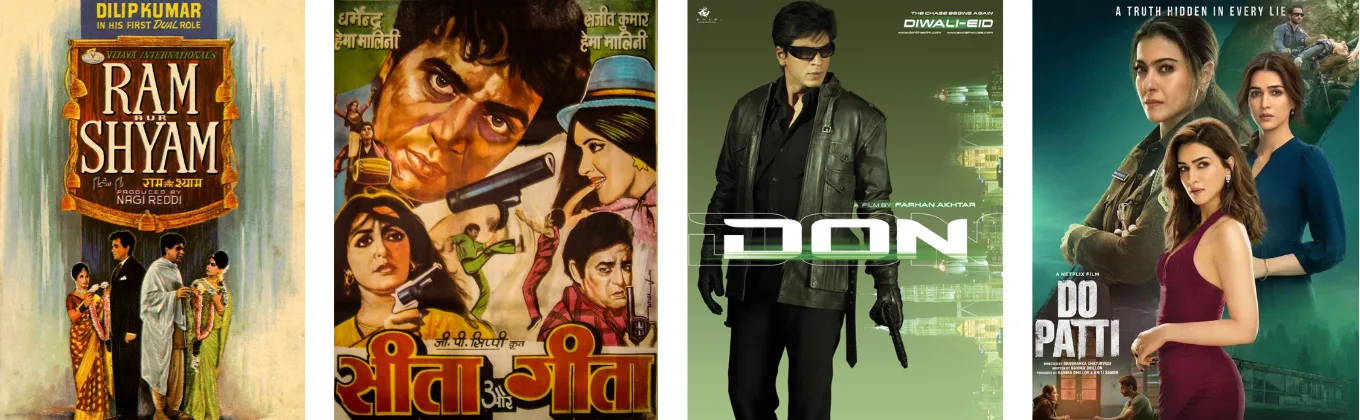
Globally, Hindi Cinema has produced exemplary moments. These instances have become stories - shared experiences that audiences will remember for generations. The basic premise is that when fans see an actor transform into a character, their face becomes weirdly illuminated, their body language appears quite different, and there is a generally odd mood suggesting something out of the ordinary is about to happen. For instance, when Amitabh Bachchan (actor) slowly turns towards the camera with a cool yet apprehensive look in his eyes, he exemplifies the power of this technique in his film Don (1978). When Hema Malini (actress) morphs her body language and her voice from some degree of discomfort into outright defiance within one moment in her movie Seeta Aur Geeta (1972), she also exhibits this same technique. The excitement these moments create is not based on mere shock value, but also comes from audiences immediately knowing they are about to see one of the most celebrated elements of storytelling within Bollywood films - the twin role or double role character.
This narrative device has functioned for decades as an efficient means of storytelling without appearing empty, thanks to its ability to align with the emotional language of most mainstream Hindi films. The twin narrative device gave filmmakers a quick way to establish conflict and create moral tension, while simultaneously allowing double the star presence without requiring a complicated setup. However, as Hindi films and audiences have changed over the years, the effectiveness of this type of storytelling has significantly diminished. A story that feels innovative today may have been made with the intention of building excitement about the film, rather than developing the characters or advancing the story. This shift raises an interesting question: how did the dual narrative device thrive so seamlessly for so long, and what has changed since then to prevent it from maintaining the same level of intrigue and emotional impact?
Why the Twin Trope Worked So Well in Bollywood
Twins, as a common trope, fit the commercial, masala movie structure of mass-market Hindi Cinema, which relies on a fast-paced plot and heightened emotions to draw in and entertain audiences. Using twins allows filmmakers to create conflict immediately via mistaken identities, dramatic irony and/or the inevitability of confrontations. There is little need for them to hone in on character development over an extended period. In this way, masala movies can juggle (balance) action, romance, comedy and melodrama, within the scope of one film. In addition, audience familiarity with these narrative mechanics does not detract from the enjoyment of their use in Hindi cinema; quite the opposite, their utilisation creates anticipation and recognition in the viewer, which are inherent pleasurable elements of the viewership experience.
Twins also enable viewers to witness two contrasting portrayals of their favourite star in one film. One twin is usually a heightened, flamboyant, or extreme character, while the other is typically simple, reserved, and emotionally driven. Neatly contrasting the two characters allows the actor to showcase their range of abilities within a single plot or story system, thereby enhancing their overall on-screen persona. By showing their ability to portray both extremes, the contrast enhances and solidifies the viewer's emotional attachment to the star and increases the perception of the star's versatility.
The Golden Era: When Twins Ruled the Box Office
The classical phase of Hindi Cinema characterises the time period where the twin trope had the most authoritative and lasting expression as movie makers saw it as part of an ongoing process and not just as an interesting tool to create drama and pathos, which helped further establish a distinct connection between the actors and viewers.
The film Ram Aur Sham utilised the technique of the double role to depict the negative factors imposed by society on the individual and also to depict the internal transformation of the individual, through the use of Dilip Kumar's portrayal of two vastly different personalities, thus allowing the audience to experience empathy and catharsis as the timid character gains the inspiration from his more assertive sibling to develop into an individual who has courage and self-esteem. The film's entertainment value lay not only in the intrigue generated by the confusion and/or coincidence of the two characters, but also in the idea that strength can be developed through one's environment or those around them.
The ideas presented in the movie Seeta Aur Geeta expanded on the premise of a female character at the centre of a motion picture, with the toggle trope also exploring the consequences of her environment on her agency. The performance of Hema Malini is seen to reflect these values very clearly, as the difference between the two sisters is not simply that they are different on the surface, but that the differences in their characters were from their realities, enabling the film to critique the effects of patriarchy while providing entertainment that was not only accessible but also directly emotional to the audience. The audience's response to this film further confirmed the notion that the dual role can convey a significant social message while still appealing to a broad audience.
Comedy, too, found fertile ground in doubling, with *Angoor* standing out as an example of how the device could generate escalating absurdity without relying on moral dichotomies. The film trusted viewers to keep pace with its layered misunderstandings, demonstrating that the twin trope did not always need to resolve into a triumph of virtue, but could exist purely as a mechanism for farce.
Dharmendra’s repeated engagement with double roles illustrates how actors embraced the trope without fear of diminishing returns, as long as tonal variation and narrative context remained fresh. His films spanned action, romance, and drama, suggesting that audience fatigue was not inevitable, but contingent on execution. This willingness to return to the device without apology was sustained by a cinematic culture that valued familiarity as comfort rather than as limitation.
Twin narratives were popularised by music. The dual-performance songs have become exciting spectacles by presenting symmetry, contrast, and playful interaction in a visually stimulating way. "Songs of Yore" describes how Hindi film musical sequences featuring twin characters often served to appeal to audiences rather than to advance the plot. The twin format has been preserved through musical exposure to the sensory enjoyment of these ingredients in popular Hindi cinema.
The late 1980s and the early 1990s manifested a new, more aggressive (and perhaps gaudy) era in twin stories. Films such as Judwaa and Kishen Kanhaiya introduced exaggerated slapstick humour and improbably coincidental events as their major attractions. For example, Salman Khan's twin characters in Judwaa were defined by their extreme physicality and disarray; they represented a genre in which logic was subordinate to rhythm, momentum, and repetition, as long as there was excessive energy. The comic double characters of Govinda followed a similar format, leaning on exaggerated facial expressions and absurd situations to hold the audience's attention, even though the storyline templates have become increasingly identifiable.
Reinvention Attempts: Darker, Flashier, Louder
The emergence of the 21st Century saw an awakening in Bollywood, where filmmakers began to recognise the sophistication of viewers and, as a result, had to think about how best to reinvent the established twin trope for this ever-changing cinematic world. There were, however, filmmakers who opted not to abandon the device altogether but to continue using it and intensify its significance, either by darkening its moral tone or by refining the techniques used to produce it. Don, for example, elaborated on this change, and the breaking of expected beliefs related to redemption; in the film, Shah Rukh Khan's character uses the twin switch concept not to escape from a life of crime and villainy but to establish himself even further in his villainy and thus uses the twin device as a means to comment on deception and power, rather than morality and balance.
Tanu Weds Manu took a different approach to the question of how to rethink the device of doubling; in this film, doubling is a way of questioning a woman's identity and, consequently, her desire within the social context in which she exists. The two characters played by Kangana Ranaut serve more to reflect how women experience class and cultural expectations, while still providing the structural familiarity of the doubling trope. This interpretation of the trope is consistent with a larger trend in Hindi Cinema: a character-driven narrative.
Movies such as Dhoom 3 and Rowdy Rathore attempted to modernise several elements of the traditional double role by incorporating new technologies and a larger approach to filmmaking, with the addition of computer-generated imagery (CGI) for many of the scenes where the characters interacted with each other, which would not have been possible just a few short years earlier. The analysis of double roles by India Today during this time frame shows that stars commonly returned to this device during periods of career re-evaluation, suggesting that using a double role was both a creative opportunity and a means of financial security in a highly competitive environment. Media outlets such as Hindustan Times frequently note Bollywood's fascination with the double role as particularly prevalent during periods of slumping creativity. Thus, the cyclical use of the double role format is simply an expression of adaptive creative response to uncertainty.
While attempts to reintroduce new versions of the twin narrative(s) were successful, there was no fundamental change in the overall structure of a twin narrative. Therefore, while the manner in which the twin narrative was presented was significantly different, the underlying and functional aspects remained relatively unchanged. Consequently, the result of remixed films is greater intensity, but without a substantive modification in narrative structure regarding the use of elements in their videos.
When Doubling Became a Crutch
In Hindi cinema, when doubling became common practice, it highlighted a wider rift between how filmmakers were telling stories and the audience's expectations. Filmmakers had been using doubling as a storytelling tool for years. They thus created an understanding of the methods and conventions of Bollywood to allow audiences to accept coincidences, binary hero-villain choices, and highly exaggerated acting, but as more viewers were exposed to a global culture, the ability to relate to these types of stories became less and less possible. In addition, many viewers began seeking out stories and characters that demonstrated they were acting with the same thoughts and reasoning as other viewers. Therefore, doubling was no longer a creative device but one that relieved filmmakers of their narrative responsibilities. Rather than providing any depth to the characters, doubling ultimately produced a sense of largeness from confusion over identities and coincidences. In other words, filmmakers relied on the novelty of doubling rather than investing in characters and nurturing their emotional growth. Instead, doubling emphasised the writing's weakness, making it predictable and devoid of emotion.
This shift has changed how viewers view engagement. Conflict based on coincidence now seemed more like a deferral of the story's conclusion than a continuation of the plot's development, delaying the opportunity for a substantial resolution rather than advancing the plot toward it. Instead of strengthening the narrative, Doubling disrupted it. Star-driven creativity, once a trademark of the entertainment industry, now appeared more as an unattainable ideal than a reflection of society's demand for realistic storytelling, credible characters, and emotionally honest characters.
Jawaan, Do Patti, and the Illusion of Freshness
A few recently released movies, such as Jawaan or Do Patti, make it even harder to declare the twin trope outdated, as these films have done well at the box office, proving that the device can still be popular when executed with skill and excellence. In Jawaan, Shah Rukh Khan plays a dual role that serves as both a narrative driver and a symbol of the film's themes, expressing generational anger and moral resolution through two forms of authority and rebellion. The success of this film suggests that viewers were not necessarily opposed to seeing a dual role; instead, they were more interested in the theme and visual presentation than in being surprised or shocked by the trope.
In contrast, the many reactions from critics reveal that the effectiveness of movies featuring the twin trope is more dependent on execution than on innovation, because most audiences have expected to see a double much earlier in the film and have anticipated its appearance before it actually appears. This focus on expectation means that the source of enjoyment is now in how well the actors performed and the scale of the film, which reinforces the belief that the double has become less of a shock to viewers.
Films like Do Patti demonstrate that contemporary storytelling conceptualises duality psychologically or thematically, rather than using it solely as a narrative technique, as seen in the work of many writers, movies, and directors today. Critiques of Do Patti express disappointment at the film’s uneven execution and also acknowledge that a key focus is on depicting dual identities and toxic relationships without resorting to physical doubles.
In addition to reinforcing a growing trend across several areas of the film industry (particularly the South Indian industry) to reflect on the significance and potential negative consequences of double roles, LiveMint has published an article analysing several films and discussing how they interpret or represent double roles. Through these analyses, LiveMint finds that the film industry is still using the popular trope of the double, but is beginning to view, interpret, and present double roles primarily as a means of exploring internal conflict or thematic complexity, rather than merely as a visual delight.
The Takeaway
The waning popularity of the twin trope is indicative of the growing connection between audiences today and how they perceive film/TV. Modern audiences are much savvier than previous generations and have developed a greater understanding of film genres and narrative structure through the proliferation of long-form storytelling on streaming services, combined with increased exposure to films from around the world. Today, most filmgoers expect to see character growth over time through internal struggles and emotional resolution versus abrupt plot devices. Social media has contributed to this shift by transforming viewing into a group event for predicting plot points—anticipating, discussing, and often ruining surprises—long before they are seen. Therefore, the performance-based device of doubling no longer guarantees emotional connection for moviegoers. Increasingly, films are evaluated based on their narrative consistency and psychological realism rather than excitement or uniqueness.
The twin trope isn’t without artistic merit, but it’s also shown us how limiting it can be when filmmakers fail to reinvent or motivate its use. In the past, a twin character provided a simple moral understanding and added to the stardom of the actor playing the twin; today, using the twin trope could be seen as a way to avoid taking narrative responsibility. The role of the twin in storytelling has evolved from a functional one into a highly debated mode of creative expression as the movement towards realism and interiority continues to grow. The question now remains: will filmmakers be able to reconceptualise the twin to address identity, trauma, and power with greater earnestness rather than simply using the twin trope for dramatic effect? The greater question being asked of Hindi cinema as a whole is whether it can produce good stories without depending on safety nets, and how much weight a single character carries in an emotionally charged film.
2022 © Milestone 101. All Rights Reserved.