STAY CURIOUS
Keep reading to find the excellency out of perfection and skill.

By: Milestone 101 /
2026-07-05
bollywood
Entertainment in Sixty Seconds: India's Shift to Snackable Drama
India's entertainment habits are shifting from long-form binges to 90-second cliffhangers. This piece traces micro-drama's journey from China's duanju boom to JioHotstar's Tadka, Zee's Bullet partnership, and a wave of funded platforms, examining why 880 million smartphones and cheap data made India fertile ground for snackable storytelling.
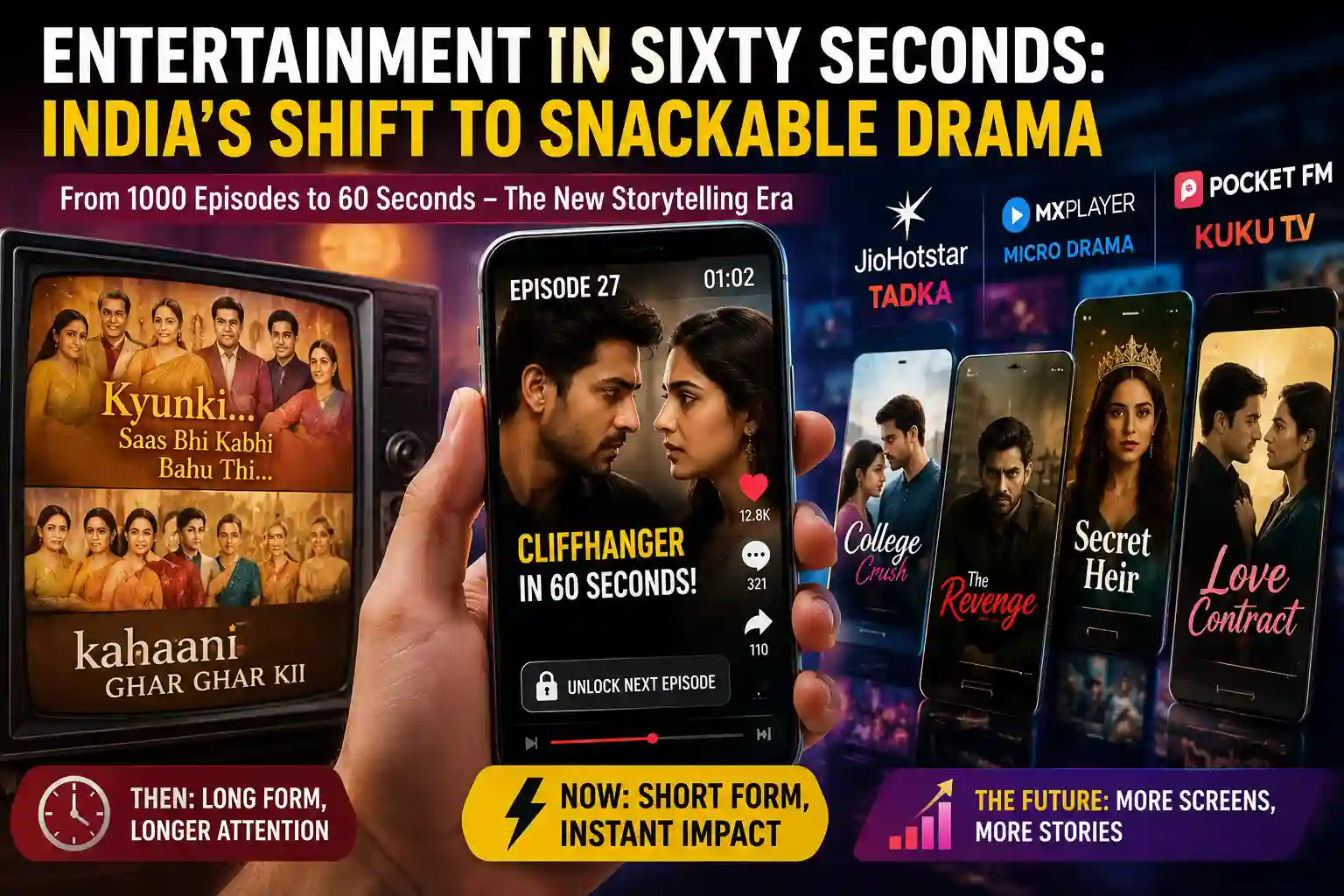
What does it say about us, about the country that once sat riveted through a thousand episodes of Kahaani Ghar Ghar Kii and Kyunki Saas Bhi Kabhi Bahu Thi, that we can no longer be trusted to sit still through a seven-episode web series? This is not a crisis. It is a complete restructuring of how India consumes stories, with a clear origin point, a global journey, and a very Indian destination.
The pandemic years in China ushered in the format reformative process that would reshape Indian screens. Dubbed duanju, vertical storytelling has since emerged on platforms such as Douyin and Kuaishou. The growth of Chinese short-form dramas was staggering; revenue in the sector rose from US$500 million in 2021 to US$7 billion by 2024. In 2024, micro-drama revenue will exceed that of all Chinese cinema combined.
The formula behind this success was chillingly simple: episodes run between 90 seconds and two minutes, have serial narratives with cliffhangers inserted every 60 seconds, and a paywall conspiring against viewers. This article explores how the shift from long to short to nothing is not a crisis but the beginning of a complete change unfolding across every single screen, every single story, and every single storyteller in India's new, morphing digital era."
From Douyin to Dollars: The Global Spread
The reshaping of Indian screen content began in China during the global pandemic of 2020. What started as duanju (i.e., vertical storytelling) within platforms like Douyin and Kuaishou exploded in growth. The market for short-form dramas in China grew from $500 million in 2021 to approximately $7 billion by 2024 (i.e., micro-drama revenue exceeded box office revenue for the first time in 2024).
The model was extremely simple: Episodes typically lasted 90 seconds to 2 minutes; storylines were serialised across multiple episodes; each episode ended with a cliffhanger after approximately 60 seconds; and each episode included a paywall to compel users to continue watching. Shorts, a French micro-drama platform, has collaborated with Los Angeles-based Fumero Films to create an extensive library of 40 pieces to be released as part of one of the largest international vertical video orders ever placed.
Latin America was the most recent area to be opened up in this newly emerging market. Sony Pictures Television's recent announcement of 60 1-minute episodes, created specifically for vertical viewing platforms in Latin America (entitled No es un Mito: La Llorona), demonstrates how quickly this marketplace is growing. The announcement happened only two weeks before the president of Sony Pictures Television's International Production group publicly declared that vertical scripted content would not be a viable format for the marketplace. That reversal alone demonstrates the tremendous acceleration in this format's acceptance, which a market forecast could never capture.
India's Moment
India came to the format with its own unique conditions: 880 million smartphones, some of the world's cheapest mobile data, daily short-video viewership surpassing 350 million users in 2024, and a tradition of storytelling with a long, emotional arc. These features made India not only a target for the micro-drama format but specifically fertile ground for this emerging genre. Today, the micro-drama category has approximately 100 million monthly users and has amassed over 450 million downloads. The micro-drama sector is projected to reach $4.5 billion by 2030, with a 31% CAGR. The micro-drama category is expected to grow by 91% in 2026 alone.
The biggest institutional signal came in April 2026, when JioHotstar launched Tadka, a dedicated micro-content layer within the country's largest streaming platform, with over 100 titles live on day one. Each season runs to forty episodes of 1.5 to 2.5 minutes each, meaning a full season fits inside an hour. JioHotstar's Vice-Chairman Uday Shankar had already committed to investing $10 billion in Indian content over the next three years; Tadka is where the mobile-first, cricket-watching audience gets retained between matches. Zee Entertainment also partnered with startup Bullet to launch a micro-drama application integrated within its ZEE5 ecosystem.
Additionally, Amazon has developed its own micro-drama category through MX Player, and established production companies like Yash Raj Films and Red Chillies are investing heavily to support the trend, with YRF anticipated to invest approximately Rs 150 Crores in producing micro-dramas over the next few years. Balaji Telefilms is partnering to produce premium Hindi vertical dramas, thus moving the long-standing saas-bahu tale into the smartphone era; when studios built on the 70mm format begin to pursue a 6-inch format, it signals that the format has truly arrived.
The Platform Ecosystem: Not Just the Big Names
The involvement of JioHotstar and Amazon isn’t what sets them apart; the sheer number of smaller platforms focusing exclusively on micro-dramas is a much more revealing statistic. Examples of these platforms include Kuku TV, Pocket FM, and Flick TV, as well as new platforms such as Reeloid, ReelSaga, and Moj, all of which are currently active in the micro-drama ecosystem.
Stellaris Venture Partners backs flick TVs and wants to be the micro-drama OTT equivalent to how Hotstar became the leading OTT for live sports content. Chai Bisket from Hyderabad just raised $5 mm in their seed round, with actor Rana Daggubati as an angel investor, to launch their micro-drama platform, Chai Shots, which will premiere original Telugu shows and plans to add 8 different Indian languages by December 2025.
MS Dhoni has joined Kuku as both investor and brand ambassador. Pocket Reels, Scooper, StoryTV, and HoiChoi's Hindi micro-drama arm are all live. The list grows every quarter. These are not fringe experiments but funded, competing bets from investors who see the window still open.
The appearances of familiar faces are increasing the format's credibility. Actor Sunny Leone is appearing in a vertical-aspect thriller series called Betrayal, directed by Vikram Bhatt, which has been shot entirely in a 9:16 aspect ratio. This is what advocates of this format have strongly argued: that vertical drama is not just a cheap alternative to mainstream OTT but a separate platform with its own production values and viewers' expectations.
The Craft of the Cliffhanger
It can be difficult to believe how many small moments this format demands. Every episode must have a take-off point; you cannot start slow. The two (2) crime fiction heroes (Commander Karan Saxena and Reeta Sanyal) created by Amit Khan have been produced and are ready for Jio; he has recently finished making micro-versions of both characters for Amazon MX Player. He continues with the same analogy: just as cricket has gone from Test cricket to 20-20, Storytelling moves in a similar direction, with a shortening of the time from start to finish; in fact, the shortest time frames have been adopted more frequently. Other similarities include keeping the pace of action high, with entertainment and a surprise/twist every time you scroll.
Those critical voices are not as confident in their opinion regarding the use of cliffhangers as a device to create a formulaic narrative. Also, the change from horizontal framing to vertical framing has exposed gaps in creativity: for example, actors had their heads cut off at the forehead, crowd shots that needed to be shot horizontally became over-the-cheek shots when the orientation changed, and over-the-shoulder shots became over-the-cheek shots. Verticality remains an extension of horizontal storytelling, not a creative opportunity in its own right.
However, it costs between 12 and 15 lakhs (1,200,000-1,500,000) to produce 60 episodes of a completed 45-minute micro series, compared to 1-2 crore (10,000,000-20,000,000) for 45-minute episodes on traditional TV. Based on those numbers, the format can incur significant losses during experimentation while still breaking even.
Who Is Watching, and How
Micro-drama consumption has become a unique sociological phenomenon. A staggering 90% of viewership occurs when people are watching on their own devices and multitasking. Additionally, 57% of viewers identify their micro-drama viewing as background noise. The majority (89%) of viewers discover micro-dramas through social feeds rather than searching for them.
The majority of viewership occurs between 8 PM and midnight, with additional spikes during the commute and lunch hours. Micro-drama consumption among viewers is dominated by Hindi-language programming, followed by Tamil, Telugu, and Kannada. Regional providers are now producing many shows in each of these languages.
Brands have taken notice of how many people are consuming content on their mobile devices in such an individual way. The personal nature of micro-dramas creates an advertising environment unlike anything else at scale, and brands are quickly transitioning from passive to active placement within narrative arcs.
The Takeaway
Micro-drama's rise is not an extinction event for long-form storytelling. The same viewer who binge-watches a micro-drama on Tuesday's commute sits down for Panchayat on Saturday night. But the format has claimed all the moments in between: the commute, the lunch break, the thirty minutes before sleep, and turned them into a viewing habit that the industry can no longer look away from.
India's 2025 legislation banning real-money gaming applications left millions of users without a way to fill 45 minutes on a mobile device, so micro-drama emerged to meet that need. The micro-drama format did not create interest in India; Instagram Reels, YouTube Shorts, Josh, and Moj have fundamentally changed how Indians interact with screens. Micro-drama has creativity tied to stories.
With 880 million smartphones, inexpensive mobile data, countless available platform ecosystems from JioHotstar to Pocket Reels, and many of Bollywood's largest production companies actively participating, India is not merely observing this movement; it is already participating in it through micro-drama!
2022 © Milestone 101. All Rights Reserved.