STAY CURIOUS
Keep reading to find the excellency out of perfection and skill.

By: Milestone 101 /
2026-07-17
bollywood
Fame With a Spine: Celebrities Who Took a Stand
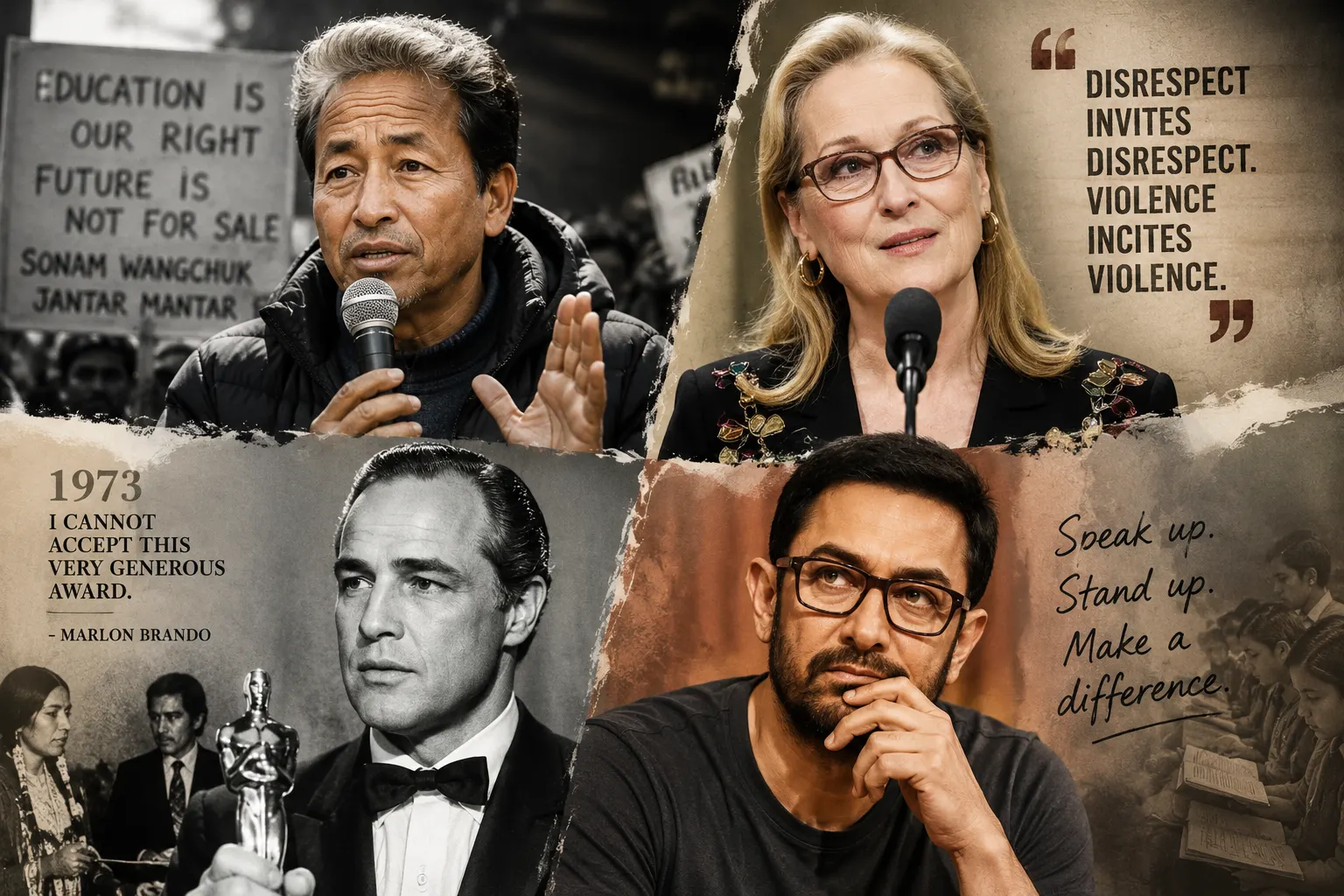
From Marlon Brando's Oscar refusal to Sonam Wangchuk's ongoing hunger strike at Jantar Mantar, this piece traces moments when celebrities and public figures chose conviction over convenience. It looks at Meryl Streep, Robert De Niro, Tom Cruise, Vinesh Phogat, Deepika Padukone, Swara Bhasker and Prakash Raj, and what their stands reveal about risking fame for a cause.
What does a person do once they have everything to lose?
At its simplest concept, fame is viewed as a mere trade. A public figure gives up part of their privacy for public admiration, but in exchange, the public expects this person to act in a particular way. They want them to be a famous person, do everything possible to enhance their reputation and image, and stay likeable and fresh, avoiding anything that might affect their status in a partnership.
That is why events that run counter to this traditional exchange are so remarkable. The rules of being a celebrity mean that it is always better to keep what you have earned and not risk it for any cause that cannot give you anything good in return. From time to time, a speaker forgets that they are renowned and starts thinking they are a person of sense with something fascinating to share, which is more important than admiration for their fame. They jeopardise the reason for becoming famous in the first place and lose the status they once held.
This article is a look at some of those moments, across decades and continents, when celebrity stopped being about self-preservation and became a vehicle for something larger.
The Refusal that Started it All
In 1973, Marlon Brando received an Academy Award for Best Actor for his role in The Godfather. But he refused to pick up the award. Instead, he sent Sacheen Littlefeather, an activist and Native American actress, to decline the award for him, as a sign of protest against the way Hollywood portrayed Native Americans and their situation in general, with a particular reference to the Wounded Knee event.
The audience of the Academy Zoo booed Little Feather and did not allow her to finish. The Academy needed almost fifty years to apologise to Little Feather for that incident. The event, however, provided a model for those who would not follow similar principles.
The Protest India Can't Look Away From
Closer to home, in recent weeks, the protest capturing India's attention is not primarily from Bollywood. Educator Sonam Wangchuk has been on a hunger strike in Delhi's Jantar Mantar since last month in support of the sit-in staged by the Cockroach Janta Party, demanding the resignation of Education Minister Dharmendra Pradhan over frequent question paper leaks that have affected millions of students. His health has deteriorated so much that the Delhi High Court has directed the monitoring of his health daily.
Bollywood reacted to this episode in its own manner. Aamir Khan, associated with Wangchuk through his character in 3 Idiots, tweeted about the same. At the same time, actors like Sonakshi Sinha urged him to call off the fast and urged the government to begin dialogue on the issue. On the political front, politicians such as former Delhi CM Arvind Kejriwal, NCP (SP) MP Supriya Sule, Sushma Andhare, Samajwadi Party MP Dimple Yadav, and Congress leader Pawan Khera have paid a visit to the protest site, which started as a satire on social media and turned increasingly into one of the more prominent protests during the 12-year rule of Prime Minister Narendra Modi.
When a Golden Globes Speech became a Headline
Meryl Streep did not need the platform. By 2017, she had already won more acting awards than almost anyone alive. Yet when she accepted the Cecil B. DeMille Award at the Golden Globes that year, she used her time at the microphone not only for gratitude but also for a pointed critique of a sitting American president-elect's mockery of a disabled reporter, framing it as an attack on empathy and decency in public life.
The speech sparked a political uproar, leading to a public response from Donald Trump. Streep did not retract her words. What made this moment remarkable was not just that she expressed her political views at a nonpolitical event, but that she was ready to face the consequences of her statement, even though she was at a point in her career when she had no vested interest in politics.
Robert De Niro went even further on several occasions. At the 2018 Tony Awards, he made a foul-mouthed remark about Trump, prompting applause and heated criticism.
He has been repeating this statement on different occasions, being aware that it would provoke criticism and calls for a boycott. One might ask why De Niro would continue to do it if he could be criticised for saying what he was saying.
Returning the Trophy
Tom Cruise took a different route entirely. In 2021, he returned all three of his Golden Globe awards to the Hollywood Foreign Press Association. This body organised the ceremony, after reports surfaced about the association's lack of diversity among its voting members and questions about its ethics.
Cruise neither held a news briefing nor released a detailed announcement. His action was self-explanatory: a man who has spent countless years seeking recognition for the award from the Globe has returned his awards, showing that it is not he who decides who excels and who doesn't in the industry.
Closer to Home: Vinesh Phogat's Protest
If Cruise's gesture was quiet, Vinesh Phogat's was anything but. In December 2023, the Olympic wrestler announced that she would return her Khel Ratna and Arjuna Award, two of India's highest sporting honours, in protest against the election of Sanjay Singh, an aide to former Wrestling Federation of India chief Brij Bhushan Sharan Singh, as the federation's new president.
Phogat was at the top of the protest against the allegations made by Brij Bhushan over the sexual harassment of several female players. She had accompanied Bajrang Punia and Sakshi Malik and had spent most of the year in New Delhi demanding that Bhushan resign. But when it became clear that the federation elections would benefit him again, Phogat attempted to return her medals in person to the Prime Minister's Office.
She was stopped by the security personnel at the entrance itself and left the medals on the pavement, along with a letter explaining her actions. Bajrang Punia, on the other hand, gave up his Padma Shri award the same week, while Sakshi Malik announced her retirement from wrestling. For an athlete like Phogat, who built her career on the success of her medals, this act makes the statement loud and clear.
DeepikaPadukone'ss JNU Visit
Deepika Padukone's brief but mostly silent attendance in January 2020 led to an incredible response. She made an appearance at Jawaharlal Nehru University shortly after masked attackers mauled the students and faculty on the campus and then stood shoulder to shoulder with student leader Aishe Ghosh without making any formal statement.
This appearance took place just before the opening of her film Chhapaak, leading to immediate calls for a boycott. Padukone did not explicate or address any political motivation behind this move, but the uncertainty did not help ease the backlash. She came out at the risk of her film when the majority of the industry was keeping quiet.
Prakash Raj and Swara Bhasker: The Vocal Minority
Some public figures choose gestures. Others choose to keep talking, year after year, regardless of the cost. Swara Bhasker has been among the most consistently vocal Bollywood actors on questions of civil liberties, minority rights and government accountability in India, using interviews, opinion pieces and social media to criticise policies and incidents she believes deserve scrutiny.
The consequences have been tangible: trolling campaigns, legal notices, and a steady stream of commentary questioning her career choices and patriotism. She has continued regardless, arguing that an actor's citizenship does not end where their filmography begins.
Prakash Raj, a veteran actor across several Indian film industries, has taken a similarly consistent public stance, criticising the government on issues ranging from intolerance to press freedom, and even contesting the 2019 Lok Sabha election as an independent candidate on an anti-hate platform, a race he did not win but ran anyway.
Like Bhasker, he has faced organised backlash for it, including boycott calls tied to his film releases. What connects the two is not the specifics of their politics but the fact that neither has treated professional risk as a reason to stop.
What these Moments have in Common
This situation is not about making comparisons between individuals or establishing whose plight is more convincingly stated. It is obvious that Brando's activism and Phogat's actions stem from completely different backgrounds and circumstances, and that Streep's speech does not have anything in common with Bhaskar's statements from the last several years.
The connection between the works in question is their shared commitment to making personal sacrifices in pursuit of respect, contacts, and notoriety.
Importantly, we should not forget that getting involved in the issue in question may have serious consequences. For example, it took decades for Littlefeather to be recognised, whereas Padukone faced a strong boycott campaign before the premiere of her film. Furthermore, Phogat's activism did not lead to any immediate changes in the federation's leadership.
Bhasker and Prakash Raj continue to absorb criticism with each fresh statement, and their public standing has visibly shifted as a result, with some sections of the industry and audience keeping a deliberate distance from both. Fame does not insulate anyone from consequences; if anything, it magnifies them, because the backlash has an audience,e too.
There is also a quieter theme running beneath all of this: timing. Brando's protest landed at the height of his fame, immediately after the film that would define his legacy. Streep's speech came near the end of a career so decorated that critics struggled to accuse her of seeking attention she did not already have in abundance.
The timing of Cruise's announcement was important because it came at a moment when critics were questioning whether the Golden Globes would remain a reputable awards show. Phogat's statement was also important because it was the point in her career when many risks could be realised. All the people mentioned in the article chose to act even when the timing was not perfect, knowing that there would never be a better moment than now and that waiting for a better opportunity might be a mistake.
The Takeaway
In the long run, the takeaway from those moments is less about the particular people involved and much more about the true nature of fame's function. Fame can be" used" quietly and preserved and safeguarded over the course of one's lifetime, or it can be used loudly for something that has nothing to do with the person using it.
The ones worth remembering are not necessarily those who did everything right, but rather those who understood that people have the option to make the second choice and chose it.
2022 © Milestone 101. All Rights Reserved.