STAY CURIOUS
Keep reading to find the excellency out of perfection and skill.

By: Milestone 101 /
2026-07-23
hollywood
Five Harrison Ford Movies That Define His Legendary Career
From the swagger of Han Solo to the quiet resilience of Dr. Richard Kimble, Harrison Ford has delivered some of Hollywood's most unforgettable performances. These five landmark films showcase his remarkable versatility, emotional depth and enduring screen presence, explaining why he remains one of cinema's greatest and most influential stars.
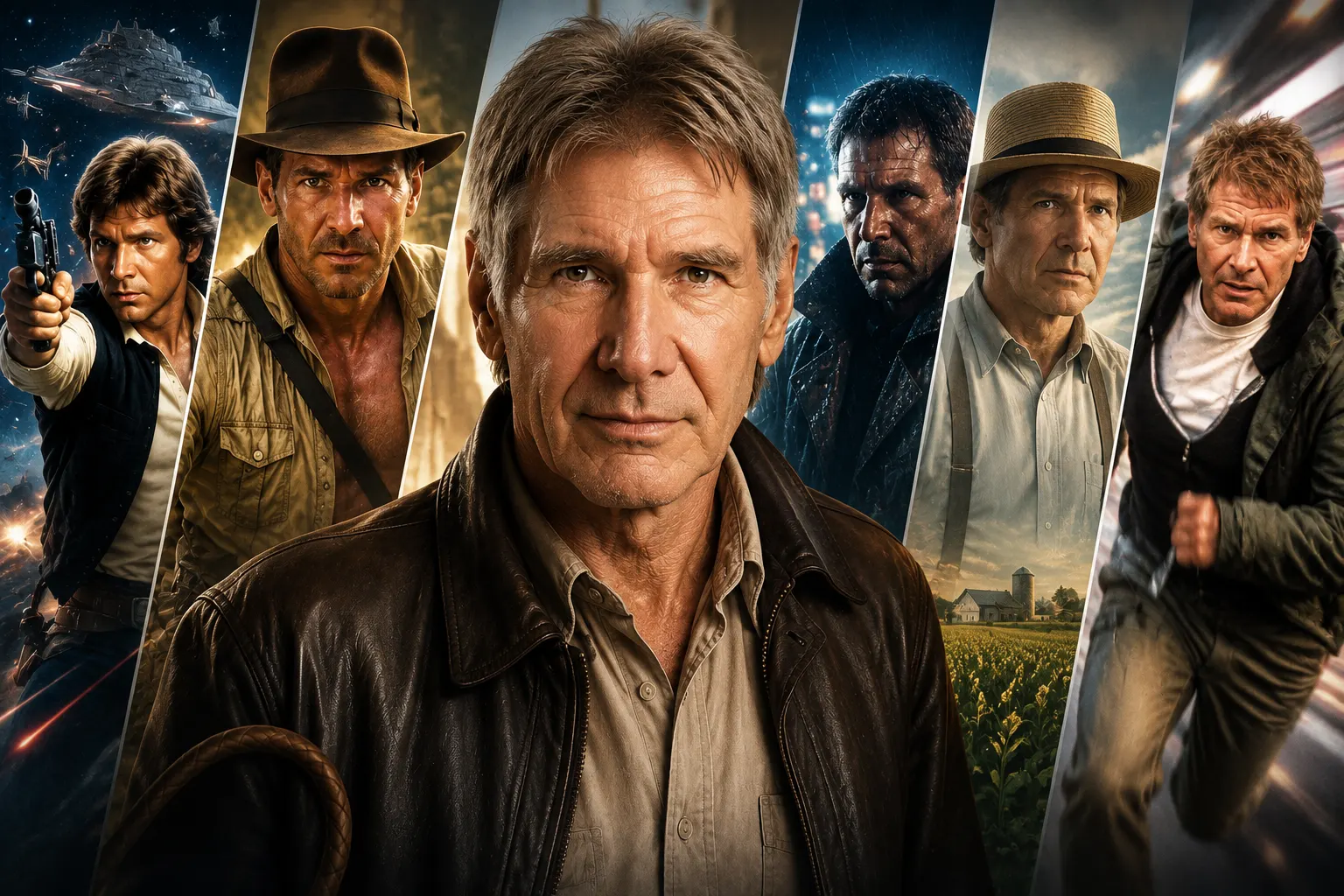
What does it take for one actor to define not just a genre, but four decades of cinema itself?
The answer to the question of what Harrison Ford is all about is not just one movie, but a full assortment of works that act like a lesson in screen charisma. Wherever Ford goes, whether it is the edges of the universe or a small village in Amish country, he will never conform to the stereotypes of his characters. He can embody a reluctant hero, a charming trickster, or a miserable fellow, sometimes all in one movie.
What makes Ford's cinematic legacy impressive is not the blockbusters he starred in, but the strong emotional message he conveyed throughout his career. He has the talent of making the audience believe that it is a real person being shown on the screen, no matter how unbelievable the circumstances are. These five films trace the arc of that rare gift, from swaggering space opera to intimate character drama, and show precisely why Harrison Ford remains one of Hollywood's most beloved and bankable stars.
Star Wars: Episode V – The Empire Strikes Back (1980)
When Harrison Ford first appeared as Han Solo in A New Hope in 1977, he presented audiences with a charmer with a good heart hidden beneath the cockiness and the weapon. While this was an appealing introduction to such a character, The Empire Strikes Back carried Solo to the rank of a real movie heavyweight.
The sequel made everything about the character featured in the first film more interesting. Solo stopped being an unimportant figure who just did his best to earn money and flirted with other members of the Rebel Alliance. Solo proved to be a true hero, forced to make hard choices between saving himself and saving others. His decision to return to Cloud City, his calm handling of the difficult situation, and his being made into a carbonite statue made the movie truly impressive.
Central to all of this was his chemistry with Carrie Fisher's Princess Leia. Their bickering, charged rapport had crackled since the first film, but Empire allowed it to mature into something more layered. Ford reportedly improvised the now-immortal exchange, replacing a scripted declaration of love with the now-immortal "I know" in response to Leia's "I love you". It is one of the most quoted lines in film history precisely because it is so unlike a conventional romantic gesture. It is wry, understated and utterly in character, and it says more about Solo's confidence and vulnerability than a page of dialogue ever could.
What Empire ultimately proved was that Ford could carry genuine emotional weight within a franchise built on spectacle. Han Solo could have easily remained a one-note charmer, but Ford's instinct for nuance turned him into one of cinema's most enduring heroes.
Raiders of the Lost Ark (1981)
Ford, a year after reconstructing the concept of Han Solo, collaborated with Steven Spielberg to create an altogether different type of movie character and, in doing so, established the precedent for modern action-adventure blockbusters. Indiana Jones – a whip-using archaeologist in a fedora who is afraid of snakes and able to outrun boulders will forever be regarded as a supreme performance by Ford.
What distinguishes Indiana Jones from the multitude of later copies is a peculiar balance Ford managed to strike in portraying this character. He is for sure heroic and capable of confronting the Nazis, ancient traps, and a villain equally effectively, but never invincible.
In Raiders, Indy suffers beatings, bruises, and humiliations, yet this, combined with his wit and real intelligence, makes him human rather than an extraordinary character to admire.
Ford's performance also has a playful self-awareness that prevents the film from taking itself too seriously, despite its surprising sets. The now-legendary moment when an exhausted Indy shoots a scimitar-wielding swordsman rather than engage in an elaborate duel, reportedly born of Ford's own bout of illness during filming, has become shorthand for the character's pragmatic charm.
Raiders of the Lost Ark did not just launch a hugely successful franchise; it established a new gold standard for how a leading man could anchor spectacle with charisma and craft. Four decades on, Indiana Jones remains inseparable from Ford's name, a testament to how completely he inhabited the role.
Blade Runner (1982)
Just a year after wearing the famous fedoras of Indiana Jones in the adventure movies starring Harrison Ford, the actor made a bold decision in accepting the role of Rick Deckard, the troubled blade runner hunting down rogue androids in a rainy dystopian Los Angeles of Ridley Scott's Blade Runner.
Portraying a character so different from the real-life heroes, he gave the audience a performance that was restrained, ambiguous, and disturbed rather than flashy and bright. Deckard was a non-hero: an individual who doubts his morality and experiences mood swings in a world populated by beings very similar to humans.
The director Scott combines the movie's visual side with Ford's emotional performance. He gave the film its emotional touch. Although Blade Runner was not a great commercial success in the beginning and the shooting process was not entirely smooth, it has become a classic over time. It is now recognised as one of the greatest productions of the science fiction genre.
For Ford, it represented something crucial to his development as an actor: proof that he could inhabit conflicted, introspective characters just as convincingly as swashbuckling adventurers. It expanded the perception of what a Harrison Ford performance could be, setting the stage for the more dramatically demanding roles that would follow.
Witness (1985)
While Blade Runner indicated Ford's potential as a dramatic actor, Witness exemplified it. Directed by Peter Weir, Witness is an intense thriller featuring the actor as John Book, a Philadelphia detective who takes refuge in an Amish community after a boy witnesses a murder linked to corrupt cops.
Witness is a breath of fresh air compared to Ford's action films. It does contain some action, but it also shows Ford's ability to perform in more sensitive scenes, which contributes to the picture's power. The film depicts Book's struggle as he tries to adapt to the life of the Amish people. He develops a romance with Rachel, played by Kelly McGillis, and becomes impressed by the lifestyle of these people, which is alien to him.
It was through this performance that Ford was nominated for an Oscar for the first time in his life - this nomination proved how far he had travelled as a dramatic performer. It was proof that he could carry a film not through gunfights or one-liners, but through stillness, restraint and emotional nuance. Witness remains a high-water mark in Ford's career precisely because it showcased a side of his talent that blockbusters rarely had room for: patience, vulnerability and quiet romantic longing.
The Fugitive (1993)
In the early 1990s, Ford had demonstrated his talents across numerous films and genres. Still, in The Fugitive, he had a chance to produce what might be considered the ultimate cinematic work on the theme of a wronged hero.
Ford plays Dr Richard Kimble, a doctor who is wrongfully accused of murdering his wife. One of the key driving forces behind the plot is the relationship between Kimble and US Marshal Samuel Gerard, played by Tommy Lee Jones. However, it is Ford's acting that creates emotional depth.
Kimble is not just running away from the law; he is searching for the truth, spiritually motivated by grief and a desire to prove his innocence. Ford shows this desperation honestly, and his character seems sympathetic to a degree when one tries to contextualise his unnecessary plight.
The film became one of the biggest hits of 1993 and earned widespread critical acclaim, including a Best Picture nomination. For Ford, it was a demonstration of everything that had made him such a durable star: the ability to ground a high-stakes, meticulously plotted thriller in genuine human emotion. Two decades into his career, he was still finding new ways to make audiences believe in the man behind the character.
Beyond the Blockbusters
Aside from his impressive cinematic legacy, Ford has taken a big step in a new direction with the show Shrinking on Apple TV+, in which he stars as Dr Paul Rhoades, an established therapist. This character is different from his previous roles in the sense that it is much more vulnerable, and it focuses on Paul's relationship with Jimmy, played by Jason Segel.
Ford has spoken candidly about treating that storyline with real sensitivity, and critics have praised the performance as some of his finest, most emotionally exposed work yet. It is a reminder that even deep into his ninth decade, Ford remains willing to surprise audiences, trading whips and blasters for warmth, humour and quiet vulnerability.
The Takeaway
When considered as a whole, these five movies highlight a striking progression: from the handsome and mischievous Han Solo, via the intrepid Indiana Jones, through the morally ambiguous Blade Runner and the subtle drama of The Fugitive. Rarely, if ever, has an actor switched genres with such grace while keeping his appeal. Harrison Ford's reputation is based not on one but rather many successful movies that have shown that versatility and emotion are possible even in mainstream cinema.
2022 © Milestone 101. All Rights Reserved.