STAY CURIOUS
Keep reading to find the excellency out of perfection and skill.

By: Milestone 101 /
2026-05-20
bollywood
Ghostwriters of Cinema: The Nameless Writing Room
Behind many celebrated films lies a hidden network of writers who shape stories without public recognition. From invisible collaborators to ghostwriters working through hierarchy, branding, and credit politics, this article explores how modern cinema functions through collective authorship, where multiple voices build the screenplay but only a few names reach the credits.
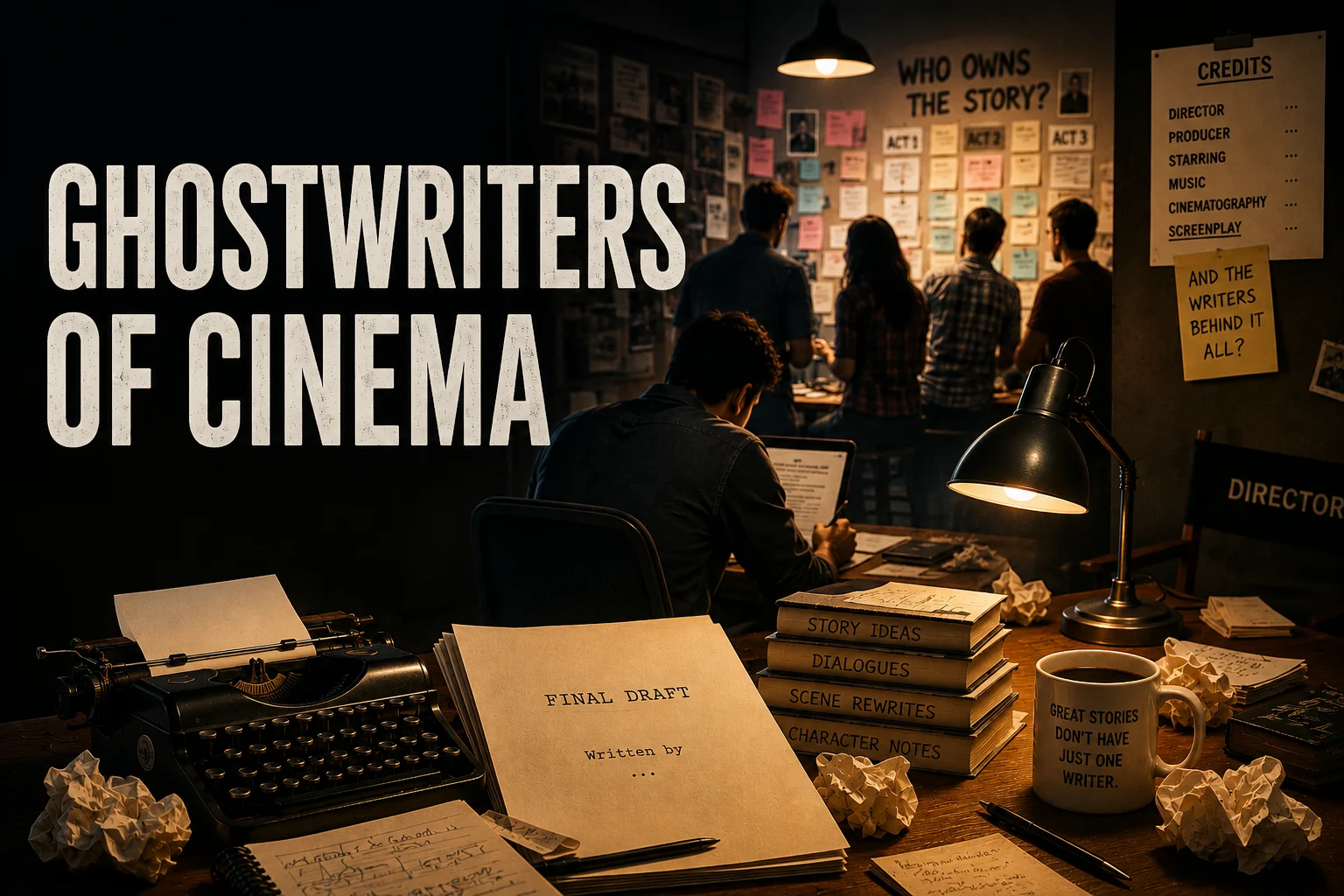
What if some of the most memorable moments in cinema were written by people whose names you will never find in the credits? The popular image of filmmaking still suggests that one writer creates a screenplay before handing it over to directors and actors, but modern cinema no longer works that way. Today, films and streaming series are built through collaborative systems involving writers' rooms, dialogue specialists, consultants, adaptation writers, and researchers, all contributing to the same project over months or even years. Collaboration itself is no longer hidden.
The real question now is far more complicated: when multiple people shape a story, who actually receives authorship and who quietly disappears from it? That is where ghostwriting enters the conversation, not as dramatic last-minute rewriting, but as an invisible system of credit, hierarchy, reputation, and selective recognition within the film industry.
What Ghostwriting Actually Is
The most common misconception about ghostwriting for film is that it is a remedy for crises—specifically, fixing failed film scenes or responding to an actor's demands for new lines of dialogue on set. While the aforementioned situations do occur from time to time, they are examples of ad hoc (or "in the moment") script doctoring, not ghostwriting in its truest form.
Ghostwriting is essentially a credit-based relationship. A writer significantly participates in the creation of the script, either in early development or in multiple drafts of the script, but is covered by an agreement, formal or informal, that they will not receive credit for any of their contributions.
The Difference Between Collaboration and Ghostwriting
Many people mistake ghostwriting for any contribution made to a project without credit. Today’s writing environment is very different from what it used to be. Many large, multi-writer productions have formal programming systems that bring several people together to work on storylines, character arcs and how a project will be presented visually (film, television, etc.). The introduction of over-the-top (OTT) services into mainstream daily viewing options has allowed for longer visual narratives than previously seen in India.
Most of these collaborative writing processes provide explicit identification of all contributors through written forms of credits (screenplay, dialogue, adaptation, additional writer, story development). Collaborative writing has been validated as an equal contributor to the end product. Conversely, ghostwriting occurs when the author has made a true (meaningful) contribution but remains intentionally hidden from view as an active partner in the end product.
Authors can write scenes, polish dialogue, improve emotional arcs, add impactful concepts to their films, etc., and are never given open credit. This can be due to a multitude of reasons, such as contracts, organisational politics, business decisions, brand strategies, hierarchy, or personal preferences/decisions about how or when someone should receive credit, to name just a few. The failure to provide credit is intentional, not an oversight.
Why Writers Agree to Invisibility
If the writing industry is increasingly professionalised, why does ghostwriting persist? The answer almost always leads back to credit — and the complex motivations surrounding it.
If a director is also a capable writer but not considered one within the industry, they might collaborate with an established screenwriter so that the work's credibility rests with the screenwriter, who will ultimately receive credit for the written material. Conversely, some writers may accept an assignment strictly to receive the work and avoid visibility associated with the assignment; thus, they may want to avoid any conflicts created by obligations to other projects, guild & obligation rules and/or personal appearance issues.
In addition to the instances mentioned above, the dynamics may be more about power than preference. An established figure, such as an actor, producer, or director, may take credit for a project's writing when their contribution was nominal. In such a case, the ghostwriter will have agreed to participate in the relationship, based on the relationship with the individual and/or the amount paid, and thus have chosen invisibility as a condition of access.
The reasons for ghostwriting are, at least as the industry recognises, not always well understood even among industry professionals. The primary rationale for ghostwriting is the risk of gaining credit/power by virtue of writing, and both parties have something to gain in the context of the ghostwriting arrangement through sharing authorial credit.
Bollywood’s Changing Its Writing Culture
In terms of screenplay development, perceptions of the Bollywood film industry have evolved dramatically due to changes in the Indian writing ecosystem brought about by the emergence of streaming services.
Production is now enhanced by development pipelines, screenplay workshops, writing labs, writers' rooms, script-consultant input, adaptation-team input, and extensive development processes.
The Screenwriters Association and other organisations have also enhanced conversations about writer rights, their contracts, and their credit frameworks. Therefore, writing in India is now far more professionalised than it was previously, given the way the Bollywood system operated.
As such, while there is a great deal of visible credit in the organised aspect of filmmaking, ghostwriting still exists in an organised industry. Why? Because the authorship of a film is not determined solely by how much of the film/television production the author contributed to, it is also a function of how much 'visibility' the author can create for themselves.
The name of a “brand” screenwriter can shape perceptions of the industry's view of the project. Certain writers have become “brands,” with producers developing marketing plans for a movie based on building trust in the working relationship with the writer.
In that environment, if there is too much visible credit, then a potential “brand” perception of ownership of the film will be reduced; therefore, invisible contributions continue to exist “behind the scenes” of the authoring process.
Credit Has Become Cultural Currency
Cinemas use credits as currency (as opposed to just credit). Both of these credit forms – the screenplay credit and the owner of that credit – determine where one can have a future career, one's ability to negotiate, whether one will be able to win awards for one's work, how much media access one has, and what one's career will ultimately look like.
Therefore, the difficulty of knowing whether there was ghostwriting on a project stems not only from whether a person contributed creatively but also from whether that contribution is reflected publicly as a visible credit.
There are times this is not the case. For example, if the writer contributes to the screenplay for six months before being completely excluded from the film's marketing because the project is attached to a more prominent creative entity, that writer may never see their name listed alongside anyone on IMDb.
If the writer provides research and their work is incorporated into the final draft of the script without giving them credit, that writer will have nothing on their résumé to show for their efforts.
When writing for streaming services and working as part of a larger group to produce new material, there are times when only selected individuals will be credited as the public writers. There can be different reasons for this, not being malicious.
Many times, simpler is better, and promoting a movie to an audience is much easier if it is more readily understood (a single name represents the film's writer) rather than trying to explain ten individual people who all contributed at different levels. But clarity and accuracy are not always the same thing.
Writers’ Rooms Changed Everything
The increasing prevalence of writers’ rooms in the Indian entertainment industry has demonstrated a significant change in how screenwriters create work. In earlier years of film and television writing, most screenwriters worked in isolation. They would come up with a project on their own or with one other writer, but the creation of streaming services disrupted that entire model.
Today, many web series are created using a collaborative approach, with writers working together to develop story arcs, define character motivation, structure episodes, track emotional arcs, and continually improve scripts. This collaborative environment has opened the idea that there are no singular geniuses who create stories, but rather that a multitude of voices can contribute to a story.
Interestingly, the evolution of collaboration has resulted in more interesting conversations about ghostwriting than a diminished relevance of the conversation. Following the acceptance of this form of collaboration, the differentiation between visible and invisible collaboration has become more clearly defined.
If some writers get credit for their work as part of writers’ rooms, then why are there still writers who remain anonymous? If collaboration is accepted as a valid way of creating content, then why are there still invisible contributions? The answer can often be found in a combination of hierarchy and industry economics, rather than just writing.
The Psychology of Invisible Work
There is also a psychological dimension to ghostwriting that is rarely discussed. Different parties involved may not always wish to be seen.
Some authors prefer to collaborate privately without being recognised by the world. Others have no interest in having others credit them for their work but would rather work with collaborators to solve various issues, including tonal or structural ones.
Ghostwriting is also found across the publishing continuum, from celebrity memoirs and memoirs to fiction. While the audience may know in their heads that many well-known people do not write every word associated with their name, ghostwriting still exists because of the importance placed on presentation, with authorship very rarely acknowledged in many sectors of the cultural industry.
Cinema is an example of this as well. Once again, the audience will see only the final emotion, rather than the complex system of creations required to produce it.
The Question of Fairness
When it comes to the ethics of ghostwriting in the film industry, it’s not about the fact that a writer has no name associated with their work. It’s really about whether or not that individual was treated fairly by the writer.
A writer can be considered professional if: The writer receives an appropriate level of compensation for their efforts; they fully understand the terms of their agreement (before signing); and they make a conscious choice not to receive credit for their contribution. In many cases, writers will have the opportunity to make these types of professional decisions.
The problem arises primarily when these choices aren't available to writers. An example would be when a writer is required to remain "invisible" (ghostwriting) to gain access to opportunities in the film industry. Another example would be when a writer contributes significantly to a project or body of work to the point that they can't receive adequate compensation. Therefore, arrangements that appear creative can sometimes be interpreted by others as exploitation.
Who Owns the Story?
By the time a movie is shown to the public, its script has usually gone through many different writers/collaborators (each with their own unique "imprint"). All of these contributors left their imprint on the final film as creators, but who actually owns the finished product? Typically, ownership is legally defined through contracts and credits; however, there is often a disconnect between what the creator wants and what is actually presented to the audience.
The "chaos" of ghostwriting in film isn't about chaos or managing creative problems; it's about establishing the terms of credit and ownership in the business of film, where having credits has tremendous value professionally, economically, and client-wise. Therefore, to understand the issues associated with ghostwriting in cinema, you must begin with the truth of everything a ghostwriter does. This includes rejecting myths surrounding how midnight rewrites happen.
The Takeaway
The primary truth regarding ghostwriting in the film industry is that it involves collaborative efforts by writers, rather than anonymous individuals writing scripts on their own.
Filmmaking as we know it today relies on many different influences that shape who an author is, including creative processes, levels of authority, branding, negotiation ability, access to resources, and the industry's power structure.
Some writers are well compensated for collaborating with filmmakers and have no desire to be credited as authors, while others are treated unfairly and do so unwillingly. Even though many ghosts are identified this way through external means or by cooperating with the filmmaker, and some remain hidden, they contribute to a greater truth about the film industry: that there has never been a single author behind any film project.
Typically, all screenplays come from a multitude of contributors who have participated in various stages of each project, either directly or indirectly. As a result, many writers' contributions are hidden from audiences, who are unaware of how many other writers and creators were involved in developing the finished product, even though the audience can see the results of each writer's contribution on screen.
2022 © Milestone 101. All Rights Reserved.