STAY CURIOUS
Keep reading to find the excellency out of perfection and skill.

By: Milestone 101 /
2026-07-23
bollywood
Indian Cricket Biopics: Bollywood Actors who Played the Icons
From Ranveer Singh as Kapil Dev to Sushant Singh Rajput as M.S. Dhoni and Rajkummar Rao's upcoming portrayal of Sourav Ganguly, Bollywood has brought India's cricketing legends to life on screen. Explore the actors, performances, and films that transformed iconic cricketers into unforgettable cinematic characters.
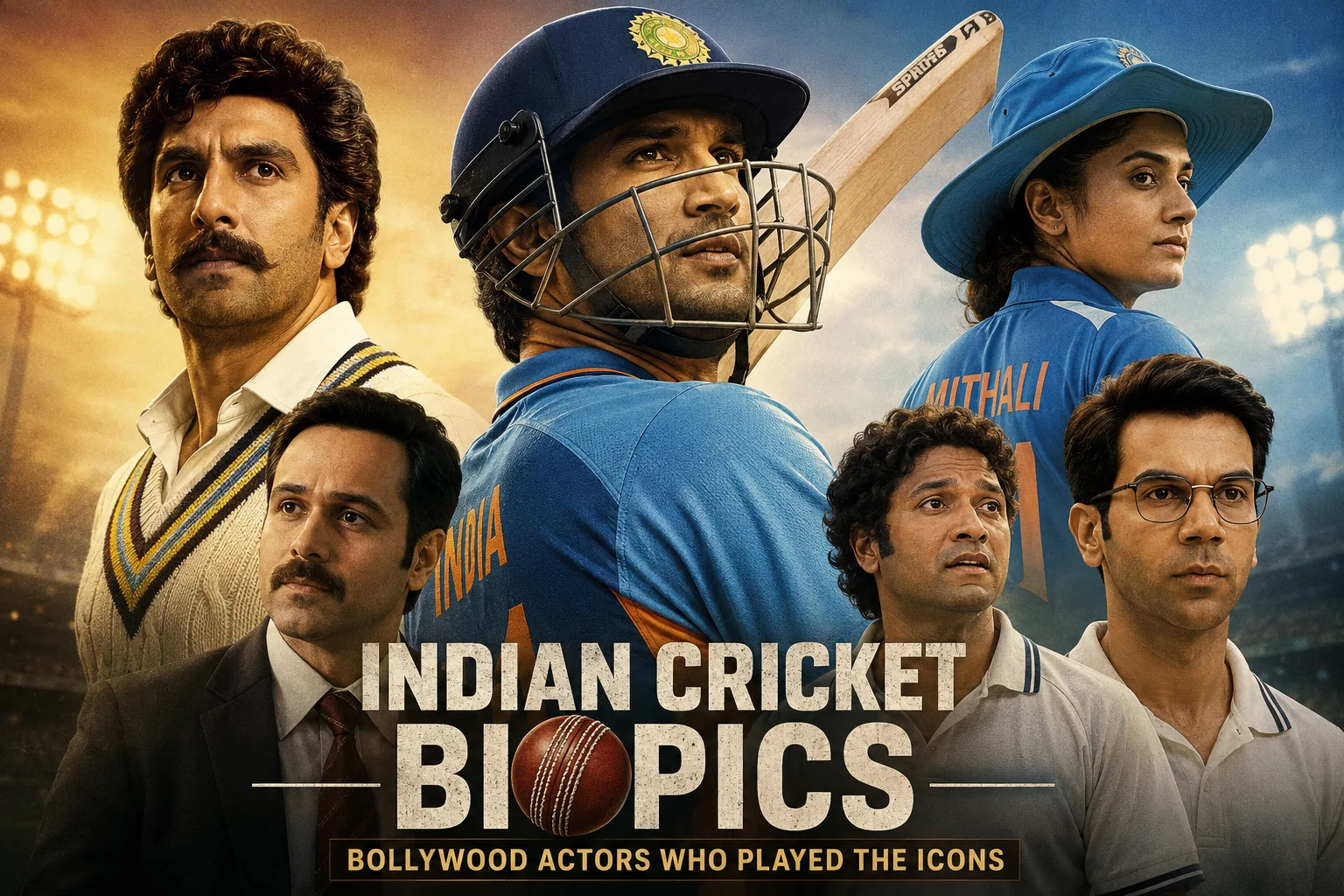
Can an actor ever truly fill the shoes of a cricketing legend the nation has watched for decades?
Cricket stands tall in the consciousness of India and is unequivocally one of the few sports integral to the country's identity. Cricket offers Indians not merely entertainment but a repository of memories full of instances of success, failure, and determination. With this, one can fathom why Bollywood films have always sought inspiration from the lives of cricketing legends.
These are extraordinary stories rich in drama and suspense that can easily capture the audience's attention. What Bollywood has established over the years is that it can present a faithful portrayal of human life, not merely statistics of their achievements on the cricket field.
Bollywood seems determined to keep answering that question, and with each new biopic, it comes a little closer to a convincing yes. This article looks at the ones who made these performances unforgettable.
India's Obsession with Cricketing Icons
In India, cricket has become synonymous with religion, establishing players as some of the most respected personalities in the country. Sachin Tendulkar is the best example of this reverence, virtually worshipped with temples dedicated to him. Virat Kohli enjoys similar adulation today, while M.S. Dhoni has become a symbol of respect for his calm demeanour, particularly since 2011. This obsession with cricket is evident in everything, from street posters to million-dollar endorsements.
Ranveer Singh as Kapil Dev: Reliving 1983
In the history of Indian sports, not many events have the level of importance and relevance that the 1983 World Cup victory has. In '83, directed by Kabir Khan, the story of that marvellous tournament is being told, and the centre of the story is Ranveer Singh, who plays the crucial role of Kapil Dev, an amazing athlete whose powerful ability to lead the team has helped India to penetrate the strong wings of the rival team of the West Indies.
Ranveer, who is famous for his larger-than-life persona, toned down his typical flamboyance to bring Dev's subtle, understated leadership style to celluloid. He painstakingly prepared to replicate Dev's unique batting stance and bowling style, and the effort paid off in scenes where Singh looked more like Dev than an actor.
The reason behind Singh's successful portrayal lies not merely in mimicking the technique but also in imparting subtlety to the role. Kapil Dev was never a man known for making bombastic speeches, and even in this film, Singh made sure there was no needless drama.
Instead, it let the enormity of the achievement speak through small gestures: a steady gaze before a crucial delivery, a quiet word to a nervous teammate. The result was a performance that anchored an ensemble film and gave audiences a way into a triumph many of them had only heard about secondhand. Another special thing about the movie was Deepika Padukone's portrayal of Romi Bhatia Dev, Kapil's wife.
According to critics, Ranveer Singh's portrayal of Kapil Dev has been considered noteworthy for both his performance style and physicality. However, the box office performance of the movie 83 has not met expectations for such a widely discussed film.
Emraan Hashmi as Mohammad Azharuddin: Elegance and Turmoil
If the story of Kapil Dev is one concerning the recognition of a collective achievement, then the story involving Mohammad Azharuddin is decidedly more complex, with Azhar not at all afraid of complexity. The role of Azharuddin was given to Emraan Hashmi, renowned for elegant batting that earned him fame as a batsman, and the match-fixing scandal was among the events that put him in the spotlight at the end of his career.
The choice of Hashmi as the actor for the role created waves in the industry, as he had never acted in a movie related to cricket. However, he proved true to the role, improving his batting skills to make his play close to Azharuddin's.
The film conveyed Azharuddin's story in detail, capturing sympathy for him while also showing that he was not innocent. Hashmi's approach to the role helped convey better that Azharuddin was a man caught between public admiration for him as a great player and the trouble of allegations against him.
Despite the scepticism surrounding the casting of Emraan Hashmi as Mohammad Azharuddin, he delivered an unforgettable performance, adding emotional depth and humanity to the character.
The movie itself was torn apart by critics, many of whom believed that Azhar's portrayal of the protagonist was overly positive and that it glossed over the match-fixing scandal rather than tackling it directly.
Sushant Singh Rajput in and as M.S. Dhoni: The Untold Story
Among all the cricketing biopics Bollywood has produced, M.S. Dhoni: The Untold Story remains a high-water mark, largely because of Sushant Singh Rajput's performance in the title role. Dhoni's journey, from a ticket collector's son in Ranchi to one of the most successful captains in the history of Indian cricket, was already a compelling underdog narrative.
Sushant Singh Rajput embodied an uncommon combination of physical precision and emotional sincerity while taking on Dhoni, reflecting not only the peculiar batting style and the infamous helicopter shot but also the steadfast person behind it. Months spent with different cricket trainers established his style of play: calm and confident under pressure. The movie revealed Dhoni's hardships on his way to becoming a captain and, since Sushant passed away in 2020, it serves as a tribute to his skills.
The television interviews featuring Rajput's performances have received renewed attention, with audiences watching them online, including one in which he recounts his struggles as a young cricketer unsure of his future ambitions. Many people tend to mix this story with a specific scene from the film Chhichhore, in which the character played by Rajput urges a boy who attempted suicide to talk about failures with a fatherly tone.
Sushant Singh Rajput's role as Dhoni has become the benchmark of Indian cricket biopics. The film earned accolades for its storytelling and commercial success. Since then, any new cricket biopic in Indian cinema has been evaluated for success based on this film's achievements.
Taapsee Pannu as Mithali Raj: A Different Kind of Captaincy
In the past, Bollywood has made biopics prominently about male cricketers, but Shabaash Mithu is different in this respect. Taapsee Pannu starred as Mithali Raj, who was the captain of the Indian women's cricket team for more than 20 years and has contributed significantly to promoting women's cricket in her country, where this sport usually receives less attention. The actress focused on Raj's life, from her childhood with her family to her successful career in cricket as a considerate player.
This movie not only shows the life of Mithali Raj but also highlights the challenges women cricketers face in Indian cricket, such as a lack of funding and sponsorship, limited media attention, and a constant fight for their rightful place alongside men. Taapsee played the role in a subtle yet effective manner, which also demonstrates Raj's approach as a player – she preferred her actions to speak for her.
Taapsee Pannu, who played Mithali Raj, was praised for being true to the character, as she showed Raj's ability to maintain calm. Still, the film could not make an impact at the box office even if it dealt with an important subject. But the film's significance lies not in its finances but in its potential to change the meaning of cricket biopics in India by telling the important story of women involved in the development of this sport.
Shreyas Talpade as Pravin Tambe: The Underdog's Tale
Bollywood narrates many cricketing stories, but only a few concern the national team's captains and World Cup triumphs. 'Kaun Pravin Tambe?' tells the lesser-known story of Pravin Tambe, another cricketer from Mumbai who made his Indian Premier League debut at 41.
Shreyas Talpade portrayed the lead character very convincingly because he knows what it means to have a long, unsuccessful career. The role helped Talpade express not only the frustrations of a talented player ill-used by selectors but also the strength needed to pursue a seemingly unreachable dream.
'Kaun Pravin Tambe?' intrigued the viewers as it portrays the plight of an average man rather than the legendary story of a national icon, while Shreyas Talpade's performance is just what the film calls for, portraying the struggles and perseverance of a regular cricketer waiting for his due recognition. In that regard, the movie was launched on an online platform and was not likely to make any significant impact, though it proved to be relevant.
Rajkummar Rao as Sourav Ganguly: The Next Chapter
In recent years, Bollywood's obsession with cricketing stars seems to be going full swing, and the next one in line is Sourav Ganguly. The ex-captain of the Indian team is considered to have instilled vigour and self-belief in the team during his tenure as captain in the 2000s. Rajkummar Rao has been roped in to play Ganguly in a biopic about him, sparking curiosity about how Rao will carry the role, given his expertise in character-driven roles.
Ganguly's life offers a wealth of exciting material, from his initial struggle to make a place in the team to his well-recognised achievements, which paved the way for many future successes. It will be interesting to observe how Rao conceives the character and especially how the film shows Ganguly's turbulent relationship with the authorities in general. Given the standards set by previous biopics, the expectations are definitely high.
As Rajkummar Rao is yet to portray Sourav Ganguly on screen, it is an open question rather than a settled issue. Due to the genre's inconsistent record of performances and box office outcomes, the success of the film will decide whether the Hindi film industry has solved the cricket biopic genre problem or not.
The Takeaway
Overall, the films show a genre in transition, moving from uncomplicated idolization idolisationects towards more complex and sometimes disturbing representations.
To play these roles, the actors need to do much more than master batting or bowling – although that is also an important part of the job. They must locate the person behind the legend, identifying someone who is both a public figure and an individual facing victories, failures, stress, and sometimes disgrace.
As Bollywood keeps exploring the stories of India's cricket history, the pressure on these performances will continue to grow, especially because the audience, used to seeing these players in real life, will hold every move against their memory.
What sets more successful films in the genre apart is a willingness to embrace contradiction rather than suppress it. In the best performances, the players understand that an icon in cricket is seldom just a hero or a lesson – they are usually both at once.
2022 © Milestone 101. All Rights Reserved.