STAY CURIOUS
Keep reading to find the excellency out of perfection and skill.

By: Milestone 101 /
2026-06-13
bollywood
Main Vaapas Aaunga: Cinema with a Soul in the Age of Adrenaline
Imtiaz Ali's Main Vaapas Aaunga is a slow, soulful, and emotionally rich partition drama that dares to be different in an era of adrenaline-driven, alpha-male cinema. This think piece explores why such films struggle to survive today, examining its music, cinematography, performances, and the cultural landscape it exists in.
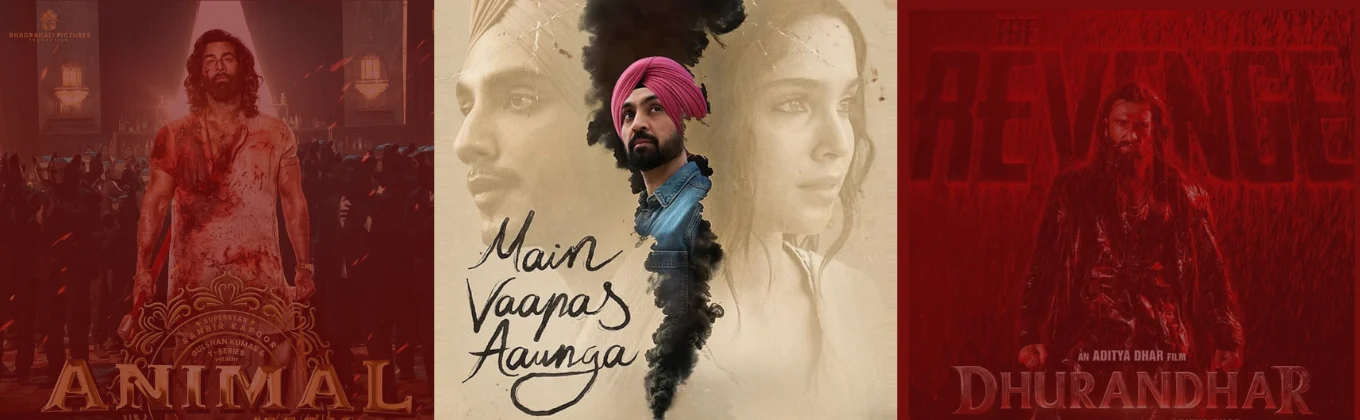
A love story set against the backdrop of partition would have worked very well twenty years ago, or even a decade ago, but in times of films like Dhurandhar, where gory is the new cool? Why not? Imtiaz Ali's latest 'Main Vaapas Aaunga' asks that question, or rather makes one mull on it.
Most movies nowadays have somewhat illogical dialogue, remixed songs, melodrama that could have fared well without the 'melo', unnecessarily gory scenes, or actors who can't convey their emotions. Fortunately, Main Vaapas Aaunga is exactly the opposite of all the above metrics. Unfortunately, it also classifies it as 'old school.'
The World of Imtiaz Ali.
Filmmakers who not only tell stories but create whole worlds of emotions and invite viewers to live within those worlds long after the credits have rolled are rare. Imtiaz Ali is one of those rare filmmakers. With Socha Na Tha, he announced himself as a tender, relaxed, and refreshingly real voice in Hindi cinema, producing a love story that felt very much like it could actually occur in everyday life.
Imtiaz had directed not just the various sections of the film but also the emotional performances of each actor, which were not so much parts of real life.
Across all his films, his direction creates pop culture references, has a deep impact on society, and does one rare thing consistently: it makes characters breathe.
Actor's Buffet
Main Vaapas Aaunga is a performance package propelled by the actors who wear their characters like well-fitted clothes. Naseeruddin Shah's portrayal of a 95-year-old Ishar Singh Grewal, aka Keenu, is entitled, always ready with insults, yet someone who's lost in the alleys of Sargodha. He sheds all of this when he meets his long-lost love, sprucing himself up.
Diljit Dosanjh as Nirvair Singh Grewal is a common portrayal of an adult who's frustrated with his job, his love life, and family. He got into the character exactly as required. Not a beat missing.
Vedang Raina of 'The Archies' and 'Jigra' fame is a young Ishar who's nothing like his older self. He's Pookie, a green flag, and a budding poet who gently defuses any moment that arises during his meet-cute with his potential girlfriend. He's not shy about announcing his love or embracing it when he's lost everything. Vedang becomes Ishar aka Keenu effortlessly. The post-partition effects harden him, leading him to work overtime and distance himself from his loved ones.
Sharvari as Afsana is a treat to watch. She's not a coy girl, but pretends to be for Ishar, not giving herself up to him easily. She struts, makes stern faces, and dresses up as her potential boyfriend, expressing that love is freeing her and serving as an escape from a conservative family and uncertain times, and that she gets to spread her wings when she falls for Ishar. When these lovebirds agree to get married, Afsana asks Ishar, "Itni asaani se aapke hawale soap rahi hu kam kimti nahi samjhenge na," reflecting her integrity as she makes room for a new love.
Rajat Kapoor as Iqbal Grewal, Nirvair's father and Ishar's son, is a rigid, ever-complaining father who first mocks his son for believing his father's bakwass and later berates him when it gets too real for Nirvair.
Dolly Ahluwalia, Keenu's grandmother, is portrayed as a hapless character who makes some unfortunate decisions during a hostile takeover. In her few solid scenes, she commands her presence.
Vinod Nagpal's Kitpal is yet another character actor, but he has an imposing presence in his scenes.
Anjana Sukhani's portrayal of Anjana Grewal was, on the face of it, the butt of a few jokes. She's oblivious to her father-in-law's condition, constantly saying "will toh banayi nahi" or checking if he's still breathing amidst a serious scene.
An Original A.R. Rahman Treat
When A.R. Rahman composes a film's music, the expectation is already set. Thankfully, it exceeds our expectations. 'Maskara', sung by Nilanjana Ghosh Dastidar, is a beautiful song that captures the early stages of love blooming between the two characters. Actor Vedang Raina also lends his voice to the song. The tune will definitely make you shake a leg.
'Ishq Mastana' by Mohit Chauhan, Nargis, and Pooja Tiwari is a mix of Jazz and traditional Punjabi folk. Adding another layer of depth to the track is its central refrain, "Haman Hai Ishq Mastana, Haman Ko Hoshiyari Kya," which originates from the timeless verses of Sant Kabir. The song celebrates being alive, rooted in the spirit of pre-Partition Punjab, yet feels completely timeless.
'Vo Nahin', 'Dheere Dheere', 'Dariya', and 'Tere Paas Main' strike an emotional chord, ensuring that the audience sheds tears.
The end credits' Kya Kamal Hai' sung by Diljit Dosanjh takes the cake. The audience has now come to assume that the end credits song would probably be an item number starring a well-known celebrity, but that's where this movie flips the script. It's a song that reflects the current times, the wartime we are living in, where powerful nations are attacking each other, while millions suffer because of this petty escalation. The clips of refugees escaping their cities because of wars will tug at your heartstrings and send a chill down your spine, simultaneously.
Rahman's background score creates magic and propels the scene, immersing the audience into a story of long-lost love. The exact partition is silent but loud when fights break out, trains are filled with bodies, and live executions that pause the moment.
Writing with a Voice
A dialogue between two characters - one Indian and one Pakistani summarises the mental effects of partition and how people who lived but lost their soul and voice: Log kehte hain dil nahi hai inka." "Yaha jo reh gaya." At the beginning of the film, a dementia-ridden Ishar Singh Grewal, played by Naseeruddin Shah, visits the Indo-Pak border hoping to cross it. Still, when the officials bring him to present, he asks, "Partition hua tha! Kyu?" - We all know the answer to that, but we probably wouldn't be able to summarise it.
Lovebirds Afsana and Ishar are aware of the times they live in, but nothing can stop their love. "Ye waqt hi aisa hai, der ki toh der na ho jaye", or "Dono Christian bann jaye toh ho sakta hai" when Afsana asks Ishar how they can marry due to their different religions.
There's violence that was inflicted on both sides of the partition, but it's never sprung upon you. Unlike the beloved alpha films, the violence here is not rammed down your throat. You keep guessing when it'll arrive, and when it does, it will send shivers down your spine.
Character arc evolves during their journey. For instance, Naseeruddin's Keenu is a softie, a green flag in the pre-partition era, but in the present, he's a rigid, unloving father who never hugged his sons. Yes, it's not an ideal development, but you are made aware of why someone so good at heart is turned into a 'patthar-dil' post-partition.
Nirvair Singh Grewal, a restless software engineer, moonlights as a stand-up comedian, weaving his grandfather's story of the Partition into his sets to educate youngsters. His gamophobia keeps him emotionally distant, until the weight of that inherited history finally forces him to commit to the people he loves.
The screenplay is fast-paced, travelling constantly between 1947 and 2026. There's nary a dull moment. Yes, there are too many emotionally charged scenes, but that's to be expected in a romantic drama set during the partition.
Cinematography - Frames That Remember
The film constantly switches between pre- and post-partition times and the present, and the transitions feel almost organic. In fact, it's the film's DNA, and it never feels forceful. When the camera pans to the pre-partition era, you see Sargodha, currently a city in the Pakistani province of Punjab. Sargodha's alleys, people, church, houses, and colourful surroundings are beautifully presented by Sylvester Fonseca. His previous work includes Amar Singh Chamkila, Dhadak 2, and Nishaanchi.
The movie mostly focuses on the past, as evidenced by its depiction of natural surroundings. The modern times are mostly confined to indoors - clubs, houses and such. You'll be able to differentiate between the past and the present times without rolling your eyes.
When the Screen Became a Classroom for Misogyny
Over the past decade, the Indian film industry has transformed from merely an artistic expression of culture to an active agent in shaping society, sometimes in harmful ways. Male role models such as those in Arjun Reddy, Kabir Singh, and Animal have established a model for male roles in today's culture that includes behaviours of swearing freely, treating women as property and having absolutely no regard for even the most basic concepts of human decency as something to aspire to.
The repercussions of these images have been significant. This has been illustrated by the ₹370 biryani controversy in which the comedian Pranit More made jokes about the notion that buying a woman dinner would give him the right to sex, an in-your-face cultural reflection of glorified screen misogyny. The film Dhurandhar wrapped the language of nationality around the motivation for communal violence and re-branded the action of jingoism as entertainment.
And then, all of a sudden, Main Vaapas Aaunga arrives with a quiet, humanistic quality, is musical, slows down time, and is emotionally truthful... reminding us of what cinema should be.
The Audience It Deserves, Not the Audience It Will Get
Partition is an emotional, quiet drama that typically does not appeal to the masses at a multiplex. The impact of OTT platforms on how Indians consume films in cinemas has altered audiences' mindset about going to see similar stories in cinemas, given how quickly they can be consumed on their phones. This change has created an inherent vulnerability for slow, atmospheric films such as Main Vaapas Aaunga. Spectacle will always go fast to theatres; however, the soul will wait for you when you are at home.
Partition as a subject presents yet another layer of potential commercial risk for film creators. The audience is looking for entertainment from the theatre; they are not necessarily looking to unearth or explore. Thus, being a filmmaker who chooses 1947 as a canvas to create is both a gamble with their money and an act of courage on behalf of many filmmakers.
Despite this, before lines were drawn and before the world was divided with the passing of hatred like an inheritance from one generation to another, there was one world we all shared. For example, Piyush Mishra's 'Husna' from Coke Studio Season 2 is a perfect representation of that world in a single song. Humanity existed before hatred existed; think of the real question — who benefits from making you forget?
2022 © Milestone 101. All Rights Reserved.