STAY CURIOUS
Keep reading to find the excellency out of perfection and skill.

By: Milestone 101 /
2025-12-16
bollywood
Media Mettle: How India's M&E Sector Flipped the Script
India’s media and entertainment sector hit a turning point in 2024. Crossing INR 2.5 trillion, it saw digital overtake television, ads move online, and live experiences roar back. This article breaks down what changed, what’s driving growth, and why the road to INR 3 trillion is closer than it looks.
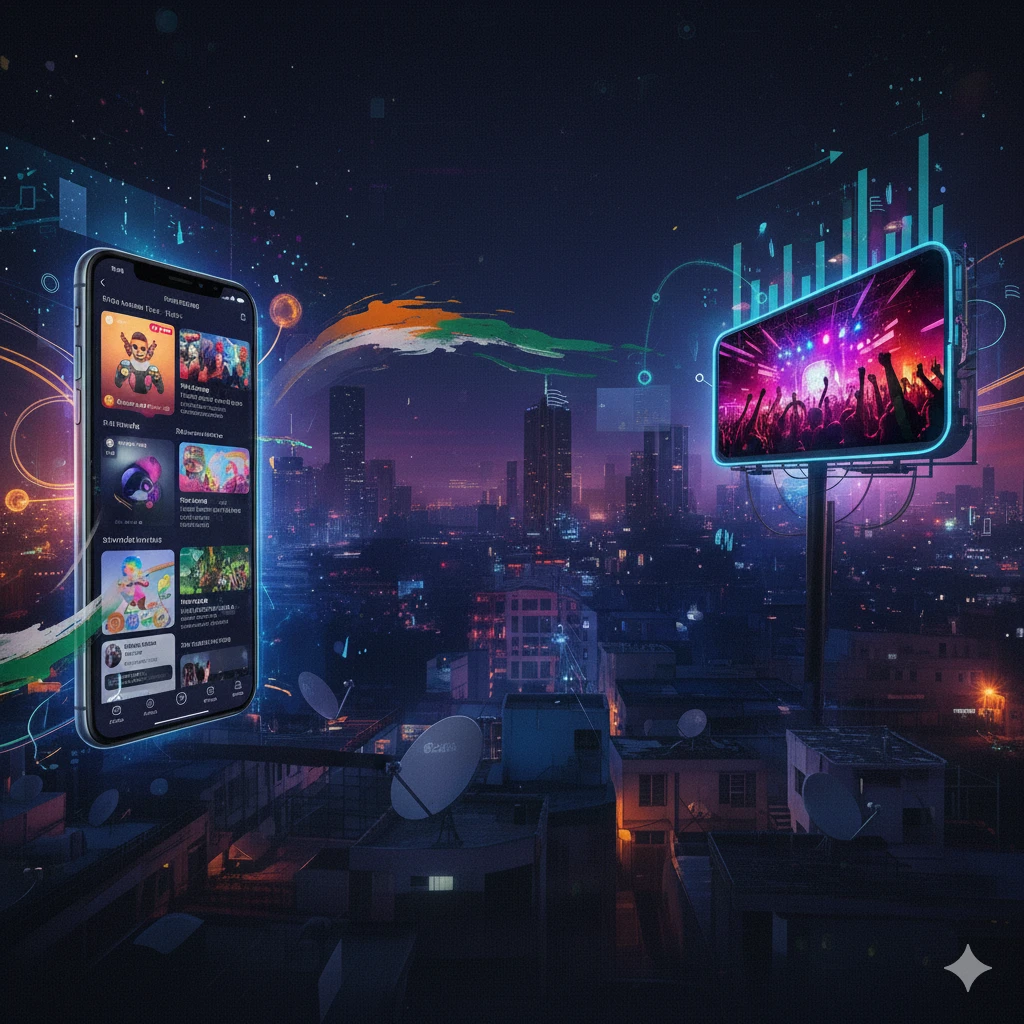
In 2024, India's media and entertainment (M&E) industry reached a tipping point. Even amid severe global economic headwinds and softening consumer sentiment in key markets, the sector exceeded INR 2.5 trillion in value and grew 3.3 per cent year-on-year. What we recognise in the numbers is the strength of the numbers; what stands out is how the very fundamentals of the sector had changed—and had changed significantly—in just one year.
Digital media overtook television as the single most significant revenue contributor, marking a critical tipping point for India's content economy. Advertising shifted along with it, underscoring the mobile-first habit of consuming content, the increase in internet adoption, and a growing base of mostly digital-native consumers. The in-person events bounced back, and newer formats, such as digital out-of-home advertising, had become more mainstream. Each of these changes did not merely denote resilience but also reinvention—setting India's M&E environment on a stronger, more ambitious growth path.
This article explores how the transformation unfolded, what’s driving it, where the challenges lie—and why India’s M&E sector appears ready to leap beyond INR 3 trillion by 2027.
The Turning Point: INR 2.5 trillion and a 3.3% Growth
For decades, the M&E sector in India has grown steadily, though two things distinguish 2024: the growth rate achieved and the shape of that growth. As per the joint FICCI–Ernst & Young (EY) report Shape the future: Indian media and entertainment is scripting a new story, the industry reached a milestone of INR 2.5 trillion (around US$29.4 billion). Even in a world of uncertain economic conditions, prioritisation shifts for advertisers, and upheaval across content marketplaces globally, the sector managed to enjoy year-on-year growth of 3.3%. It has also contributed about 0.73% to India's GDP, reminding us that entertainment has graduated from a soft or peripheral industry to a pillar of the country's economic throughput.
Understanding the significance of what we've seen in 2024 is straightforward. There was stronger growth in earlier years - for 2023, we had a reported increase of about 8.3% - but the significance of 2024 is in the emphasis of change that happened below the surface. The scale is only half the equation; what is most important is the structural reset happening across platforms, revenue pools, consumer behaviours, and the business of content. The sector has not increased in value; it has matured, marking an evolution, further highlighting that the entertainment economy in India has opened a new chapter.
Digital Media Overtakes Television: The Structural Shift
Digital media passing television is not another data point. It represents a fundamental shift in how Indians engage with content and how the entertainment industry makes money. Television dominated for decades, shaping advertising costs, celebrity contracts, and even storytelling formats. In 2024, everything turned on its head. Digital media—which includes OTT platforms, mobile video, digital advertising, social media content, and gaming—became the M&E sector's largest revenue source. According to the EY report, digital media accounted for 32% of total industry revenues.
What makes this shift especially significant is that it reflects not only a change in technology but also a behaviour change. Viewers, especially young audiences, are watching on their phones more than on living room screens. Advertisers are following the eyeballs, creators are chasing the algorithms, and the entire industry is recalibrating around digital-first storytelling and distribution.
What Drove this Shift?
With the Internet and mobile connectivity, the online ecosystem in India has expanded rapidly. Hundreds of millions of people own smartphones and use mobile data, making content consumption more mobile-focused than ever before. The EY Report states that India's "digital revolution... finally shattered television's two-decade stranglehold on attention."
Consumers consciously engage with content whenever they want, in whatever format best fits their language, while leveraging mobile-first, snackable, short-form content. The Mediabrief article emphasised how media and entertainment companies must now be "consumer-first tech companies," utilising unified sign-on, content discovery, and mobile-first workflows.
In addition, traditional TV subscriptions and advertising are under pressure. For example, the report states there were 6 million fewer pay-TV homes in 2024.
So, the combination of expanding digital reach + changing habits, and structural constraints in old media created the perfect storm for digital to leap ahead.
Implications of the Shift
This is not simply a matter of numbers. The rise of digital media overtaking television means that content creation is no longer optimised merely for the "lean-back" TV viewing audience, but must also take into account mobile-first, on-the-go, multi-screen consumption.
Monetisation has to develop from traditional subscriptions and ad revenue to new models-micro-transactions, freemium, creator economy, live interactive formats. Advertising dollars are quickly shifting into digital ecosystems, and media companies need to build new business models rooted in data, personalisation, and direct-to-consumer relationships.
India’s M&E sector has flipped the script. The old model, which relied heavily on television, is being replaced by a dynamic, digital-first model. And while TV remains essential, it’s no longer the engine driving growth.
Key Growth Drivers: Digital Advertising, Live Events, Digital OOH
Having flagged the structural shift, let’s pick out the key growth engines that propelled the sector in 2024—and which are likely to continue powering it.
Digital Advertising’s Surge
As of 2024, advertising continued to power the M&E sector, with total growth of 8.1%; however, the real driver of growth was digital. Digital advertising rose to INR 700 Billion, up 17% and accounting for 55% of total industry ad spend. In fact, this means that, for the first time, more than half of every advertising rupee in the Indian entertainment sector is being allocated to online platforms rather than traditional media such as television, print, or outdoor. The growth drivers weren't just one category; they were a confluence of several factors. Short-form video and social media remained significant areas of user attention, with around 11% growth in 2024.
The category that saw the most significant growth was e-commerce advertising, as brands increasingly treated their shopping apps and marketplaces as their storefronts. Overall, e-commerce advertising grew by a remarkable 50% to INR 147 Billion. The other primary growth driver was SMEs, with long-tail advertisers spending close to INR 258 Billion in total, signalling that the digital advertising space isn't just for large corporate advertisers anymore.
Taken together, these trends make the picture clear: digital is now the dominant battleground for advertisers, because that’s where the audience lives — on mobile screens, on social platforms and inside e-commerce ecosystems.
Live Events and the Revival of “Experience”
Live experiences have returned, and 2024 is proof of this. The EY report shows that this segment has experienced approximately 15% growth, with organised events surpassing the INR 100 billion mark for the first time. A field that used to be seen as a side channel of the entertainment economy has become a main growth engine. People want experiences in the physical world again, including concerts, world tours, music festivals, large-format weddings and personal events, and new immersive experiences that combine technology with performance.
The appetite is strong, and spending is high. Ticket sales, sponsorships, brand activations, merchandising, food and beverage, and influencer-led promotions all add layers of revenue that digital alone can’t replicate. For a country with a young population, growing urbanisation and rising disposable income, the live events boom feels almost inevitable. India is quickly becoming a top-tier tour destination, and brands are learning that the emotional pull of a physical experience often creates deeper loyalty than a screen ever could.
Digital Out-of-Home (OOH) Media
Another frequently overlooked source of growth is digital OOH. The report states that OOH media grew approximately 10% in 2024 (across traditional and transit formats). Digital OOH grew 78% to comprise 12% of total OOH revenues now, up from only 7% of revenues in 2023.
This illustrates how the outdoor media landscape is being re-imagined to include: digital screens in transit hubs, bright billboards, connected displays, and programmatic buying—brands are incorporating digital OOH into their OUT OF HOME advertising plan alongside mobile, social and video.
Other Emerging Drivers
In 2024, Print still saw modest ad revenue growth (1%), while subscriptions continued to decline. Radio experienced ~9% growth in 2024, driven by ad volumes and event-related content. While outsourcing of global animation & VFX is expected to decrease in 2024 (which we will discuss further below), it remains a strong growth area for India.
Together, these growth drivers show that the upside is not limited to one sub-sector, but is spreading across digital content, advertising technology, immersive experiences, and outdoor media. India’s M&E sector is shifting from broadcaster-centric models to its new content+experience+platform model.
Challenges: Subscription Decline, Global Demand Weakness in Animation/VFX
While the headlines are upbeat, the story is not without wrinkles. Some segments of the industry are under pressure—highlighting that the evolution is uneven and that strategic risks remain.
Decline in Subscription Revenues
One concerning trend: subscription revenues across multiple sectors decreased in 2024. According to the EY-FICCI report, subscription revenues declined by 2% in 2024 across TV, print, film and online gaming.
The report states that pay-TV homes decreased by six million in 2024. The declining number of pay-TV homes is due in part to:
Audiences are shifting from linear TV to connected TV/OTT platforms. Many legacy pay-TV models struggle to adapt. Weak film/theatrical performance: only 11 Hindi films crossed INR 100 crore (US $12 million) in 2024, compared with 17 in 2023. Print subscriptions continued to erode; digital substitution is still minor in many cases.
While digital platforms are seeing healthy growth, specific segments that rely on older monetisation models are struggling. This underscores the potential (being moved) for a transformation strategy.
Reduced Global Demand for Animation & VFX Services
India has long been a popular destination for animation/visual effects, gaming, and post-production services, thanks to its large talent pool and favourable cost structures. After all, in 2024, worldwide demand for animation/VFX work outsourced to India decreased by 9% (as referenced).
Reasons include:
Global content producers are facing budget pressures
Production delays (global Hollywood strikes, etc.)
Increased competition from other geographies
Rising costs and skill requirements in the global value chain
The contraction in this segment is a warning that export‐oriented segments are sensitive to global cycles, and that India must stay competitive on cost, quality, and turnaround time.
Overall Moderation in Growth Rate
In 2024, growth is expected to be 3.3%, significantly lower than the previous year's 8.3%. This deceleration is a result of structural headwinds: a decline in subscription revenue, soft global outsourcing demand, inflation, currency fluctuations and changing consumer habits.
Growth is stable but not as rapid. The question for India’s M&E sector is how to maintain quality growth and adapt business models.
Additional Risks to Watch
Several risks sit beneath India’s fast-growing digital entertainment economy, and they can’t be ignored. Regulation and policy remain fluid, especially around content moderation, data privacy and platform accountability, which could create uncertainty for creators and platforms. At the same time, piracy and revenue leakages continue to shadow digital expansion, threatening monetisation just as consumption peaks. The talent and infrastructure ecosystem hasn’t scaled at the same pace as demand, either.
India is pushing aggressively into AI-led production and MediaTech, but the industry still needs more skilled workers, better studios and stronger post-production capacity. Regional and vernacular content continues to explode in viewership, yet monetisation often trails behind, suggesting platforms must figure out how to make local content financially sustainable. And finally, economic volatility hangs over the sector. Advertising growth is tightly linked to macroeconomic stability, so inflation, currency swings or global slowdowns could soften revenue trajectories in the coming years.
The Road to INR 3 Trillion & Beyond: Opportunity-Rich Future
Despite the headwinds, the outlook for India’s M&E industry is optimistic. The change underway provides foundations for sustained growth into the next decade.
Growth Trajectory
According to the EY-FICCI study, the sector is expected to grow at ~7.2% in 2025 to reach INR 2.7 trillion, and at a ~7% compound annual growth rate to hit INR 3.1 trillion by 2027.
Some media commentary hints at even larger ambitions: one piece suggests the Indian M&E sector could cross US$100 billion (INR ~8.5 trillion at current rates) by 2030.
So the message is clear: from the INR 2.5 trillion milestone of 2024, the sector is on a path to substantially larger scales. For a content writer like you, this means it’s not just about numbers but about fundamental transformation in strategy, formats and ecosystem.
Why this Next Wave could be Different
- Mobile-first and regional-driven consumption: India has moved beyond simply following global consumption trends—it's building distinct consumption patterns suited explicitly to its digital-born population, given ubiquitous smartphone use and an explosion of regional language content. The Mediabrief article discusses this transformation.
- Creator economy and long tail monetisation: Digital platforms allow smaller creators, vernacular producers and niche formats to find audiences. This extends reach beyond the mainstream film/TV axis.
- Advanced technologies and global production hub: India is consolidating its role not only as a consumer but as a creator and exporter of content. The “A Studio Called India” report highlights India’s cost advantage in animation/VFX and its large talent base.
- Experiential economy (Live, OOH, immersive formats): In addition to passive consumption, Indians are prepared to pay for experiences—concerts, festivals, live international acts, interactive formats. The very growth in live events and digital OOH we cited earlier is evidence of this.
- New business models and monetisation pathways: Hybrid business models that marry advertising, subscriptions, freemium, micro-transactions, e-commerce partnerships, gaming monetisation, etc., are developing. The industry is edging past ad + subscription.
- Policy and eco-system support: The government is increasingly seeing media, animation, and gaming as strategic. Incentives, production hubs, and cross-border collaboration are all improving.
Strategic Collaborations and Innovation
Strategic collaborations and innovation are shaping the road ahead for India’s media and entertainment ecosystem, opening up a fresh set of opportunities for both companies and creators. One of the biggest levers is collaboration across platforms — where streaming services, social media, short-form apps, and live entertainment can work in tandem rather than operate in silos. The same applies to brands, which are now experimenting with immersive advertising through digital out-of-home networks, experiential events, and interactive brand moments. Regional localisation is emerging as a high-value frontier too, with Indian-language storytelling and globally relevant narratives unlocking export potential.
To keep pace with this shift, investment in technology infrastructure has become essential, especially in AI-assisted content creation, localisation tools, VFX, and immersive formats such as XR, AR, and VR. At the same time, monetising the creator economy through commerce integrations, subscriptions, and fandom-driven models is becoming increasingly viable. Strengthening export value chains in animation, VFX, and post-production, supported by clearer policy frameworks, tax incentives, and simplified production clearances, can further accelerate the industry’s next phase of growth.
What Needs to be Watched
As India’s M&E sector enters its next growth phase, a few critical areas require close attention. The first is monetisation: consumption is rising rapidly, but audience growth doesn’t automatically translate into revenue, and platforms will need more innovative pricing models and diversified income streams. It’s also important to avoid leaning too heavily on a single growth driver, because advertising alone can’t carry the sector forever — subscription, commerce, licensing, and ancillary lines must strengthen in parallel.
Talent and infrastructure capacity will be another deciding factor, especially as demand for high-quality production, post-production, and localisation continues to climb. With India competing more actively on the global stage, cost advantage won’t be enough; differentiation will depend on storytelling, quality, and the creation of original IP with international appeal. The digital shift also sharpens debates over data, privacy, and platform regulation, while heightening the need to maintain cultural sensitivity amid increased scrutiny of content. Watching these pressure points will be key to sustaining momentum.
The Takeaway
If ever you would consider the phrase “flip the script” to apply to India’s media and entertainment sector, 2024 will be that inflexion point. The industry crossed a significant milestone—INR 2.5 trillion—and did so as a result of a structural shift: digital-first, mobile-driven, experience-rich. Also, advertising soared (the growth in digital advertising’s 8.1% share being particularly noteworthy). Live events and digital out-of-home grew their new vectors. At the same time, headwinds in subscriptions and issues in outsourced animation/VFX served as reminders that the urge to change is never frictionless.
The narrative now switches to a new chapter: one in which the sector not only catches up to global benchmarks but also creates new global templates for growth—regional content exported globally, creator-economy models, immersive interactive experiences, and digital monetisation that moves beyond simple ad modelling. The trajectory toward INR 3 trillion by 2027 and beyond is real.
This signifies to all stakeholders—writers, creators, companies, investors—that the landscape is changing: content is no longer exclusively defined by movies and television; it is mobile apps, short-forms, live experiences, branded ecosystems, global distribution and tech-enabled storytelling. The winners will be those who do not merely grasp the “what” of content but its "how" in respect of monetisation, “where” in relation to distribution (mobile, smart TV, outdoor digital, live venues) and “who” regarding audience (regional, vernacular, digital-native, creator-driven).
India's M&E sector has turned the script. Now is the time to write the sequel.
2022 © Milestone 101. All Rights Reserved.