STAY CURIOUS
Keep reading to find the excellency out of perfection and skill.

By: Milestone 101 /
2026-07-02
bollywood
Naseeruddin Shah, A Reluctant Legend: The Many Lives Behind One Man
As Naseeruddin Shah turns 75, two projects converge to capture him at an unexpected career peak: back-to-back screen roles in Main Vaapas Aaunga and Made in India: A Titan Story, alongside an intimate documentary by longtime friend Arunima Sharma. Together they reveal an actor who spent decades avoiding stardom, only to become a reluctant icon.
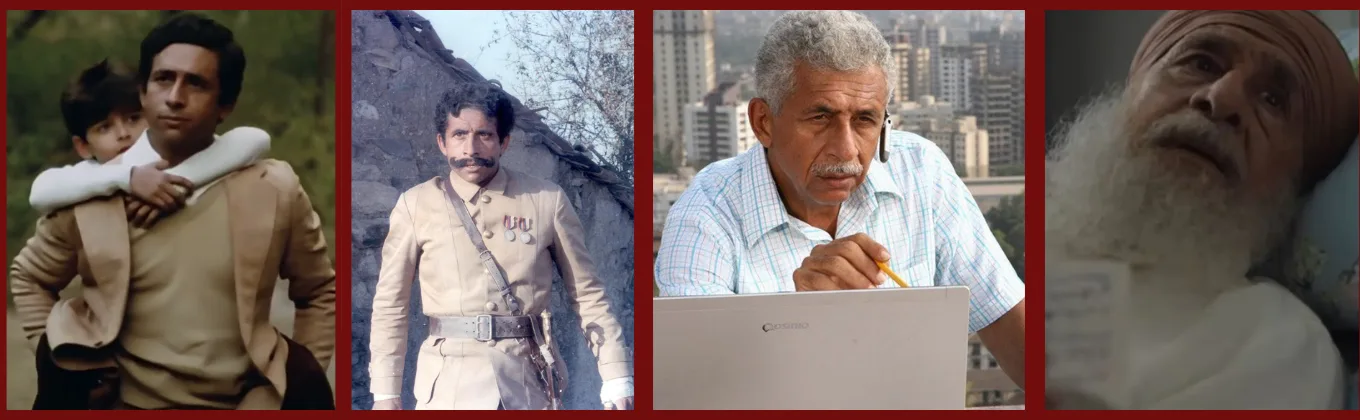
What does it take for a man who has spent fifty years dodging the spotlight to be called a national icon suddenly?
Naseeruddin Shah turns 75 this year, and the timing feels almost too neat. Two separate threads, one on screen and one off it, have converged to capture him at a point most actors never reach: the moment when a career stops being a body of work and starts being a mirror held up to a nation. He did not plan this convergence. It simply arrived, the way most honest reckonings do, somewhere in the middle of a busy year that he was probably too occupied to notice as historic.
He is portrayed on screen in two consecutive performances that, while embodying two distinct roles, actually confront mortality, memory, and the ongoing experience of being Indian. On screen is a movie about him, directed by Arunima Sharma, who has documented their friendship for over two decades and continues to add new footage each month. Taken together, these two narrative strands illustrate an actor who spent over fifty years fighting against the very idea of being held in reverence for his abilities as an actor, only to discover that, at the age of seventy-five, he has become almost an icon to the nation.
The Weight Of Two Roles, A Week Apart
In the movie Main Vaapas Aaunga by Imtiaz Ali, Shah plays an older man who survived the partition of India. In this film, he is 95 years old and has dementia. His dementia provides him with an unusual chance to relive those memories that were repressed due to the trauma of the partition.
He remembers how he spent his childhood in Sargodha, India, where he identified more with his religion than with being a member of a particular community; he attempts to relive his love story, which was interrupted by the partition, and feels a sense of identity as a person before history forced him to make a choice. Diljit Dosanjh plays the central character's grandson and is solely responsible for holding space and assisting him through this experience.
His performance is primarily conveyed through still images throughout the film. He communicates his longing for connection through the eyes and face of the character he portrays, which another critic characterised as a combination of the gentleness of desire and violence of belonging. To watch him perform in this manner, one feels that the character and the actor's relationship have almost been completely amalgamated into one. There is no need for the actor (Shah) to perform or appear frail, as he is 75 years old, and the camera can capture him in that moment.
A week later, in the series Made in India: A Titan Story, Shah turns up as JRD Tata, the industrialist who shaped the idea of a self-respecting, ambitious India in the decades after independence. It is a role that echoes his earlier turn as a coach mentoring a deaf and mute athlete in Iqbal, except the underdog this time is the country itself.
Where his Partition survivor mourns the loss of a more innocent India, his Tata is busy building the one that came after it. Watching the two performances back-to-back is like watching the same actor stand on either side of a national wound, once as the man who lost something to it, and once as the man who tried to build past it.
The work's collective power is more than just what makes it worthless; nevertheless, it is the identity of Shah wherein he has also become not only an actor portraying a character but rather utilising them to work through his own issues concerning faith, loss and the cost of retaining one's unique identity in a world that rewards conformity and not faith.
Thus, his success comes from being a non-tragic figure in the world; for so long, he has been far above the level of skill required for 'mainstream' commercial cinema but also too far below the traditional measurement of 'stardom'; thus, at this point in his career, that distance has finally given him the recognition of success he deserves.
A Camera That Does Not Flinch
Another film project is underway at the same time as Shah's return to the screen. Filmmaker Arunima Sharma, who has known Shah since she was 19 years old, is currently 60% through production of an independent documentary entitled Backstage. This project came together somewhat accidentally.
During Shah's 75th birthday festivities, Sharma witnessed his delivery of an upbeat, humorous speech. She realised that while Shah is viewed as a very successful actor, the public sees very little of him in that manner, and she wanted to bring that part of Shah's life to the forefront through her documentary. Immediately after the speech, she approached Shah and expressed her desire to make a film about him, not as an actor, but as a person. To which Shah responded, "Toh banao"; therefore, she followed through with producing this documentary.
Sharma is careful to distinguish her approach from the standard documentary playbook. There are no talking heads lining up to praise him. She is not interested in colleagues offering polished testimonials about his greatness. Instead, the film follows him at home, backstage in the theatre, on film sets and inside his vanity van, the spaces where a person's guard tends to drop. The only voice she plans to include beyond his own is that of his wife, actor Ratna Pathak Shah. It is, by her own description, an inside-out portrait rather than an outside-in one.
This separation between the two figures is significant in light of what Sharma says about how much of an issue it is for Shah to be famous. He is not someone who seeks adulation from the public, and, in fact, he is portrayed during his public interviews as serious, articulate, and opinionated, which is what fans expect of him.
Sharma's intention with the camera is to reveal more than this — to show him as humorous, guilty, and vulnerable, as well as to present his stories from his formative years as an actor during the eighties and nineties, making unmemorable B-grade films, which are seldom referenced in retrospective evaluations of his career.
The amount of footage accumulated in this film indicates its scale and the length of its production. So far, Sharma has gathered close to 15 hours of footage of Shah, and once she completes the remaining portion of her shoot in approximately six months, she will have accumulated another 12-15 hours of footage.
Sharma has spent over a year filming Shah so far, visiting him a few times per month and fostering a growing friendship rather than eliciting an immediate response from Shah. Sayan Banerjee of Colour Palette Films is currently funding the film, and while not platform has been identified to distribute it yet, Sharma anticipates it will be available sometime in mid-2027.
Eight Roles, One Legacy: Naseeruddin Shah's Defining Performances
Naseeruddin Shah's contributions to film over five decades defy categorisation; however, there are 8 that most compellingly demonstrate the breadth of his abilities. First, he emerged: Nishant (1975), depicting an alternate form of intensity within Hindi films.
Second, he provided numerous impactful portrayals throughout his career, including in Sparsh (1980), where he portrayed the character of a blind principal, who possesses extreme strength based upon the dignity he employs; thus making it one of the most poignant portrayals of this era's parallel cinemas (aka., raw realism).
In Masoom (1983), he transformed a story of infidelity towards a married couple with children into an experience which is both heartwarming and emotionally troubling, giving the viewer a glimpse into what it means to have a child without recognising that you have had one (this will ruin the marriage, among other such things). Speaking of Mirch Masala (1987), sheer viciousness accompanied by entitlement (a feudal nature) led to one of his most outstanding performances, in which he demonstrated that there are many shades of evil residing within; truly a study in how to create tension through subtlety.
By the 2000s, he had reinvented himself in Iqbal (2005), playing a gruff, alcoholic coach mentoring a deaf and mute cricketer, a role that balanced humour with genuine emotional stakes. A Wednesday (2008) showed a different register entirely, with his common-man-turned-vigilante carrying the film's tension almost single-handedly.
His stage and screen work in Ismat Apa Ke Naam and other Manto adaptations cemented his standing as theatre's most committed film actor. And most recently, Main Vaapas Aaunga (2026) brought his career full circle, with a dying Partition survivor's fractured memories serving as both performance and personal reckoning. Together, these eight roles trace not just a career, but the evolution of Indian cinema's appetite for difficult, honest performances.
Why The Reluctant One Becomes The Icon
There is a distinct irony in watching an actor who has spent his entire career trying to avoid the traps of stardom become the subject of both a high-profile film comeback and a personal documentary feature, both of which will be released this year. Although parts of his success have been based on comparisons to other actors such as Anthony Hopkins or Robert De Niro, he has never sought the kind of validation those comparisons often produce.
A more applicable way to frame it is not that he was an actor improperly placed in the wrong country, but rather that he was acting in the proper country, on his own terms, without regard to whether the industry in which he worked was geared toward rewarding someone for that choice.
This refusal to show any reverence, on- or off-screen, is exactly what makes this moment feel earned rather than contrived. His most recent roles are not designed to be nostalgic and remind the audience of a past time, but rather to give them a performance that demands work of them, so they can enjoy it (such as coming to terms with the loss of memories or the burden of nation-building).
His documentary, meanwhile, is not a hagiography stitched together from admirers. It is the record of a friendship that has earned the right to ask harder, more honest questions.
When combined, both the screen work and the documentary indicate that an actor has now been portrayed as he would understand it to be; not a legendary figure 'frozen' in his past, nor a disgruntled old man wanting credit for achievements which they were unable to achieve, but rather someone who has spent the last 50 years trying to escape from being in the public eye until one day the public learned to respect him", thus coming to see him as he is now, at 75 without needing to be considered, or asked to perform & be great.
2022 © Milestone 101. All Rights Reserved.