STAY CURIOUS
Keep reading to find the excellency out of perfection and skill.

By: Milestone 101 /
2026-07-22
bollywood
Paheli, Bulbbul, Tumbbad & More: Seven Films Inspired by Indian Folklore
Indian cinema has long drawn on folklore, ghosts and legends passed down through generations. From the ghostly romance of Paheli and the eerie village horror of Bulbbul to the mythic greed of Tumbbad and the Bhoota Kola rituals of Kantara, these seven films prove how folklore continues to shape and unsettle modern Indian storytelling
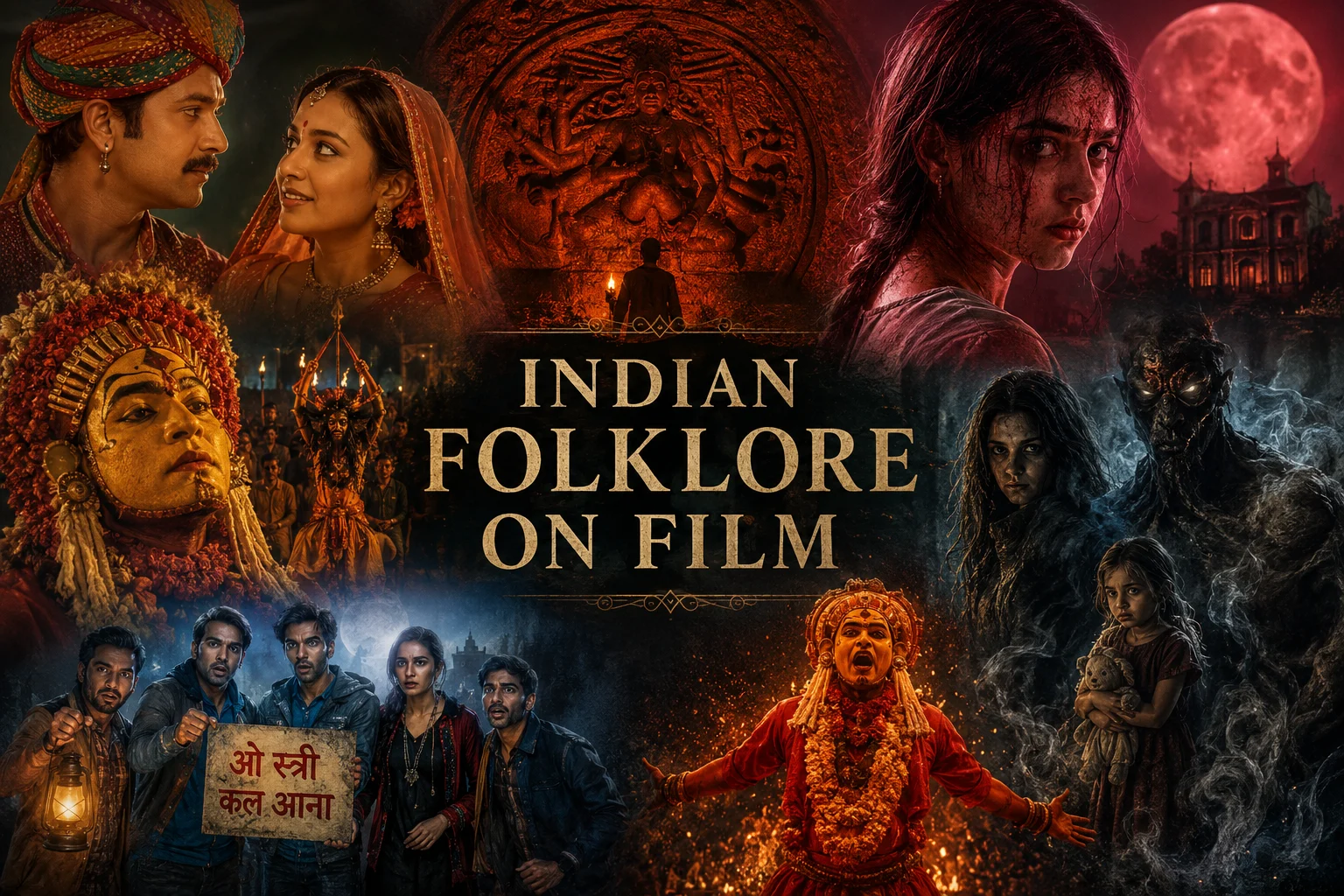
What do a ghost bride, a cursed god of gold and a boar-faced forest deity have in common? They are all proof that Indian cinema has never really let go of the stories whispered around village hearths and temple courtyards.
Long before multiplex theatres and streaming services came into existence in India, stories filled the air. The stories of ghosts floating around in banyan trees, gods masquerading as travellers among people, and curses on villages for bringing about disturbances in forbidden matters were shared by grandmothers. This constitutes the essence of Indian folklore, characterised by oral tradition and regional context.
Each state has its own ghosts, spirits, and cautionary tales that have been handed down through the dialogue of elders around a fire. It is no surprise that the Indian film industry continues to draw on this folklore. Folklore gives filmmakers something that the original script cannot: simple, appealing emotional meaning, fear, or fascination that a certain tale already offers the audience. Seven movies released over the span of three decades prove the strength and relevancy of these old tales.
This article explores how deeply folklore is woven into Indian storytelling, and how these centuries-old legends still hold the power to captivate, unsettle and move audiences today.
Paheli - Love, Borrowed From a Ghost
Amol Palekar's 2005 film Paheli could be considered the softest representation of this genre. Following a Rajasthani folktale that had already been adapted once under the title Duvidha, the film tells the story of newlywed Lachchi (played by Rani Mukherji), whose husband leaves her for a work trip just hours after the wedding ceremony. A ghost, who has been madly in love with her for a long time, takes her husband's appearance and remains near her, giving the woman all the tenderness and affection that her husband was unable to give her.
A story that could have easily developed into horror turns out to be a subtle reflection on loneliness, unfulfilled desires and emotional neglect in arranged marriages. The fact that Shah Rukh Khan plays both the good husband and the ghost only adds to the contrast.
Bulbbul - Beware the Feet That Turn Back
While Paheli expresses longing and sadness, Bulbbul (2020) expresses sheer rage. Anvita Dutt's debut film captures the story of a legendary female ghost called chudail, who haunts the lives of ordinary people. The film's plot focuses on the life of a little girl who is married off to a much older zamindar.
When the girls of the village start getting killed, the people start suspecting a ghost. Dutt's treatment of the chudail legend, however, allows the director to expose the horrors of child marriage, domestic violence, and the cultural norm of women being silent. Visually striking with its blood-red skies and moonlit havelis, the film successfully utilises folk-horror elements to convey far more serious horrors of reality.
Tumbbad - Gold Has a God, and He's Starving
While Bulbbul presents the updated view of mythological stories, Tumbbad (2018) creates its own myth from the beginning and makes it look ancient. This is a work by Rahi Anil Barve in which a forgotten goddess of wealth gave birth to a son, Hastar, who became so greedy for grain and gold that the gods decided to end his life.
However, rather than killing him, the gods decided to curse him so that he is not worshipped and cannot satisfy his hunger for grain throughout his life. Many years later, in the ruined village of Tumbbad, a family possesses a secret about hidden treasure, and the story follows a person who seeks to extract gold from a frightful, womb-shaped temple.
What makes Tumbbad remarkable is how convincingly it mimics the texture of genuine scripture. Hastar was never part of any actual Hindu pantheon, yet the film's world-building, its rituals, its half-remembered warnings passed down by frightened grandmothers, feels lifted from a text that has existed for centuries. It is a masterclass in using the grammar of folklore even when the myth itself is fabricated.
Kantara - The Nature Doesn't Forgive
A discourse on folklore on film would not be complete without the inclusion of Kantara (2022) and its prequel, Kantara: Chapter 1 (2025), both of which were produced and directed by Rishab Shetty. These movies are inspired by Bhoota Kola, also known as Daiva Nema, a ritual performed in Tulu Nadu, coastal Karnataka, that involves the possession of individuals by guardian spirits such as Panjurli and Guliga through a series of spectacular ceremonies.
Kantara is set in the present day and revolves around a reckless villager embroiled in a dispute with a forest officer over ownership of a piece of land. It ends with a gripping possession sequence. Kantara: Chapter 1, on the other hand, returns to the Kadamba dynasty and explains how the daivas of Panjurli and Guliga originated, as well as the connection between a local Raja, a spice plantation, and the daivas who guard it.
Together, the films do something few folklore-inspired projects attempt: rather than merely referencing a tradition, they stage it, letting audiences witness the trance, the drumming and the divine fury of Bhoota Kola as something living rather than archived. The result was not only critical acclaim but a genuine box-office phenomenon, proof that audiences across languages are hungry for stories rooted in specific, textured regional belief rather than generic supernatural tropes.
Stree - Say Her Name, Save Your Life
Stree (2018) takes a lighter, though no less clever, approach. Directed by Amar Kaushik, the film is built on small-town superstition, specifically the legend of a spirit who is said to haunt certain towns during festival season, abducting men who step outside alone at night unless the households paint "O Stree, kal aana" on their doors as a warning.
Set in the fictional town of Chanderi, the film wraps this local legend in horror-comedy, using the genre to sneak in sharper commentary about consent and the fear men rarely have to feel. Stree proved that folklore did not need to be treated with hushed reverence to work on screen; it could be played for laughs, for scares and for social bite all at once, and audiences would still respond, a formula that has since spawned a hit sequel and helped establish an entire cinematic universe built on similar small-town legends.
Pari - Smoke, Fire, and a Mother's Secret
Pari (2018) is a film starring Anushka Sharma that draws on Islamic folklore traditions of Bengal by employing the supernatural lore of djinns, which are believed in Islamic literature to be formed from smokeless fire and to occupy the space between human beings and the eternal. The film is about a young girl whom her mother brings up in isolation,n as her mother was assaulted by a djinn cult several years before, and illustrates how that legacy comes back to haunt her in adult life.
Unlike the charming havelis of Bulbbul and the rustic horror of Tumbbad, Pari focuses more on cults, religious extremism, and trauma inherited from one's ancestors. She showcases how wide the story is in terms of folklore.
The film also stands as a reminder that folklore in India rarely stays confined to Hindu mythology alone; centuries of shared coexistence mean that Islamic, Christian and tribal belief systems have all left their mark on the country's ghost stories, and cinema is only just beginning to explore that wider canvas.
The Takeaway
These seven films demonstrate one major aspect of Indian storytelling. Folklore has not been static here; it is primarily oral and can be changed. What Paheli does for marital desire is what Bulbbul does for patriarchal domination, and greed is what Tumbbad does. Kantara evokes land and Belief, Stree evokes male entitlement, and Pari triggers trauma.
Although the details change, the principle remains the same; old fears and new hopes are there, but they remain relevant due to new audiences. All the above films accept folklore as art or as an effective means of frightening the audience. But each of them lives under the invisible influence of the belief system they use as a source, taking its rituals and warnings very seriously,y so that the magical theme reveals the truth about the reality of deity.
2022 © Milestone 101. All Rights Reserved.