STAY CURIOUS
Keep reading to find the excellency out of perfection and skill.

By: Milestone 101 /
2026-05-20
bollywood
Superfandom: When Fans Become the Story
From Rajesh Khanna and Amitabh Bachchan to Shah Rukh Khan, Salman Khan, and Vijay, Indian fandom has evolved from emotional admiration into a culture of obsession, spectacle, and identity. This article explores superstardom, fan devotion, celebrity mystique, and how modern social media has transformed the relationship between stars and audiences forever.
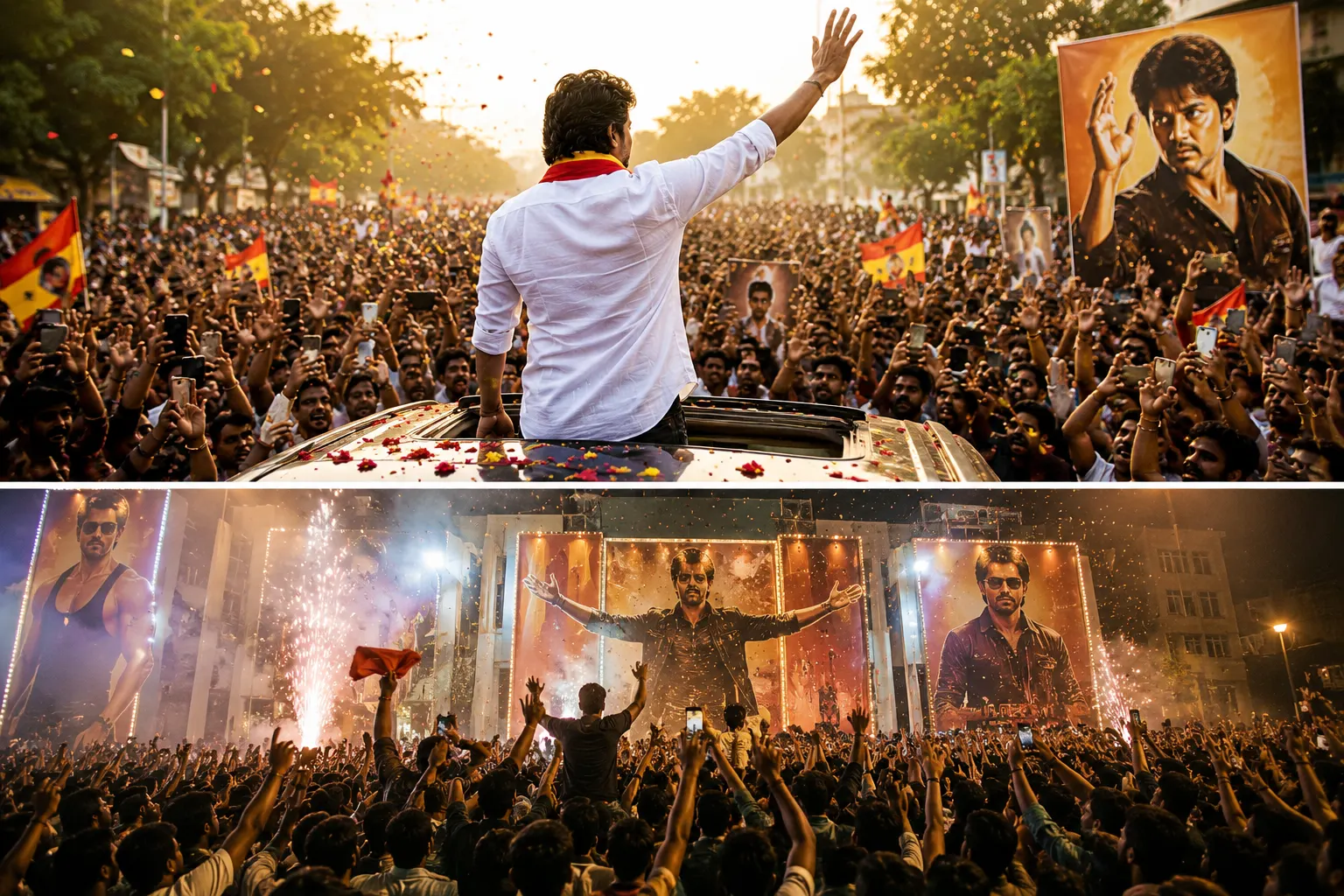
What happens when fandom stops looking like admiration and starts resembling devotion? Earlier this year, during Vijay's political rise in Tamil Nadu, massive crowds followed his rallies with the same hysteria once reserved for blockbuster openings. Thousands ran behind his motorcade, fans travelled across states for a brief glimpse of him, and several tragic incidents reportedly unfolded around campaign events, including a deadly crowd crush in Karur and a fan's death linked to a Salem rally months later.
What made these scenes striking was not just their scale, but their emotional intensity. These were no longer ordinary political supporters; they were emotionally invested devotees blurring the line between cinema, identity, and belief. Indian stardom, after all, was never built merely on admiration. At its peak, it thrived on emotional surrender.
When Stars felt Untouchable
Once upon a time, Indian film stars were not as easy to connect with as they are now in celebrity culture. Back then, they had more of a distant, mythological, or even "unreal" feel. The public did not know the details of what the stars ate for breakfast, where they went on holiday, what kind of slippers they wore at the airport, or which gym they went to each evening.
The only places you could see them were in movies, on magazine covers, on posters, on television, and at very few public appearances; thus, the audience spent the majority of their time imagining them rather than constantly consuming them, which created the obsession.
As an example of this, when Rajesh Khanna became India's first true superstar, the stories that surrounded him ceased to be about fandom and began to take on the form of folklore; it was reported that women married his photographs, wrote him letters using their own blood, and smeared lipstick on his photographs until the photographs looked red.
One of the most frequently retold stories from that era was how female admirers had surrounded his automobile after he left the hotel where he had been staying. When he stepped out of the vehicle, it was completely covered with lipstick kisses. It became irrelevant how much or how little of these stories was true because the myth surrounding Rajesh Khanna was integral to his stardom. He wasn't just an actor anymore; he had transformed into a national ideal.
After Rajesh Khanna came Amitabh Bachchan, and there was another shift in fandom. When he was in a near-fatal accident while filming 'Coolie’ in 1982, the entire country responded as though they had lost a member of their family. Prayers and puja (ceremonies) were performed in temples for his recovery. Families fasted in support of his healing. Newspapers regularly printed updates from the hospital and treated it as if it were a matter of national importance.
Throughout those days, thousands of people continued to come to Breach Candy Hospital to see if the doctors would have good news about his recovery. Even today, thirty years later, hundreds still visit Jalsa every Sunday, hoping for the opportunity to see him waving down at them from the balcony.
The tradition of doing this has continued over several generations. Furthermore, the hysteria surrounding Amitabh Bachchan's near-fatal accident was not confined only to Bollywood fans.
The South's Superstar Culture
Star power has been closely linked to emotions and theatrics in South Indian cinema, whereas for most Bollywood fan bases, it is nothing but performative. The way the followers of Rajnikanth would pour milk onto large image cutouts of him before film releases was similar to temple ceremonies.
His fans worshipped N.T.Rama Rao, for his portrayal of Hindu deities, would often conflate his role as a god with his role as an actor emotionally.
After M.G.Ramachandran's passing, reports indicated that devastated fans had committed suicide because they could not emotionally cope with losing him. Today, when Allu Arjun, Yash, Prabhas, or Jr. N. T. R. releases a new project, theatres throughout parts of South India look like a cross between political rallies and religious festivals, with bike processions, large image cutouts, drum performances, firework displays, and fans dancing outside the theatre during an early-morning screening.
Even the political rise of Vijay proves that this culture still exists in the South at a scale Bollywood no longer fully commands. His party workers and fans did not behave like ordinary supporters during the election season. They behaved like emotionally invested devotees who saw his political victory as personally meaningful. And perhaps that is exactly why his rallies became so overwhelming and chaotic.
Moreover, a 28-year-old Vijay fan, living in Krishnagiri District of Tamil Nadu, attempted suicide after hearing false exit poll results indicating the defeat of Vijay's Party (TVK) prior to the election count taking place in May 2026. Residents found him with his throat slashed and hospitalised him as they were not able to stop him from doing so.
When Fans Crossed the Line…Literally!
Indian celebrity culture has a long history of creating situations in which adulation becomes an obsession, leading to chaos, invasion, and sometimes even fear for celebrities themselves. For example, Hrithik Roshan was mobbed by fans at the premiere of his film, Bang Bang, where he was physically pulled from the crowd by security, and Shahid Kapoor recalls female fans waiting outside his house for hours and sending him bloody letters proposing marriage when he first became a television heartthrob.
A famous example is Dharmendra, who received numerous marriage proposals and fan pictures daily while at the height of his fame.
Asha Parekh experienced one of Bollywood's most disturbing stalking incidents when a Chinese fan reportedly camped outside her house,e insisting he wanted to marry her, threatened neighbours with a knife when they intervened, and forced the actress to call the police commissioner for help.
Even after being jailed in Arthur Road Jail, the man allegedly continued sending her letters asking her to bail him out, while Parekh later admitted the experience terrified her so much that she began hiding inside her own car while entering her home.
Hema Malini regularly attracted unruly crowds outside film sets in the 1970s, and Deepika Padukone has dealt with fans breaking through security barricades to touch her.
A fan who wanted to marry Aishwarya Rai Bachchan once tried to force his way into her ho by claiming he would marry her. During her peak in the 1990s, Raveena Tandon experienced throngs of fans as an actress. Sridevi inspired such devotion that one fan wrote her thousands of letters; he also believed he was married to her. Many people from Madhya Pradesh made the trip to pay their respects to her when she died; one travelled nearly 750 km (466 miles) to attend her funeral.
In one of the most remarkable stories about fans in Bollywood, a woman from Mumbai left nearly ₹72 crore (over $10 million) worth of property to Sanjay Dutt in her will. She had never met him before, but he returned the assets to her family after her death. Akshay Kumar has also had fans climb over barricades and attempt to chase him down while he was out promoting his movies.
All of this demonstrates the wide spectrum that exists with respect to how Indians relate to "heroes" and their associated behaviours, from admiring, being emotionally dependent and obsessively pursuing.
Like Sachin Tendulkar's Sudhir Kumar Chaudhary, who travels extensively around India, painting himself in the tricolour while attending games with an Indian flag, there is a high level of emotion surrounding support for all sports in India. Many fans admire MS Dhoni and also have a massive digital following for Virat Kohli.
However, the current celebrity culture associated with sports appears more disjointed and dispersed because digital technology has dramatically changed how fans consume, compared with how they used to consume stars or celebrities. Therefore, many fans view stars/celebrities as emotionally very distant from them, as a fantasy. Nowadays, many fans perceive that they have access to stars/celebrities because almost all celebrities are constantly available to them online.
The Last Bollywood Superstars
The last phase of truly gigantic Bollywood superstardom probably belongs to Shah Rukh Khan and to some extent Salman Khan, because they rose before social media destroyed the mystery that once protected celebrity culture.
Stories about Shah Rukh Khan are reminiscent of a time long gone when fandom was of another kind. There were instances when groups of female followers would trail him from one country to the next, simply out of obsession with him.
Even at Mannat, people continue to gather outside hoping to see him on the balcony every day. On his birthday, fans gather at Mannat in hopes of catching a glimpse of him. When 'Pathaan' was released, fans celebrated outside of theatres at the first showing of the day as if India had just won a cricket World Cup.
Salman Khan's fans hold blood donation drives every year to celebrate one another and their love for him. During peak box-office hits like 'Wanted' and 'Dabangg,' fans have been known to throw change at the screen, dance in the aisles of the theatres, and engage in traditional public affection on the first-day-first-show instead of just viewing them as entertainment.
However, while these celebrations still happen today, people feel differently about modern-day stars than about stars from earlier generations.
Too Much Access, Too Little Aura
There's a misconception that the rise of social media and our increasing ability to connect with celebrities on that platform have resulted in new heights of fame, when in fact social media has flattened celebrity and made celebrity content more widely accessible. Audiences used to create images of stars as standing in stark contrast to everyday people and thus, filled in those spaces/confused areas with dreams, intrigue, and illusions.
Audiences had no idea what actors ate at home, what clothes they wore casually, where they went on vacation, or who came to their houses for late-night visits. The proverbial "mystery" surrounding their lives led to a larger-than-life image of them.
A rare magazine interview featuring Shah Rukh Khan once felt valuable because audiences were receiving limited access to someone who otherwise existed behind cinema screens and carefully controlled appearances. Today, that same distance has disappeared completely. Celebrities upload Instagram stories from their living rooms, paparazzi photograph them outside gyms and airports every day, and audiences know what brands they promote, what coffee they drink, and where they travel almost in real time.
Earlier, fans waited outside theatres, collected posters, bought film magazines, and watched films repeatedly to feel connected to stars because devotion required patience and effort.
Now, the relationship between celebrity and audience has changed due to the permanent visibility of previously elusive stars through the constant availability of content (memes, reels, advertising, trending and viral videos).
We no longer view actors as an illusion; instead, we view key performers (e.g., Ranbir Kapoor, Ranveer Singh, Kartik Aaryan, Tiger Shroff) from the standpoint of their visible personalities and, therefore, the amount of hysteria that accompanies these performers is significantly less than previous generations since today's audiences are not worshipping the myths those performers projected but rather consuming a steady stream of their visible persona.
The Fall of Hollywood Mystique
The decline of the Hollywood film industry came much before, when celebs such as Marilyn Monroe, Elvis Presley and James Dean created frenzied crowds, public breakdowns, obsessive fanaticism from their fans and national hysteria.
Women would faint while watching Elvis perform. Marilyn Monroe would cause massive traffic jams simply by appearing somewhere. Modern celebrity culture in Hollywood is emotionally flat due to a lack of separation from pop culture, stemming from excessive exposure over the last 20 to 30 years.
India's film industry is quickly reaching the point where its classic stars are devoid of emotion; older stars have more emotional clout than newer ones. When Shah Rukh Khan waves at audience members from the balcony of Mannat, or Amitabh Bachchan walks out onto the balcony of Jalsa, you see an audience reacting not just to the actor anymore, but rather to the last remaining semblance of the type of celebrity status that may never be replicated again. Yes, the stars still exist; however, their aura of celebrity is now missing.
The Takeaway
Although Indian films produce celebrities, it no longer has an overwhelming religious or mythological effect on individuals in the same manner as before. Past generations created a strong bond with their fans through a combination of fantasy, distance, emotional experiences with film, and imaginative speculation, building a fanmania characterised by irrational behaviour, excessive adulation, and a deep sense of personal responsibility.
Fast forward to today, and we see a different reality: where accessible celebrities are visible all the time, and there is no longer any mystery about them; the "celebrity aura" is diminished tremendously when a celebrity is readily accessible and never out of the public eye.
As such, superstars like Rajesh Khanna, Amitabh Bachchan, Shah Rukh Khan, and Salman Khan seem less like what we think of as celebrities and more like the very last fragments of what we remember about celebrity fandom (and how it has evolved) in today's world.
2022 © Milestone 101. All Rights Reserved.