STAY CURIOUS
Keep reading to find the excellency out of perfection and skill.

By: Milestone 101 /
2026-05-20
bollywood
The Saviour Complex: One-Man Army Syndrome
From Singham and Dabangg to Article 15 and Uri, Bollywood repeatedly turns complex social crises into stories of lone heroes fixing broken systems. This article explores the rise of the “One-Man Army Syndrome,” why audiences love saviour figures, and how these narratives shape ideas about leadership, justice, and collective responsibility.
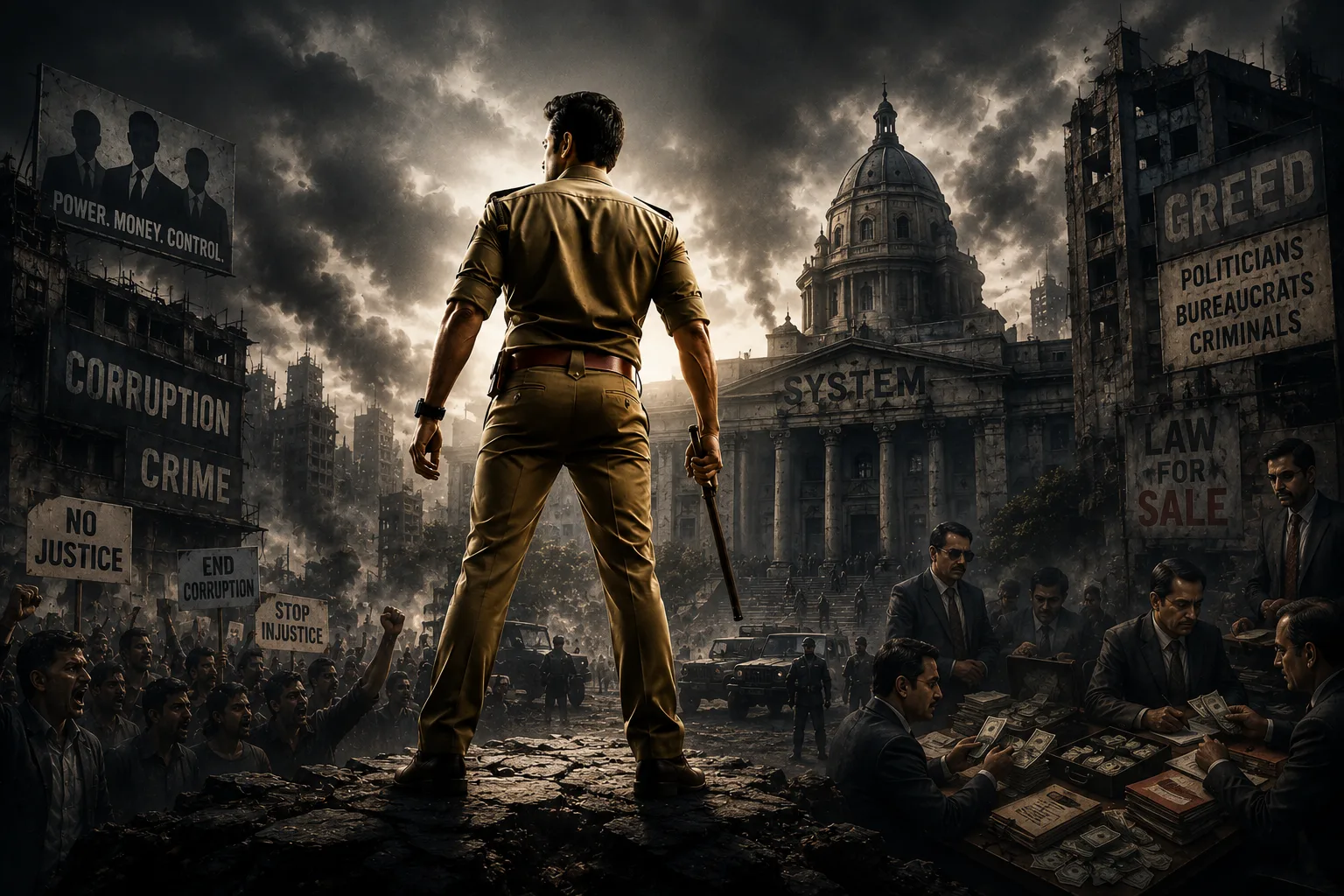
What happens when cinema convinces us that one man can fix an entire broken system? Bollywood often uses the concept of a hero who can overcome chaos, study the system in mere hours, and succeed where other institutions fail, including corrupt police departments, the oppressive caste system, and threats to national security. For instance, the movie Cuttputlli depicts a single police officer solving a serial killer case with very little assistance from the institutions around him. At the same time, Article 15 portrays the moral journey of a police officer as he reflects on deeply entrenched caste issues.
The cop in Singham has to rely on pure willpower and strength to restore justice, while in Dabangg, Rowdy Rathore, and Holiday: A Soldier Never Off Duty, a single hero can prevail against a failed system. The stories tell us an emotional and gratifying narrative of a person, but simplify the complexity of our real world through the "One-Man Army Syndrome" concept.
Why We Love the Saviour
This pattern works so well because viewers don't recognise how simple it is; they see that life usually doesn't give you clear, quick solutions and all those feelings are wrapped into one character.
For example, in the Salman Khan movie "Dabangg," you are not focused on all the red tape and details of how the legal system and law enforcement work. You are watching a guy who makes it happen with his gut, his charm and his power, creating a world that makes it feel like all the problems can be solved because someone is making it happen. This sense of emotional clarity can also be found in other films like "Kick," where the hero's big-time actions hide the complicated crimes against him, and "Wanted," where the hero drives nearly the entire story with his power over the system.
A cultural narrative that influences all of our lives and is an appealing aspect of how cinema celebrates masculine traits (such as decisiveness, control, and authority) allows for individual heroes acting alone in their own singular situations to showcase the idea of individual action being more powerful than collective actions (a pattern that has risen from Amitabh Bachchan's "angry young man" in movies such as Zanjeer and Deewaar to represent defiance against systems that no longer exist).
In addition to a cultural narrative, filmmakers have a practical reason for developing narratives around a single main character: it allows them to advance the storyline quickly because they do not have to consider numerous perspectives on the true protagonist. Thus, Gabbar Is Back and Satyameva Jayate may create narratives that resolve grand social conflicts with a single protagonist addressing corruption, leaving viewers feeling they have seen only a simplification of the story.
So the saviour narrative persists not just because it is ideologically appealing, but because it is emotionally efficient and narratively convenient, offering audiences a clean and controlled version of a world that is anything but.
The Shortcut: Turning Systems into Personal Battles
The main flaw of having one person solution to every problem is that the real problem is reduced into something that can be resolved by one person, usually meaning that the issues created by the complex systems in society are stripped away and transformed into challenges that can be conquered by bravery, cleverness, or brute force (using a lot of work, but giving us no value for that work).
In certain movies, like article 15, we focus on the moral journey of a police officer even though caste system oppression is a major societal problem not easily solved through one person's actions; as is the case in the movie Anek, where the protagonist, with the audience as a guide and ultimately the problem-solver, must navigate the social complexity of identity and politics in India through one character alone.
This reductionist approach is even more pronounced in other films, such as Laxmii, which has one character, played by Akshay Kumar, go from being a lesser character to a greater character, rendering the audience's desire for representation irrelevant and focusing on individual redemption; and also in other action based narratives, such as Baaghi or Heropanti, where the entire crime, or chain of command, is broken down, leaving only one successful character remaining and relying on that character's strength or virtue to provide resolution to the story.
Even films that attempt to address governance and national security, such as Baby or Uri: The Surgical Strike, often centre their narratives on a few key individuals, compressing institutional efforts into personal heroics, which makes for gripping storytelling but also reinforces the idea that systems succeed only when exceptional individuals lead them.
Across all these examples, the pattern is consistent: the system exists but is secondary, while the individual becomes the primary force of change, allowing complex realities to be simplified into stories that are easier to tell and consume.
Who Gets to Be the Hero?
Once this pattern begins to be mapped, it is clear that the saviour archetype often has a specific element of conformity that forces consideration of their own storytelling and representation, as well as power dynamics in which one character has unequal power to "save."
In many films, such as "Article 15", the protagonist is depicted as an outsider who is not directly affected by the situation but feels an ethical obligation to get involved in a way that sidelines individuals who are affected by the issue where they are affected. As a result, people experiencing a problem become passive recipients of change rather than active participants in that change.
Across all genres of storytelling, there appears to be a pattern of outsiderness in both the police dramas ("Singham" and "Sooryavanshi") and the vigilante stories ("Gabbar Is Back"). In both types of narratives, heroes are portrayed as operating outside the system and presenting themselves as authorities to address situations that are either too complicated or too corrupt to be treated as community issues.
Even in films that centre on women or marginalised groups, the narrative often circles back to a dominant figure who drives the resolution, which reinforces the idea that change must come from a position of power rather than from within the community itself, shaping not just the story but the audience's perception of who holds agency in the real world.
When Cinema Starts Shaping Reality
Narratives displayed via film have influenced how people view their actual problems/dealings. When film repeatedly shows inoperable systems and individuals as the only ones capable of changing them, it fosters the belief that collective action is ineffective and that strong, decisive actors are needed to lead change.
Films such as "Singham" and "Satyameva Jayate" distort justice by depicting a hero who rushes through a seemingly bureaucratic process and delivers almost instantaneous results. While this may bring emotional satisfaction to some viewers, there may also be an unrealistic expectation regarding how government and accountability function.
Additionally, there is a general culture of hero worship. Therefore, over time, audiences link individual achievement/heroic acts to effectiveness (through charismatic individual traits) and devalue any degree of collaboration/collective process in the formation of leadership outside of film.
Stories That Do It Differently
Although most cinematic narratives are built around a hero who saves others, some films significantly diverge from this pattern, thus offering an alternative means of storytelling through presenting a more complex, layered structure of system/community/cross-pollination reference points.
Films, such as Talvar, demonstrate various ways to interpret the same case, and as such, do not come to an agreement about any particular truth; Jaane Jaan creates tension by using many different characters as opposed to one main character; and Raazi uses one main character's actions to create a web of relationships to demonstrate how intelligence and strategy affect each other.
These types of stories may not have the same definitive resolution that typically comes from a hero saving another; however, they more accurately reflect the realities of our world, where change emerges from the interplay of multiple forces working in concert, rather than from the efforts of any single entity.
The Takeaway
Although the one-person army archetype can be readily embraced because it aligns so well with film language, its ramifications extend well beyond the story itself. The one-person army archetype creates an overly simplistic view of reality, in which systemic problems can be resolved through single-person intervention and collective effort becomes a secondary concern, or even less than a critical consideration, thereby affecting how audiences perceive leadership, governance, and social responsibility.
This does not mean that the saviour narrative needs to be discarded; it still has a role in storytelling; however, it must also be augmented with narratives that illustrate ambiguity and large systems or highlight the importance of collective efforts.
If cinema continues to depend solely on the myth of the knight on a white horse fixing everything, it will ultimately lead to a paradigm in which audiences expect to find solutions for problems individually, as opposed to through a collective, institutional approach; and where the concept of pulling together, as a group, will not appear to be of as much interest as the fantasy of one person saving the day from an isolated location.
2022 © Milestone 101. All Rights Reserved.