STAY CURIOUS
Keep reading to find the excellency out of perfection and skill.

By: Milestone 101 /
2025-12-06
bollywood
The Ultra-Rich Wedding Playbook: When Marriage Meets Showbiz
A look at how ultra-luxury Indian weddings shape social expectations, influence middle-class spending, and blur the line between celebration and spectacle. The article explores the cultural pressure created by hyper-viral, extravagant events and how these trends redefine what a “perfect” wedding is supposed to look like.
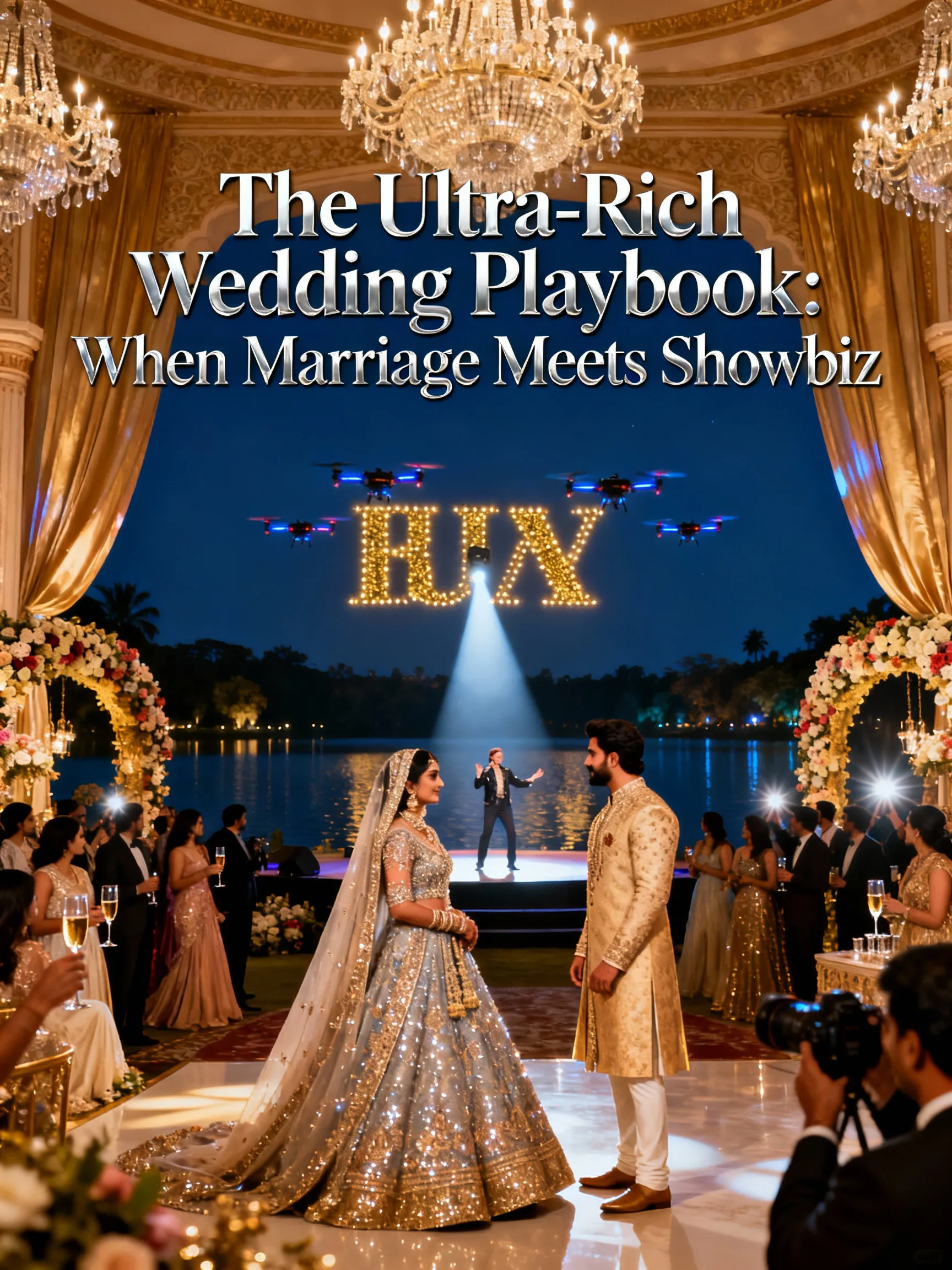
Paparazzi flash at silk-draped pathways while a star shines on stage before public applause for the star. The stars’ initials are in gold sparkles in drone formation above the lake. Visitors come to the event dressed like they are movie premiere actors, with every sari glistening and every tuxedo so tailored for social media feeds. Music grows increasingly loud, and the world is waiting with bated breath.
Except this isn’t a movie. This is a wedding.
In the past, weddings in India were all about families gathering together to perform rituals. In recent years, families of the upper class have created entire wedding productions that can last multiple days, blending hospitality, performance art, celebrity glitz and glamour, fashion, and luxury.
A shift occurred in this type of wedding in India, where weddings shifted from a celebration of family and the wedding day to high-priced entertainment for the very wealthy. A wedding is not just the marriage of two people but is a marketing statement for the ultra-rich. It has become a global headline and a legacy in photographs and videos that can go viral.
These events combine hospitality, celebrity culture, high fashion, world travel, and entertainment into a marriage of all these types. No longer are they family events. They are designed to excite, influence, and be remembered by those who attend.
The focus of this article is on weddings as showbiz events. Their rationale, development, and relationship to ambition and memory are related to Modern Indian luxury. This article explores immersive venue concepts, celebrity performances, a curated aesthetic, branded products, and the cultural ramifications of large-scale events. Case studies supporting this discussion shed light on the marriage market as a luxury-based performance.
Understanding India’s Luxury Wedding Boom
Originally exclusive to indigenous culture and tied to community facilities, Indian weddings have exploded into an enormous global marketplace. As India has become an increasingly affluent society and as Indians have developed a greater sense of "entitlement" and "experiencing life," the amount of money spent on Indian weddings has grown exponentially.
Recent studies demonstrate that the Indian wedding marketplace has grown to approximately ₹10.79 lakh crore, roughly double that of the United States' wedding marketplace. Analysts believe the wedding industry will continue to expand by 6.5-7% annually through 2025 due to increased demand for luxurious designer wedding attire, custom-made wedding experiences, and extravagant vacation weddings at remote, scenic locations.
Why is this growth occurring? Several factors are contributing to the development of the Indian wedding industry, including the rapid increase of affluence among Indians, exposure to Western cultures, the influence of social media on market trends, and the need to leave a legacy/reputation through lavish weddings. Wedding-related purchases in India span multiple industries, including but not limited to jewellery, fashion, catering/hospitality/event planning & travel, and account for a large share of consumer spending.
Many families regard an Indian wedding as far more than just the joining of two people. Wedding celebrations serve as a means to reflect the family’s social status and the level of wealth or prestige they may possess. Thus, the demand for exotic wedding locations is high. Couples who are getting married are moving away from the more traditional options of community centres or banquet halls to seek out grand palaces, stunning/unforgettable historical forts, stunning beaches/private islands or even on board cruise ships as the location for their wedding celebration.
A recent trend report estimates that weddings in emerging destinations — silent hills, beach retreats, forest resorts — are becoming popular among those seeking exclusivity and privacy alongside luxury.
This shift from “traditional big fat wedding” to “immersive luxury experience” reflects a more profound transformation — weddings have become lifestyle events, aligned with global luxury culture rather than confined to regional customs.
It’s not just the location or décor that’s changed. The mindset has. Weddings are now seen as experiential journeys, curated by planners, stylists, and event-design experts — similar to film productions.
Weddings as Entertainment Productions
Walk into any of these ultra-luxury weddings today, and you’ll feel less like a guest at a family affair, more like a VIP at a music festival or a gala premiere.
Celebrity Performers & Guest Lists
The most noticeable evolution is the type of guests and performances represented at many weddings today. Previously, Bollywood stars and international pop and other global celebrities were guests; now, it is common to see them performing as entertainment at these events rather than just attending.
Hiring a celebrity as a wedding guest is not a new phenomenon; it began about 15 years ago and has undoubtedly grown since then. For example, during the wedding of Anant Ambani and Radhika Merchant, international artists are said to have performed, and many dignitaries were invited to the event.
The recent wedding of Netra Mantena and Vamsi Gadiraju, held in Udaipur, also shared the debut of this new phenomenon, as it was a major event filled with many elements of popular culture and celebrity glamour. There were many famous people at the sangeet, including several high-profile guests, all of whom participated in the performances.
Bollywood legends Salman Khan & Shah Rukh Khan made the internet go into a frenzy with a video of the two dancing together at a Delhi wedding to the 90s hit song "O O Jaane Jaana." What truly made this moment so shareable was its rawness: just two superstars spontaneously dancing to the music while surrounded by guests and dancers. It was like we were watching a late-90s film unfold before us. The video went viral on social media, with fans revisiting the moment in a mix of nostalgia and disbelief.
Watching Salman perform a song that was a defining moment for him, and seeing SRK match his every move, was something many did not foresee but many desired. The two's relationship over the years, along with the easygoing chemistry they share, contributed to the video's overall viewership. The unchoreographed moment of joy, combined with the current curated celebrity appearances, may have made it difficult. The spontaneity reminded fans of the power these two men have to make them take notice and stop scrolling.
Also, Salman Khan and Shah Rukh Khan earn astronomical sums for their presence at weddings and private events. Reportedly, Salman charges in the range of ₹3-4 crores (depending on the size and scale of the event) if he is booked to perform or attend a high-profile gathering. On the other hand, Shah Rukh Khan is expected to charge an average fee of ₹5-6 crores (on the high end of the scale, making him one of the most sought-after Bollywood actors to appear at private or social gatherings).
Production Values: Lighting, Stage, Drone Shows
A wedding is not just an event; it's a grand production. There are a multitude of elements that come together to create a successful wedding: wedding planners provide choreographed elements, staged sets or designs, and lighting specifically designed for that event; filmmakers produce movies or music videos that feature those weddings.
The venue has shifted from a traditional hall to a more "palace"- style setting, with luxurious decor and high-end amenities for each couple. As seen in reports on high-end wedding venues, many weddings now offer clients a new "venue takeover" option, allowing them to "take over" an entire city or location for a week, creating a unique atmosphere and experience. These "takeovers" take place in beautiful settings, such as private islands or historic fortresses, with a specific focus on bespoke decor, lighting, and hospitality.
Weddings today go beyond a couple being surrounded by family and friends. A team of dedicated professionals is behind every significant visual effect associated with weddings, and every detail of each wedding is the responsibility of multiple professionals in the industry. Therefore, weddings today have become more like commercial photo shoots or movie sets than simply social gatherings.
Gastronomy & Couture: Luxury Is in the Details
The treatment of food and fashion on screen is equally luxurious. Nowadays, couples are opting to hire high-end chefs and/or to provide Michelin-star-quality catering, preparing a globally inspired menu for their guests to enjoy. According to a recent industry article, weddings in India in the luxury category feature elaborate food displays (individualised, unique plating), live kitchens, and artisan-level service for their guests.
Attire development has evolved from traditional lehengas and sherwanis to creating custom-made, uniquely designed capsule wardrobes for each event. Couture is regarded by many not only as an expression of personal style but also as a representation of the ceremony's aesthetic and the identity of the brand associated with it.
While these weddings are about Love, they are also about Experience and Design. The unions that have taken place at these events are only a small part of a much larger "production".
The Signature of Personalisation — Branding, Memory, Identity
Behind the glitz and glamour lies a more profound cultural shift: from spending to storytelling; from opulence to personalisation. For ultra-rich couples, what matters is not just “how much was spent,” but “what was experienced.”
Custom Branding & Signature Elements
Couples are increasingly looking for ways to create a wedding as a “branded experience”. This means creating custom monograms, logos, and motifs, as well as designing unique signature scents that are repeated across invitations, décor, gift boxes, and other forms of Social Media collateral.
Some weddings treat invitations almost like movie trailers or press kits. For example, guests may receive leather-embossed boxes filled with curated playlists, couture gift boxes, and other items related to or appropriate for the wedding they are attending or are invited to attend. Others create capsule collections of clothing for themselves and their guests to wear at special events such as sangeet, haldi and reception (for example, outfits, jewellery, shoes, etc.).
This level of (personalised) wedding branding creates a more curated experience for the couple rather than just a ceremony.
Psychology Behind the Shift
Why put in all the effort? In today's society, there are so many status symbols (real estate, luxury cars, yachts) that the ultra-wealthy are seeking even rarer status symbols, such as emotional memories and experiences, as well as exclusivity, uniqueness, and so forth. The wedding should be viewed as a story, and couples will share their stories however they choose (publicly or privately).
By creating a bespoke event, the couple can ensure that every single detail — obviously, from lighting to music to guest experience — reflects who they are as individuals and what they stand for. The wedding will become an extension of their brand.
This is also a robust social signal. Within a social circle where wealth has already been established, it is the curation of a couple's taste and the vision of their wedding that will help them stand out from the crowd. A wedding like this sends the message that they not only have resources available to them but also the ability to create their own unique experiences.
Case Study 1: Anant Ambani & Radhika Merchant’s Wedding
If there is one wedding that defines the new era of ultra-rich Indian weddings, it is the union of Anant Ambani and Radhika Merchant.
The six-day extravaganza — held in July 2024 across multiple venues, including the gleaming high-rise home of the family and the expansive Jio Convention Centre in Mumbai — was described by some as “India’s own royal wedding.” Estimates range from USD 600 million to USD 1 billion.
Scale & Production
Months before the wedding, several pre-wedding celebrations were held. The first pre-wedding event reportedly took place in Jamnagar, with approximately 1,200 guests, and featured performances by top Bollywood and international celebrities.
The second pre-wedding celebration was a four-day Mediterranean cruise that included surprise performances, yacht dinners, and elaborate decorations. The final wedding and reception took place in Mumbai, with a guest list of celebrities that consisted of many business leaders, international celebrities, political leaders, film stars, sports stars, and leading entrepreneurs from across the globe.
Guests arrived at the wedding and reception by private jet, were transported to the venue in luxury cars, and were welcomed with red carpets. The planning and execution of these large-scale pre-wedding events were similar to those of a major event.
Couture, Glamour & Guest Personas
Celebrities arrived at the event dressed to the nines as if it were a global gala, and each outfit was more sophisticated than the last. Several reports have stated that most attendees arrived in custom-made apparel featuring personalised motifs, coordinated colour palettes, and couture details specifically designed to complement the visual theme. Not only were the newlyweds the focal point of this wedding, but each attendee contributed to the beautiful overall aesthetic. All aspects of the wedding — including decorative elements, light fixtures, stage design, and floral design — were deliberately designed together to express a unified vision. The wedding felt more like a grand movie set than a traditional venue.
Why It Matters
The Ambani wedding has redefined weddings as we know them in India. This wedding has set a standard (or a standard that is too high) for luxurious weddings. It has immediately become the "model" for all destination weddings, including celebrity appearances, high fashion attire (couture), hospitality services and products, global networking capabilities, and media events.
The Ambani wedding has provided families with wealth and luxury wedding planners and designers with an entirely new approach to planning weddings. More importantly, the Ambani wedding also represents changing values in society regarding weddings; weddings are no longer just private family meetings, but are now public events, brands, opportunities to create a legacy, build a network of friends and family, and solidify status.
Case Study 2: Netra Mantena & Vamsi Gadiraju — Udaipur’s Pop-Culture Fairytale
A few months after the Ambani affair, the Udaipur Wedding of Netra Mantena, Daughter of a Billionaire Indian Pharmaceutical Manufacturer, and Vamsi Gadiraju, a Tech Entrepreneur, captivated the Indian and Global communities and transformed the City of Lakes into a Pop-Culture Carnival.
Though the venue rates for the main palace (Jagmandir Island Palace) were quoted as being approximately ₹75 - ₹90 Lakh (before add-ons), the full cost of the wedding was said to have exceeded several crores when considering items such as celebrity fees, décor, hospitality, and other premiums.
Celebrity Glamour Meets Global Pop
Bollywood celebrities took part in the sangeet and pre-wedding festivities, followed by an unbelievable finale: Global pop star Jennifer Lopez. According to reports, Lopez received a sizable sum to perform exclusively for the wedding.
The guest list included more than just India’s elite; it also included celebrities from around the globe and wealthy people from all over to make it a truly global event.
Many onlookers witnessed an extravagant four days of transformation into a fairytale with flowers everywhere, majestic palace-like surroundings, custom experiences for every guest, live entertainment, and an ambience reminiscent of a music festival rather than a wedding.
Why This Wedding Resonated
The Ambani wedding exemplified old-world opulence and elite old-money networking, whereas the Mantena-Gadiraju ceremony showcased a blend of contemporary pop-culture luxury and youth-lifestyle wealth.
Ultra-wealthy weddings in India can take on a plethora of formats; they no longer adhere to a singular template. Ultra-wealthy weddings can blend classic palaces with numerous forms of today's pop culture, indigenous regional architecture with the elegance and sophistication of global culture (and a mix of classic and modern), and a union of traditional elements with contemporary lifestyle aspirations.
Additionally, mega-wedding celebrations can occur around vibrant new money (for example, entrepreneurs, successful extended family members globally, and technology founders) rather than remaining limited to classic family wealth (dynasties).
Case Study 3: Yashaswini Jindal & Shashvat Somany — When Power, Politics, and Pop Culture Shared the Dance Floor
Naveen Jindal's daughter, Yashaswini, and Shashvat Somany's wedding in New Delhi is an example of the extravagant celebrations of certain ultra-wealthy Indians. The old tradition of using breeding and education combined with the ability to go viral on social media is now creating more "public" occasions than private ones.
Yashaswini, the daughter of Naveen and the renowned Kuchipudi dancer Shallu Jindal, drew upon her extensive classical dance training at Ivy League colleges, such as Yale, and received numerous cultural and educational opportunities before her wedding. Likewise, Shashvat Somany, from a prominent family of successful businesspeople, has a strong worldview and holds a leadership position at Somany Impresa Ltd. through his education in both the United States and Europe. The marriage appeared to be between two well-established business families, but was ultimately a cultural event on social media.
The extensive detail assigned to every aspect of the wedding, from the guest experience, the décor, and the way the celebration was staged, was indicative of the substantial money invested in the event. What created "viral" interest was simply spontaneous human experiences shared around the world. An example is the video of Naveen Jindal dancing with his brothers and sisters to a Daler Mehndi song, showcasing their love and camaraderie, which garnered millions of views. It offered a rare glimpse of billionaire patriarchs letting go, and audiences responded to that authenticity far more than to crystal chandeliers or couture lehengas.
Then came the moment that blurred lines far beyond wealth. Political adversaries Kangana Ranaut, Mahua Moitra, and Supriya Sule were filmed dancing together to "Deewangi Deewangi" amid heightened tension among political parties in India. In addition to being seen as a celebration of marriage, it quickly became a cultural statement due to its political implications.
Why This Wedding Resonated:
Unlike past ultra-rich Indian weddings, which focused mainly on exclusivity or distancing from "commoners", the Jindal/Somany wedding is more representative of today’s elite weddings; it is positioned at the intersection of politics, populism, and participation. Hence, the purpose of this wedding was not simply to show off how much money they had, but to create a culturally current moment and re-establish the perception that Indian ultra-rich weddings are "culturally-rich".
Why Luxury Weddings Are Becoming Experiential — Not Just Expensive
If you step back and look at the bigger picture, what’s clear is this: for the ultra-rich, luxury weddings are no longer about how much you spend. They’re about what you create.
Cultural Capital & Social Signalling
The rich are no longer showing off their wealth through their extravagant purchases; rather, what is now valued is a sense of style, thoughtfulness, and the ability to create an experience that is both unique and meaningful to each participant. This way, weddings serve as the ultimate expression of that ability. Every element of a wedding reflects family heritage, tradition, and standing in the community. Additionally, weddings tell an individual who they are based on their overall design, selection of music, guest list, and where they marry (location).
If you belong to an old-money family, your wedding serves as a testament to the continuity of your family name and the long-term business relationships that your family and others have established. On the other hand, if you belong to a newly wealthy family, your wedding provides you with an opportunity to enter elite social circles, signify your place in those circles, and influence how others view your family name. Therefore, in both instances, a wedding transforms from a merely ceremonial event into a cultural representation of who the couple is.
Memory, Emotion & Personal Branding
Although money can provide experiences and a standard of living, it is only suitable for a very short time. On the other hand, memories can go far beyond the lifetime of any physical object. What people carry with them through their lives is how they felt in certain moments. For example, they remember when a drone show lit up an otherwise quiet lake at night, or when a music show surprised them by having a singer they were a massive fan of perform live. They also remember walking through the palace's hallways, with chandeliers hanging from the ceilings of every room. All of these types of memories can last a lifetime, not just the visual, because the emotions behind them are so powerful.
In addition to the two marriages, every wedding, regardless of culture, creates a moment that will shape how the two individuals perceive the rest of their lives as they reflect on it. As social media, Instagram, etc., continue to be primary sources of documentation for every life event, weddings will no longer be solely private memories. Still, they can also be used for narrative purposes, both for branding and legacy building, through digital means long after the day has passed.
Economic & Industry Impacts
The movement of dollars and attention toward long lines of industries, including: Luxury Hotel, Destination-Wedding Tourism, Couture Designers, Event Planning, Celebrity Performers, Make-Up Artists, Production Crews, Décor Specialists and High-End Travel Logistics, has an impact throughout. Local Artisans, Florists, Weavers, Jewellery Makers, Caterers, and Transport Service Providers are also seeing increased demand. When a major wedding comes to town, the entire regional economy benefits. As many analysts have noted, the Indian Wedding Ecosystem now spans the whole spectrum, from Fashion and Jewellery to Hospitality, Entertainment, and Lifestyle. Weddings have become anchor events that serve as personal milestones and economic, social, and cultural engines.
Critiques, Debates & The Cultural Conversation
But such ostentation does not exist in a vacuum. For many, these weddings raise serious questions.
Wealth Inequality & Social Optics
Seeing images of lavish, gold-decked palaces, numerous celebrity-filled Sangeets, fleets of private jets, and nights spent in suites for almost one crore each can cause extreme cognitive dissonance for people living in a country where millions struggle to meet basic needs. The differences between how most people live their daily lives and the incredibly extravagant lifestyles of those who can afford them are painfully obvious.
Opponents believe these weddings have lost their true meaning as a celebration of love and are instead merely showcasing the exceptionally concentrated wealth the extremely wealthy have at their disposal. Many question both the financial excesses of wedding celebrations and what these excesses say about our society's values and priorities. Many people see these wedding spectacles as fundamentally representing the gap between the ultra-, ultra-rich society in India and the reality for virtually all other Indian citizens.
Weddings as Performance — Has Ritual Been Lost?
As weddings have evolved into larger-than-life celebrations, akin to festivals with detailed planning and production, how ritual and personal connection to a wedding will be affected has become an essential question. The unifying aspect of a traditional marriage was the communal, emotional, and personal meaning beneath those traditions. The new tradition comprises a collection of cinematic entrances, choreographed events, and staged photo opportunities, all created and planned by a team of specialised event planners.
While many of the small rituals and blessings associated with a wedding, as well as the combined experience of family, seem to be overshadowed by the result of creating beautiful, memorable, and viral images of your wedding, this is not simply a matter of modernity, but instead of losing the emotional core of the wedding ceremony to grandiosity. Are weddings becoming so grand that they lose touch with their cultural heart?
Sustainability, Ethics, Social Responsibility
The scale of resource consumption associated with megaweddings is significant and growing. Luxury brands use an extensive array of charter flights, build elaborate stages that are disassembled within a few days, import exotic floral arrangements from around the world, bring in international labour to help produce their products, offer extravagant menus, and consume large amounts of electricity continuously.
As the public becomes more climate- and environmentally conscious and society begins to discuss ethical consumption, megaweddings will come under greater scrutiny. Because of the intense environmental impact, is the extravagant style and wedding celebration still appropriate? Some argue that, because it is private money and for individual celebration, supporters have a valid point. However, critics will say that the environmental costs and moral message extend beyond those attending. There is considerable and growing debate regarding megaweddings.
Normalisation of Excess
One primary concern around ultra-luxury weddings is that they set a new standard for how we measure success in celebrating marriage. However, most people cannot realistically reach that level of extravagance (the imagery continues to circulate through social media and influencer ads, etc.), thereby providing a blueprint for many to aspire to something greater than what they can currently achieve.
While some middle-class families may desire an elaborate wedding, many lack the financial means to host a similar event, leaving them in a difficult economic situation.
As a result of this shift, the line between celebrating your love and showing off your wealth has become less clear. The ultra-wealthy weddings also expose many of the social inequities and anxieties about wealth in our society.
The Takeaway
Today's ultra-wealthy wedding celebrations aren't just about two families coming together anymore; they're about creating narratives of legacy, identity, power, and memory. They combine elements of hospitality and entertainment with heritage, global glamour, tradition, and savvy marketing.
Ultimately, these events are intended to create lasting memories for those who attend, with experiences such as being married in palaces illuminated by drone-lit stars, or wedding parties featuring people in custom-made gowns, gourmet catering, and celebrity entertainers singing beneath chandeliers. Each of these weddings represents a glimpse into a realm of possibility most individuals may only dream about. Additionally, they serve as social commentary, shedding light on issues such as inequality, privilege, and social class differences. Questions around values, what constitutes "authenticity", and how we should ultimately commemorate our lives are therefore front-of-mind when considering these amazing life-changing experiences.
In other words, for extremely wealthy Indians, weddings have transformed into far greater opportunities than simply witnessing two individuals join together; rather than merely establishing a family bond, they also create an opportunity for establishing a larger social connection (identity), serve a purpose as a legacy left through time, and function as both a celebration of an individual's accomplishments and the opportunity to make an extravagant public display of wealth. As such, these extravagant displays challenge standard societal assumptions around marriage, equality/inequality, and how our values influence how we view these celebrations.
Because when the last guest leaves and the chandeliers are taken down, what remains isn’t just a memory — but a question: who gets to marry like this, and who doesn’t?
2022 © Milestone 101. All Rights Reserved.