STAY CURIOUS
Keep reading to find the excellency out of perfection and skill.

By: Milestone 101 /
2026-02-12
bollywood
The Year Everything Released at Once: Decoding Cinema's 2026 Lineup
2026 isn’t just a packed movie year. It’s a stress test for global cinema. With Bollywood, pan-India films, and Hollywood all releasing mega-projects at once, this article examines how congestion, urgency, and spectacle are reshaping release strategies, audience behaviour, and the very idea of event cinema.
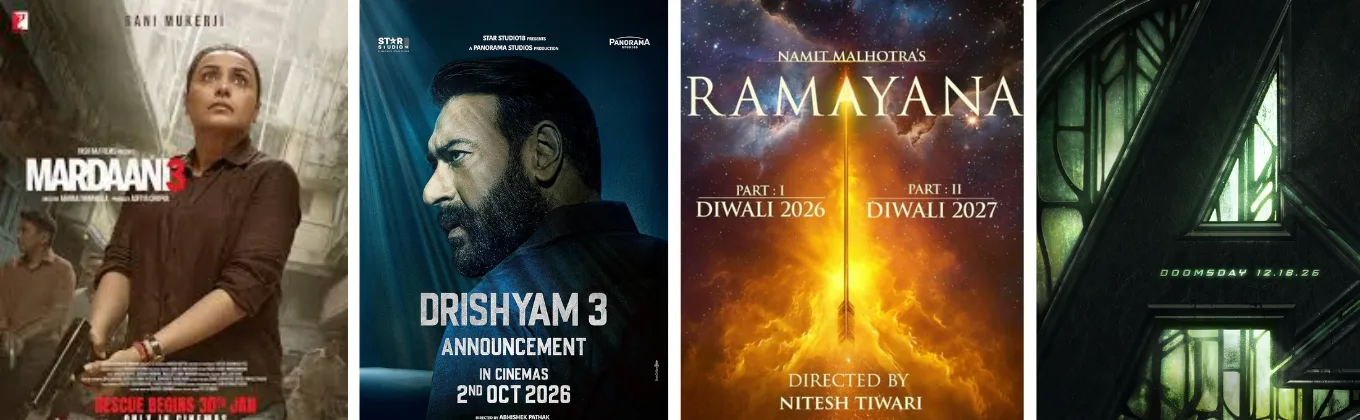
The 2026 movie release schedule feels more like an overcrowded public space than a well-organised list of dates. Every film has a substantial visual and auditory presence, with posters, trailers, and various types of previews vying for your attention. The films are also close together on the calendar with no designated off time, no breaks, and no sense of spacing or restraint.
Not only are there many films, but they will be large-scale, franchise-driven, and designed to dominate theatres and public discourse. Film studios from Bollywood and pan-India cinema to Hollywood have come to believe that the way to go is to make their movies large and loud, either now or never. There is an emotional sense of congestion from the volume of films being released, followed by logistical congestion that together create excitement, anxiety and fatigue. The films of 2026 were not planned but rather created in response to an explosion of pressure.
How Cinema Learned to Wait — And Then Forgot How
The congestion that occurred during 2026 was not something that happened all at once. Rather, it took years to develop and unfolded slowly and almost unnoticed because the global film industry had adopted a wait-and-see approach during the pandemic.
Beginning with the pandemic itself, studios were thrust into an unprecedented position as production halted and release dates were pushed into the indefinite future, resulting in theatres virtually closing overnight. Initially, waiting was not a strategy for studios, but ultimately became the only way to survive. Films were left sitting on shelves, marketing campaigns that had started were paused, and release schedules had become no more than ideas.
In addition to the pandemic, streaming has increased the culture of waiting for film releases, as films that may have previously filled gaps in theatres are now released on streaming platforms. Additionally, mid-budget projects are finding homes on streaming platforms—reinforcing the belief that only the "most important" films should be shown in theatres. Over time, waiting began to be developed into a strategy. Studios are not longer holding their films for release because they have no other option, but rather because they believe there is a better time to release them in the near future.
By 2024 and 2025, signs of theatrical recovery became harder to ignore. Reports of increased footfall, premium format growth, and event-driven successes suggested that audiences had not abandoned cinemas so much as had become selective in their attendance. Industry coverage increasingly framed theatres as “back,” even if the return felt fragile and conditional. At the same time, anxiety simmered beneath the optimism. Studio executives spoke openly about cost pressures, marketing fatigue, and the narrowing margin for error.
2026 emerged as the year when patience ran out. Too many delayed films, too many greenlit spectacles, and too much capital were tied up in projects that could no longer afford to wait. Everyone chose the same window because everyone believed everyone else would. Congestion was not planned; it was the cumulative result of postponed confidence suddenly becoming collective urgency.
The Calendar Is the Battlefield
As we reach 2026, the way movies are released is beginning to change. Traditional release schedules have long served as logistical tools—but in 2026, they will become more like tactical positions; the calendar will resemble an active war zone, with the act of moving forward or holding ground interpreted as either a sign of strength or weakness.
Studios have historically avoided releasing against each other to prevent splitting an audience or risking a compromised debut. However, by 2026, this traditional approach had largely disappeared. Recently released films have decided not to move from their scheduled release windows due to competing films. They are sending the message that this film deserves its own release window and will take that space regardless not availability.
There are also several reasons why studios are reluctant to move from their established opening dates. The marketing campaign for any high-profile movie includes a massive multi-year investment. Rescheduling a release date entails revising months of planning, renegotiating promotional partnerships, and risking confusion among audiences. The planning required to schedule major-screen showings (IMAX and large-format) is completed months before the scheduled release; therefore, the release window becomes another scarce commodity that they are willing to fight to secure.
In India, trade coverage has openly discussed the inevitability of clashes between star-led projects across languages. The same weekend may host a major Bollywood release, a pan-India spectacle, and a Hollywood tentpole, each convinced of its own indispensability. Hollywood mirrors this anxiety. Industry reporting has highlighted how studios are nervous not just about audience turnout, but about being drowned out by competing noise.
The result is a collision by design. Films are no longer stepping aside politely. They are testing their weights against one another in real time. The calendar stops being a scheduling tool and becomes a pressure cooker, forcing films to prove their relevance immediately or risk disappearing under the next wave of marketing.
The Big Hindi Line-Up: Major Bollywood Releases Set to Define 2026
Border 2 (January 23)
Released over a Republic Day-adjacent holiday weekend, Border 2 arrived carrying the heavy legacy of a film etched into popular memory. Positioned as both a tribute and an update, it leaned into scale, patriotic sentiment, and large-format spectacle, testing whether nostalgia-driven war cinema still holds mass pull in a crowded theatrical environment.
Vadh 2 (February 6)
Vadh 2 continues the franchise’s morally dense crime storytelling, trading spectacle for tension and psychological unease. Anticipation around the film stems from its promise of restraint in a year dominated by noise, appealing to audiences who value narrative sharpness over size.
Mardaani 3 (February 27)
With Mardaani 3, the franchise returns as one of Hindi cinema’s most consistent female-led crime thrillers. The film carries expectations of grit and urgency, while also standing as a rare mainstream series that treats procedural realism as its primary draw rather than scale alone.
Dhurandhar 2 (March 19)
Positioned as a high-octane action thriller, Dhurandhar 2 leans into muscular set pieces and heightened drama. Its release reflects Bollywood’s increasing reliance on sequel momentum, where familiarity is used to cut through an already congested release window.
Toxic: A Fairy Tale for Grown-Ups (March 19)
Sharing its release date, Toxic arrives as a darker, stylised period gangster film with pan-India ambition. The film’s anticipation lies in its promise of mood-driven storytelling, visual excess, and a tone that deliberately blurs the line between myth and crime.
Chand Mera Dil (April 10)
A grand romantic drama in a year dominated by action and thrillers, Chand Mera Dil positions emotion as its event hook. Its expectations rest on whether old-school romance can still command theatrical attention amid louder genres.
Battle of Galwan (April 17)
Drawing from a recent and politically charged chapter in Indian military history, Battle of Galwan arrives with inherent seriousness. Anticipation of the film is shaped as much by its subject matter as by its scale, placing it firmly within the tradition of contemporary war cinema as a site of national discourse.
Alpha (April 17)
Releasing on the same day, Alpha stands out as a female-led spy thriller within a genre long dominated by male stars. Its significance lies not only in the action spectacle but also in its attempt to recalibrate who is central in franchise-driven espionage cinema.
Bhooth Bangla (May 15)
Blending horror with broad comedy, Bhooth Bangla aims to offer counter-programming during a packed summer. Its appeal lies in tonal familiarity, drawing on the enduring popularity of horror-comedy hybrids as reliable crowd-pleasers.
Jailer 2 (June 12)
As a sequel with strong southern crossover appeal, Jailer 2 enters 2026 as a proven theatrical brand. Expectations centre on mass moments, star power, and the kind of scale that translates seamlessly across regional boundaries.
Naagzilla (August 14)
Arriving on an Independence Day weekend, Naagzilla embraces fantasy-comedy as spectacle. Its anticipation stems from curiosity about whether genre eccentricity can coexist with more aggressively serious “event” films.
Drishyam 3 (October 2)
One of the year’s most anticipated sequels, Drishyam 3 centres the franchise's narrative precision. The film is expected to dominate conversation through story alone, reinforcing the franchise’s reputation for intelligence-driven thrills.
Love & War (TBA)
A large-scale romantic drama headlined by marquee stars, Love & War, is anticipated as an emotional tentpole. Its delayed date only heightens curiosity, positioning it as a prestige cinema amid commercial excess.
Ramayana Part 1 (Diwali 2026, expected)
The most ambitious Hindi project of the year, Ramayana Part 1, is positioned as mythological cinema on an unprecedented scale. Anticipation here transcends box office metrics, carrying the weight of cultural representation, visual ambition, and franchise-building intent.
Hollywood’s Event Pile-Up: The Films Crowding the Global Conversation in 2026
Send Help (January 2026)
Released early in the year, Send Help quietly opened Hollywood’s 2026 calendar with a contained, genre-driven approach. Its arrival set an early contrast to the scale-heavy films that followed, reminding audiences that not every theatrical release needed franchise weight to justify its presence.
Avengers: Doomsday (December 2026)
Positioned as Marvel’s defining end-of-year spectacle, Avengers: Doomsday represents the studio’s attempt to reassert event dominance after years of franchise fatigue. Anticipation is driven less by novelty and more by curiosity around whether Marvel can still manufacture collective urgency on a global scale.
Spider-Man: Brand New Day (2026)
Another reset within the Marvel ecosystem, Spider-Man: Brand New Day carries the pressure of reinvention. The film is expected to balance familiarity with tonal freshness, signalling Marvel’s broader effort to recalibrate its most reliable character for a changing audience.
Supergirl (2026)
DC’s Supergirl arrives as part of the studio’s ongoing structural overhaul. Framed as both an introduction and a statement of intent, the film carries the weight of proving that DC’s future can be coherent, character-driven, and theatrically relevant.
The Super Mario Galaxy Movie 2 (2026)
Riding on the cultural and commercial success of its predecessor, The Super Mario Galaxy Movie 2 leans into world-building rather than nostalgia alone. Its anticipation reflects Hollywood’s confidence in animation as a four-quadrant theatrical anchor.
Toy Story 5 (2026)
Few sequels arrive with as much emotional baggage as Toy Story 5. Anticipation here is cautious, shaped by questions of necessity as much as by excitement, and it tests how far legacy franchises can extend without diluting their original impact.
Minions 3 (2026)
Designed as pure commercial insulation, Minions 3 continues Illumination’s dominance over family audiences. Its presence on the calendar reflects Hollywood’s reliance on established IP to stabilise increasingly volatile box-office conditions.
Moana (Live-Action) (2026)
Disney’s live-action Moana signals the studio’s continued confidence in re-engineering recent animated successes. Anticipation centres on how the film balances spectacle with cultural sensitivity, especially as live-action remakes face growing scrutiny.
Dune: Part Three (Late 2026)
The final chapter in Denis Villeneuve’s Dune trilogy is framed as a prestige spectacle rather than franchise churn. Its late-year positioning underscores confidence in adult-oriented science fiction as a viable theatrical draw.
The Odyssey (2026)
A large-scale reinterpretation of Homer’s epic, The Odyssey, positions myth asa cinematic event. Anticipation stems from its ambition to merge classical literature with modern blockbuster language.
Project Hail Mary (2026)
Adapted from Andy Weir’s novel, Project Hail Mary taps into post-Interstellar appetite for cerebral science fiction. Its appeal lies in concept-driven storytelling rather than franchise familiarity.
Michael (2026)
The Michael Jackson biopic arrives with immense cultural weight and scrutiny. Anticipation is shaped as much by controversy as by curiosity, making it one of the year’s most closely watched prestige releases.
The Mandalorian & Grogu (2026)
Disney’s decision to bring The Mandalorian & Grogu to theatres reflects a strategic shift from streaming exclusivity to big-screen validation. The film tests whether television-born franchises can command cinematic loyalty.
The Devil Wears Prada 2 (May 2026)
This long-awaited sequel trades spectacle for nostalgia and cultural relevance. Anticipation hinges on whether the fashion satire can adapt to a transformed media landscape.
Jumanji 4 (December 2026)
Closing the year alongside other mega-releases, Jumanji 4 functions as crowd-pleasing counterprogramming. Its continued success highlights Hollywood’s preference for recognisable adventure over narrative risk.
Together, these films reveal a Hollywood calendar built less on spacing and more on saturation, where anticipation itself has become a competitive currency.
Familiar Faces in Unfamiliar Volume
As risks rise, familiarity becomes the new currency. One of the main themes of 2026 will be not only how much overall film product is released but also how many times we see familiar faces throughout the year. Marquee names will not only have many outsized roles but will also continue to serve as anchors on numerous high-profile projects. The relationships between directors and their stars will be revitalised as events in their own right.
This is a powerful example of risk management at its most obvious level. The simple act of recognising somebody reduces the barriers to engagement. A familiar face provides immediate context, signalling tone, genre, and scale. Two creatives coming together again will instil confidence in the audience that what they enjoyed previously can be found again. Nostalgia will play a less obvious role today, typically not as a major driver of trend-based consumption but rather as a source of emotional reassurance.
In all three industries, the pattern we observe today is evident across multiple films. Bollywood relies on its most commercially viable stars and amplifies the over-the-top nature of pan-India films. Hollywood continues its pattern of utilising franchise and legacy stars. This strategy may not be subtle, but it is very easy to understand. In what will be a year where attention is limited, familiarity will always feel safer than newness.
Yet this volume creates its own tension. When the same star headlines multiple releases within months, uniqueness erodes. Familiarity risks turning into fatigue. What was meant to feel special begins to feel routine. The safety net is stretched thin.
Still, the calculation persists. When everything feels risky, recognition becomes strategy. It is easier to sell what audiences already know than to teach them something new, especially when the calendar offers no mercy.
The Audience as the Bottleneck
The true barrier to growth in 2026 isn’t budget or screen availability for film productions. It can only be the number of viewers willing (or able) to see all films produced that year; no matter how many films tell you to go out and see them, no one can eventually view all of them. They have finite resources in the form of time, money, and emotional energy.
In accumulated markets, ticket prices have increased substantially, particularly in premium format theatres. Movie-going is becoming a more deliberate purchase; it’s no longer just an impulse decision. Consequently, when faced with multiple ‘must-see’ films, audience members are making selections. They may select one or two and allow the remainder to sit in limbo or disappear altogether.
This leads to increasing decision fatigue; marketing becomes noise rather than persuasive/enticing. When this occurs, word-of-mouth influences again. The films that succeed are those for which someone says they were worth seeing, rather than merely the loudest marketer. The success of re-releases over the past few years demonstrates this trend, with previously popular titles responding positively due to their ‘memorable’ titles, both through nostalgia and clear messaging.
Theatres feel this shift acutely. Packed opening weekends coexist with empty auditoriums days later. Some large films vanish quickly despite scale, while others grow slowly, sustained by audience conversation rather than advertising spend. The audience, in effect, becomes the bottleneck through which all ambition must pass. No amount of congestion changes the fact that attention cannot be expanded indefinitely. 2026 exposes this limit more starkly than any recent year.
When Everything Is an Event, Nothing Is
In 2026, we find ourselves experiencing one of life’s central paradoxes: when all films claim to be events, the idea of a singular event becomes meaningless. Urgency is in a constant state of inflation until it eventually implodes under the burden of its own weight.
Once, event cinema meant specialness or something out of the ordinary. Once, the release of a film meant something different from all the other films that year. However, today all films are marketed with an eternal sense of urgency. The trailers promote large-scale productions. The marketing campaigns are urgent. Our notions of hierarchy have collapsed.
This has certain ramifications. Audiences will stop being responsive to superlatives (largest, most bold, most ambitious, etc.) because they have become all but indistinguishable. Films’ struggle to differentiate will not come from a lack of effort; it will come from an exhausted vernacular of difference. The risk of cinema today is not that it will become too large; it is that size will cancel itself out. In a culture of perpetual spectacle, it will degenerate into anticipation. If everything demands attention now, no one will have the patience or confidence to wait.
The title of this year tells the story. Everything is released at once because everything insists on being regarded as essential. Whether cinemas can survive in a permanent state of urgency remains an open question.
2026 as a Stress Test, Not a Celebration
It's easy to view 2026 as the year of a major cinema comeback, but it will tell us under what conditions big-budget movies succeed. Big-budget movies will tell us whether they can survive without some form of differentiation and whether people respond more to clarity or to the volume of product. Theatres will observe attendance patterns after the opening weekend and determine whether audiences are interested and continue to attend releases.
Some studios will discover that, simply because they produced a few successful movies, their formulas remain valid for subsequent releases. They may also find that their older formulae may not be as successful with newer releases and require them to develop new formulas. Theatrical exhibitors will determine how to proceed to retain foot traffic.
The bottom line is that whether any film succeeds, the behaviours around the way those films performed will give direction to future behaviour(s). Should a high volume of box office returns create traffic congestion for the future with respect to how those films are disseminated whether there is less interest from audiences therefore less traffic to the theatre and less revenue coming to the studio(s) from box office sales and then derived from video/radio sales could lead to the closure of studios simply because they cannot sustain day to day operations.
Never before have the studios relied so heavily on belief. Belief in stars. Belief in products. Belief in creating wonderful theatrical experiences. There is no guarantee that 2026 will provide all the answers needed by the studio; however, it will clearly provide additional empirical data.
The Takeaway
When the promotional materials have been taken down and the release schedule is all set for 2026, then there will be more than just weekend box office numbers or industry commentary left behind. There will be significant evidence of how much weight the current film industries put on viewer engagement before viewer fatigue sets in. In 2026, the industry no longer paced its releases over months but began releasing a multitude of films simultaneously, thereby testing not only box-office endurance but also cultural endurance.
Once the dust of competition settles and there is little to no marketing hype remaining, the subsequent lingering question is less clear but more difficult to assess. Is cinema still primarily a shared experience, founded on a timeline of shared anticipation and shared experience? Or is cinema now relegated to solely competition, where time urgency has replaced relationship invitation? When every film claims to be "must-see," the decision-making process becomes heavier rather than lighter.
2026 offers no neat verdict. Instead, it becomes a measure of restraint lost and possibly relearned. It asks whether scale can exist without congestion, whether ambition requires constant amplification, and whether audiences will continue to attend when everything demands immediate attention. The answers will not arrive in headlines or record books. They will surface slowly, in what continues to be watched, remembered, and talked about long after the rush has passed.
2022 © Milestone 101. All Rights Reserved.