STAY CURIOUS
Keep reading to find the excellency out of perfection and skill.

By: Milestone 101 /
2025-10-29
bollywood
Two Much is Too Much: How Kajol And Twinkle Prove That Not Everyone Can Host Talk Shows
Kajol and Twinkle Khanna’s Amazon Prime talk show Two Much promised wit and warmth but ended up exposing the pitfalls of celebrity overconfidence. What began as a lighthearted chat turned into a lesson in how charisma alone can’t replace empathy, awareness, and the true art of hosting.
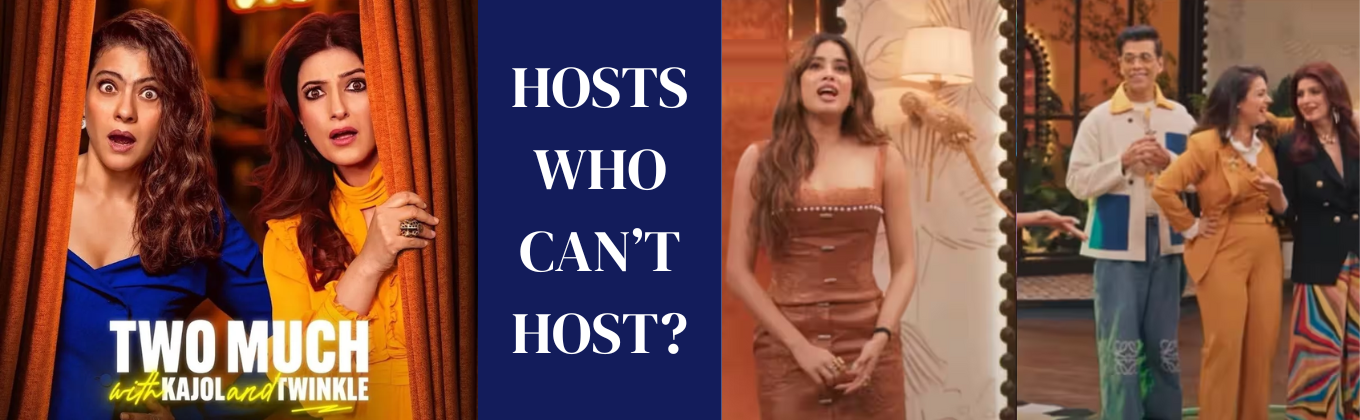
It all began with a smirk and a sound bite. Kajol and Twinkle Khanna, two women adored for their sharp tongues and unapologetic charm, sat in front of Karan Johar and Janhvi Kapoor on the latest episode of Two Much, their Amazon Prime talk show. As the conversation shifted towards infidelity—an already charged conversation—what ensued was the spark that ignited a week-long social conflagration. Kajol and Twinkle breezily dismissed the notion of a physical affair as “not a deal breaker,” and Twinkle sealed this with a glib “Raat gayi baat gayi”—What’s done is done—the internet flared up.
Social media timelines filled with rage; clips reached millions of views in a matter of hours. Viewers deemed their comments tone deaf, privileged and astonishingly cavalier in their dismissal of the emotional harm of cheating. Psychologists deemed the attitude expressed by the two a product of suppressed emotion. On Reddit and X, users accused the hosts of “normalising cheating to cope with their own experience.” For two stars recognised for their honesty, the backlash was a harsh reminder of how unmitigated honesty without consideration can sound dangerously like arrogance.
The underlying irony was palpable. Kajol's candid sense of humour and Twinkle's literary humour, which was zany and is now seen as refreshing and honest, now reads as elite in an out-of-touch way. While the incident revealed a larger truth: simply being entertaining does not equate to being compassionate, or advocating and being coarsely honest does not equate to being wise. To use the metaphor of being able to dominate as a dinner-table conversationalist versus the wisdom to know the nuance of public discourse among others. As the backlash to both women demonstrated, being a good "talker" does not make for being a good talk show host.
The Allure of Celebrity Talk Shows
The rise of celebrity-sourced talk shows in Bollywood almost feels inevitable. Stars reach another moment in their career where interviews, candid stories and the rollover of self become just as important as their film work. For many stars, talk shows become playgrounds for ego and tools of public relations strategy —a platform to wrest control of the narrative, maintain visibility, appear "relatable," and carry that traction into social media. The talk show format ultimately gives celebrities intimacy without the risk of a full flop at the cinemas.
So enters Koffee with Karan. With Karan Johar in front of the camera, gossip becomes aspirational, scandalous talk becomes mainstream, and celebrity aspirational stars become exceptions to hosting for audiences. Koffee with Karan formats the influence of stardom with the appeal of koffee and coffee, and the possibility of disclosure. A star admits to something outrageous, tweet storms will follow, and the public will want to tune in just to see if they catch the star's juiciest one-liners.
As a result, many stars may set up their own equation on their hosting: "if I am famous + witty in real life, I will have engagement." This logic is fundamentally flawed. In reality, hosting will require much more than star charisma. There is an assumption that fame is all that it takes; however, this is false. It is needed that hosting be more than an impressive riff on a popular joke or a hilarious, relatable story that is even topical. It matters that the host engage in non-judgmental empathy, restraint, conversational awareness, flow, guest comfort, and the use of silence.
The show risks erupting into mention-of-show-biz, rapid-fire, spur-of-the-moment repartee when a host relies solely on their Hollywood Highland Park, superstar self. The magic of a star does not equal the ability to host. Ask yourself: Did the host's support help the guest to be revealing? Did the host beautify the conversation, or hover over it like a helicopter? And while many Bollywood talk shows have a glam look on the surface, they are rich in lessons in show hosting as a skill, not a side hustle.
The Kajol–Twinkle Misfire
What happened on Two Much that caused the uproar? In a recent episode, Kajol and Twinkle, joined by guests Karan Johar and Janhvi Kapoor, were talking about emotional infidelity and physical infidelity. Twinkle casually said that physical infidelity was not a deal-breaker, declaring “raat gayi, baat gayi.” Kajol chimed in, supporting this soft stance. Janhvi took a much harder line: to her, physical infidelity was just as bad as emotional infidelity.
The social media response was swift. Many viewers felt that the comments minimised the experience of betrayal and dismissed the legitimate pain that comes from infidelity. What should have been a delicate discussion felt forced. The hosts, confident, polished, and articulate, came off as entitled insiders treating a serious subject as if it were a conversation at the dinner table.
It had the beginnings of great potential: two outspoken women, well-prepared and at ease, with a good rapport. This was the trap. Instead of promoting guest insight and fostering audience empathy, it became a competition — each host had a quip ready, but no follow-up question. The guest got less space, and the hosts had more.
It was less of a moderated talk show and more like a symposium of good friends roasting one another -- except the topic of infidelity needed more nuance in its treatment. Both ironic and painful, two actors renowned for their outspoken personas sounded tone-deaf. Their confidence—the advantage in their on-screen personas—was disadvantageous when they hosted the show. Hosting a talk show isn't only about being the loudest or funniest; it's about who can listen most closely. On Two Much, they talked a lot more than they listened.
Feminism or Flex? Kajol and Twinkle's Woke Act Feels Forced and Hollow
The most significant flaw in Two Much with Kajol and Twinkle is not the lack of structure to the show, but the unnecessary performance of feminism we see from the hosts. Kajol and Twinkle seem eager to present as "woke" and, in doing so, attempt too hard, and their feminism seems curated for patriarchy optics, instead of being driven by conviction and values. In making fun of each other in the same breath as preaching "women's empowerment" or in shallowly laughing off deep conversation with misplaced sass, the show's tone rings hollow.
Kajol, particularly, blundered substantially when she asserted that actors "work much harder" than people with 9-to-5 jobs, a moment so tone-deaf it instantly cost her credibility. And in a country where nearly all people work while placing little value on glamour once off an individual's own grass, this statement reeked of privilege. It showed just how out of touch the hosts are with the realities of the agenda they claim benefits their public. Their perceived boldness or liberation made everything feel dismissive or elitist, as if feminism was just another celebrity prop.
To make matters worse, they infrequently allow their guests to speak. Every conversation becomes a two-woman show—with Kajol and Twinkle eagerly interrupting, completing each other's sentences, and battling for the punchline. The guests—who should be the focal point of the conversation—become props in an effort at a vanity project with the appearance of female solidarity. In the attempt to show sisterhood and modernity, Two Much loses the basis of conversation altogether. Silencing others is not feminism, but ego masquerading as empowerment.
The Talk Show Trap
Why do actors believe hosting is easy? Because it looks easy. They see it on the screen: lights, couches, guests, cameras, and laughter. They think, “I can do that.” Then you do it. It is not the same. Hosting well takes preparation, structure, emotional intelligence, and interviewing skills. Not everything shows up on Instagram.
Hosts that do this successfully on a global level, like Graham Norton, Oprah Winfrey, or Jimmy Fallon, may make it seem like it is "just talking." But there is an agenda: they control the moment, listen intently, and know when to push and when to take a pause. They do not think of themselves as the star of the show. The guest is.
As we know from our own celebrity talk-show culture in India, this is often seen in reverse: the host frequently co-stars rather than facilitates. In Two Much, the format appeared confused; was it a talk show or comedy hour? Kajol and Twinkle appeared more interested in each other's reactions than in understanding the guest's truth. This is where the work gets complicated: when hosting blends into an extension of the celebrity rather than a platform for their guests.
The Art of Hosting: Why It’s Harder Than It Looks
Let's unpack what defines an exceptional host. It's not just about having charm — it's about: listening, understanding, spontaneity, and timing. A great host knows when to ask the question, when to stay silent, and when to give the guest space to breathe. They navigate the conversation; they don't dominate it. They change their tone depending on the guest, topic, and the mood of the moment.
Take Karan Johar: he thrives because he understands gossip as a performance, yes — but he knows when to slow down, when to build up, when to drop tension. He doesn't lie low the whole time; he cues the revelations and allows guests to chew on them.
In the digital space,, hosts like Neha Dhupia and Renee Sen can pull this off, in part because they help their guests develop space, structure the unfolding narrative, and because it doesn't erupt from what can feel like the hosts'go-driven space. The viewers can sense the difference.
Conversely, Kajol and Twinkle struggled, in part, because they dominated the space. They seemed too busy to land plausible lines that added entertainment value to the space to really ask open questions. They seemed more focused on being co-hosts than on curating a longer conversation. The two carried each other more than they focused on the guest, and, fundamentally, the narrative. That type of banter is excellent for casual friends — but in spaces that require some level of emotional intelligence and rhythm in conversation, they fell flat, comparatively.
Hosting requires a careful balance between humour and sensitivity. Being edgy in programming doesn’t mean you have to be insensitive, and being irreverent doesn’t mean you can’t have empathy. With a good sense of timing and social awareness, a host knows when a joke lands, when it doesn’t, and when the social setting changes. You don’t hear much about this, simply because hosting continues to be somewhat glamorous on the surface —moral: an act that involves less scripting than acting and a little more de-calibrating. But don’t kid yourself: the one takeaway from a smooth talk show is the rehearsal — meaning the invisible work that goes into framing comedic legacies while also adapting to actors who forget that “this is easy”.
The Audience Has Evolved
One of the factors that surprised the hosts: the audiences have changed. The current audience is both well-informed and socially conscious. They no longer passively consume the celebrity gossip or talk; they peel back every layer of every statement and judge for privilege, hypocrisy, and inauthenticity. Millennials and Gen Z are engaged not only with what you are saying — but how, why, and by whom.
So when Kajol and Twinkle dismissed the topic of infidelity in their interview, the audience didn't just hear a joke. They listened to a space where historical accounts of sexism, entitlement, and the myth of the ever-forgiving female were being normalised. The audience also questioned whether women in positions of privilege were being too forgiving because they themselves held a particular form of celebrity privilege. In this way, the talk show is a litmus test of whether women are authentically calling one another out. And authenticity necessarily means self-awareness, rather than just "saying whatever."
Similarly, if guests like Janhvi Kapoor responded with calm clarity and did not police the people's voice, they earned respect. Headlines from social media posts such as "Janhvi wins the internet" are indicative of this shift.
The audience doesn't want just to laugh. They want resonance, they want reflection. And if you don't keep the pace of resonance, you risk being seen as dismissible - simply "too much."
What this indicates is that we have entered the mature space of star-led talk shows. The format no longer ensures that the host’s fame will draw an audience. If anything, the audience expects more. They expect vulnerability, nuance, and respect. It’s when the host starts to look reflexively privileged or cavalier that the microphone becomes a magnifying glass for missteps.
When Wit Turns into a Weapon
Wittiness has always been one of Kajol and Twinkle’s assets. But during Two Much, we saw how that can come across as self-satisfaction. It’s not the humour that is problematic. It’s the tone with which you deliver the humour. A seemingly innocuous phrase like "raat gayi, baat gayi" might work within a circle of friends as a witty remark. On stage, it comes off as aloofness. Suddenly, the humour becomes an offensive weapon of deflection, not a tool for connection.
There is a gender component in this situation to be aware of. When women are outspoken and confident, that is, for some reason, applauded. But when a woman’s gusto flirts with performative privileged levity, the audience witnesses the pretty double standard. Instead of being dubbed “unapologetic woman”, the label transitions to “unemotional host”. What happened in this situation was misreading—equating honesty with hostility.
What we are seeking, from a humour perspective, is grounded humour: self-deprecating, kind and reflective. When a host refrains from liberally joking about and owning the multiple complexities, that is when the communication lands. But when the humour floats high above the subject matter, we wake up with backlash. On this occasion, Kajol and Twinkle’s rapid-fire remarks somewhat negated the fact that a swath of viewers expected some depth rather than merely delivering punchlines.
Redemption or Reinvention?
Will Kajol and Twinkle recover from the backlash? They can — if they adopt the humility to address learning from their mistake and align future efforts around structure and guest-centred flow. They would not be closed off from having a hosting career; their attempt just needs to be reinvented.
Twinkle may do better in a more scripted format — for instance, a book club-style show or an essay-driven interview series that works well with the established elements of her dry humour and intelligence, if approached with the rigour of acceptable expectations. Kajol likely has the potential to succeed in story-driven long-form discussion opportunities, where a straightforward demeanour may even create more depth and engagement rather than quick repartee.
Or to put more simply: they could shift from “hosting because we’re famous” to “hosting because we’ve studied the craft”. Learning how to respond best and then improving their practice and craft as a public figure, by facing essential feedback from an audience and responding in the affirmative, often makes them more respected at a deeper level. If public figures lean into the feedback rather than going down the route of hem and haw, this possible stumble, or rolling face-plant, or low-hurdle trip of a painful first go, may just pivot into something more acceptable and enjoyable.
The Takeaway
While 'Two Much with Kajol and Twinkle' may seem like an ironic title, it ultimately turned out to be a prophecy. What began as a shiny venture in sisterhood and satire ended poorly as a cautionary tale, reminding us of the celebrity echo chamber. Kajol and Twinkle prided themselves on showing women in a way that suggested they could be cheeky, funny and unfiltered, and instead highlighted how simply a person can shift from believable confidence to archaic.
The audience tuned into the repartee and their authenticity, only to experience dissonance. The more the hosts spoke, the less they seemed to be listening. Their dialogue was inflated and their humour was elevated; however, somewhere through the barbs and the friendly roast, the essence of hosting disappeared. Candour is not the same as being chatty. More to the point, though fame implies something is interesting about a person, being famous does not confer interestingness.
Hosting is about humility, curiosity and control, three things fame often muddies. The best hosts hold space for others; they listen, facilitate, and then cede. On 'Two Much', Kajol and Twinkle filled every silence, mistaking interruption for engagement. The banter, intended to be off-the-cuff and organic, turned out self-indulgent.
The show did not collapse from a lack of talent among the hosts—it died because the hosts did not know one fundamental principle of conversation: not every moment needs a witty line. At times, the most powerful thing a host can do is pause, listen, and let others take the floor. The irony is already written here—the show called Two Much proved that sometimes the hosts with the most capacity are the ones who finally pull back and stop talking.
2022 © Milestone 101. All Rights Reserved.