STAY CURIOUS
Keep reading to find the excellency out of perfection and skill.

By: Milestone 101 /
2026-01-28
bollywood
When Governments Endorse a Movie: The Business of Tax-Free Films
This article explores how tax-free film status in India operates as both a business tool and a political signal. It examines the lack of policy, the economic impact on films, and how state endorsement quietly shapes which cinematic narratives gain visibility and legitimacy.
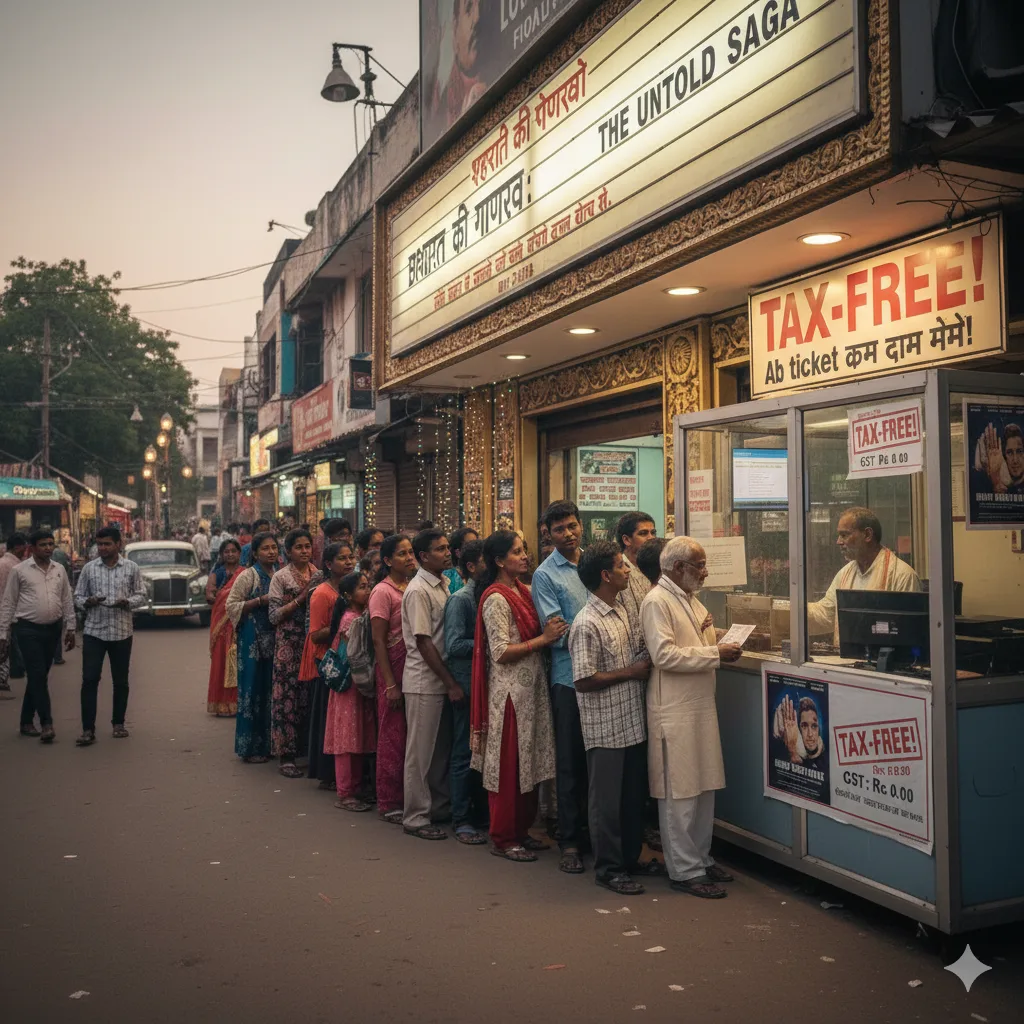
It usually starts with a harmless announcement on Twitter from a chief minister that their state has made a particular movie tax-free. Occasionally, a photo of a movie screening at the state assembly is shown, with the additional provision that it is a tribute to various national heroes, social reformers, and other underrepresented communities. The words used are carefully crafted to convey that the movie in question is valuable to people, makes them more informed, and benefits society as a whole.
The immediate impact of a Tax-Free announcement can be seen almost immediately. Admission prices decrease slightly, more shows are added to single-screen theatres, companies begin making bulk purchases for group bookings, and films that were losing momentum can regain it (especially in smaller cities and rural towns). News of a film’s Tax-Free status travels faster than word-of-mouth and reviews about a film, and provides an added level of credibility and Trust among audiences that would otherwise not consider watching that film.
Tax-Free Films exist in India as a unique hybrid of Cinema, state Government decisions and Public Messaging. On the one hand, the announcement appears to be a Welfare Initiative for audiences; on the other hand, it serves as Market Support for studios. The elimination of tax allows the State to directly affect the number of Tickets sold and where those Tickets are sold. Although the overall effect of a Tax-Free announcement may be limited in the long run, the Government's decision gives the Balance of Power to the selected film by dictating how and where it is viewed.
The Indian Express and India Today explainers on tax-free films describe this mechanism in neutral terms. States have the power to exempt films from entertainment tax or their share of GST if they believe the content serves a social purpose. The language is deliberately broad. “Socially relevant.” “Educational.” “National importance.” These terms sound objective, but they are anything but.
An important question that deserves more attention during celebrations and political proclamations is whether tax-free cinema indicates support for social impact or reflects a chosen endorsement that limits a range of narratives while excluding others. Furthermore, given that it is through the power of the state that some stories will receive cheap tickets and greater exposure, how does this influence the relationship between cinema and power?
This article will examine the mechanisms that facilitate tax-free cinema, who determines which films receive tax-free status, which themes recur, and which themes are often portrayed as advantageous business interests through moral lenses. Additionally, it will examine whether tax-free cinema accurately reflects public interest or merely reflects the priorities of the politically connected.
What Does “Tax-Free” Actually Mean in India?
Many people still have confusion about the term "tax-free film." There is still a belief that the term tax-free means free or very cheap tickets. This has never been the case.
Historically, in India, cinema tickets were taxed at the entertainment tax levied by individual state governments. This rate varied significantly by state, from approximately 30% to 40% in some cases. Each state enacted its own tax and had total discretion over whether to impose it on a film or to exempt it from tax before the introduction of the GST.
The introduction of GST in 2017 changed the system of taxing cinema tickets, but not who controlled whether a film was tax-free. Under GST, the tax collected on a cinema ticket is based on the ticket price, with different tax rates applied to each price level. Individual states still have the authority to waive GST and to provide GST reimbursement as they see fit. The Centre does not have the authority to declare a film as tax-free, which is very significant. While many times there is a national message when tax-free status is announced, it is entirely within the control of the individual states whether a film receives tax-free status or not.
This has been made very clear by many sources, including the Indian Express, News18, NewsBytes and Unacademy. There's no centralised organisation that oversees the tax-free designation process. There is no standardised policy in effect. Each state acts autonomously and typically varies its tax-free status decisions. A film may be tax-free in one state and fully taxed in another, even if the subject matter remains the same.
More importantly, tax-free status is discretionary, not rule-based. No published checklist defines eligibility. There is no legal obligation for a government to justify its decision. Most exemptions are announced after a film’s release, sometimes weeks into its theatrical run. This allows governments to respond to public sentiment, political convenience, or media narratives rather than making a principled policy decision upfront.
This ambiguity is not accidental. It gives state governments maximum flexibility and minimum accountability.
How a Film Becomes Tax-Free: A Process Without Policy
A tax exemption application process for Indian cinema would be very brief, due to the lack of a defined process. In India, filmmakers apply for tax exemptions informally through correspondence with a Chief Minister’s Office, meetings with government representatives via political intermediaries, or public pressure via media coverage or private screenings to petition political leaders. This process is not institutionally defined; it is created through improvisation.
Major publications such as The Indian Express have reported regularly that this system lacks transparency and that no specific timelines have been established for the response or review of submitted applications. There are also no defined appeals processes for rejected applications or the absence of a response from the concerned government authorities.
The criteria for classifying films as socially relevant or of national importance rest entirely with the relevant government authorities, and there is no requirement for the government to articulate reasons why a particular film falls into either category. Therefore, there is a very real possibility of a good number of films being rejected because they fall outside of the "national interest" or "youth inspiration" criteria that are used to support the justification for the privilege of tax exemption that is conferred upon other films.
In the absence of a clear policy, political discretion often outweighs a film's intent or impact. While not every tax-free decision is cynical, the system remains guided more by subjective judgment than by principle.
The Business Impact: Why Tax-Free Still Matters
Despite changes in taxation and the rise of OTT platforms, tax-free status remains essential. Not because it transforms a film’s fortunes overnight, but because it nudges the economics in subtle but meaningful ways.
Ticket Pricing and Audience Psychology
Ticket price reductions may appear minimal on the sheet. However, in small towns and at single-screen venues, a slight ticket price reduction can be significant enough to influence foot traffic. Families who have reservations about ticket costs will feel a sense of relief. Schools, clubs, unions and community groups will have increased access to block ticket purchases for special screenings. There is also a psychological impact associated with having a tax-exempt status. A tax-exempt film implicitly endorses the movie as "safe." It indicates that the film's content aligns with socially accepted values. This endorsement is very important for family audiences, particularly those outside major metropolitan areas.
Extended Theatrical Life
Tax-free status often arrives at a strategic moment. Films that are slowing down after their opening weeks suddenly get a second push. Exhibitors retain shows longer. Weekday occupancy improves. The film stays visible in the public conversation. This extended life may not always translate into blockbuster numbers, but it stabilises performance. It helps certain films travel beyond urban multiplex audiences into wider circuits.
Does It Really Help the Industry?
Some do not agree. Tax exemptions do little to save films that aren’t strong performers. The Times of India noted that in states such as Uttar Pradesh, multiple films were made tax-exempt within a few months; however, ticket prices and audience numbers at multiplexes remained virtually unchanged.
In short, a film does not necessarily become successful simply because it has received tax-exempt status. However, a movie with tax-exempt status offers lower risk and a larger audience reach than one without, in a business where profit margins are thin. Consumer perception plays a major role in purchasing decisions. That advantage cannot be underestimated.
When Tax-Free Becomes Political Messaging
The Lowy Institute has analysed Indian Cinema, which is part of how Indian Cinema and other forms of Soft Power are viewed worldwide.
When one applies the definition of 'soft Power' to the topic of films, we can conclude that films are used to shape public narratives about various issues; to develop a social image of a country; and that when a government supports a film, it is aligning itself to that particular country's view of that narrative.
The Hindu has an article written about how untapped soft power through film has been used as a Cultural Weapon. The Indian government's granting tax-free status to certain films is a cheap way to outline a country's values.
The timing of these government decisions also plays an important role. The granting of tax exemptions often coincides with primary political elections, protests, and other significant events. The result is that some difficult questions are raised: Would a particular film have received the same level of support if the government were different? Are those films that contain critical or dissenting views ever viewed by a government as utilitarian or of any other use to society?
Based on what we have seen so far, the pattern that has emerged is that governments appear more inclined to withhold (or limit) tax-free film status than to support (or encourage) films that promote critical or dissenting views.
The Films That Didn’t Make the Cut
In India, a number of tax-exempt films have been rejected and are often those which are more vague than definitive, but contain themes such as nationalism, self-determination, social reform and moral conflict, without providing simple answers or easy resolutions for the viewer, and as a result create confusion and stimulate discussion instead of providing a clear and consistent message. Ironically, this confusion is one of the reasons cinema continues to have value. Although many films address such topics as caste hierarchy, exploitation of workers, farmers committing suicide, people being held without charges or the failure of the government to provide, many of these films have been repeatedly denied tax breaks, denying recognition to the very subjects which convey the reality of belief.
The New Indian Express has found that tax exemptions are not usually about supporting and fostering cinema as an art form, nor do they create a climate that encourages difficult, unresolved themes to be explored in cinema. Tax exemptions serve as a reward mechanism for films that fit a predefined concept of social good: safe, non-confrontational, and politically correct. The Hindu's approach to viewing films as Soft Power reinforces this view by presenting governments as preferring films that support the dominant narrative rather than challenging it.
As a result, there is a significant imbalance in the creative environment that this creates for filmmakers. They quickly identify which stories support the status quo and gain validation. Which should be left alone and not validated, so that the development of their creative work is dictated by these decisions, as well as the funding and promotion of these projects. Therefore, the filtering mechanism sets the agenda regarding what should be approved by the state and what is likely to remain unsupported.
The absence of established guidelines compounds this problem because when a filmmaker is denied tax-exempt status, they are not necessarily rejected on ideological grounds; instead, they receive the same outcome as films rejected on ideological grounds: no institutional support. The difference, however, lies in visibility and validation. The films granted tax exemption will receive media exposure through publicity and be endorsed symbolically by the state, while the films not granted tax exemption, even if they are just as relevant in their own right, will remain unsupported by the state. This disparity may appear minor on paper, but in practice, it significantly affects a film’s reach and cultural standing.
This discussion relates to the greater issue of how India perceives cinema as a cultural asset. Cinema is often considered a source of soft power across various nations, with many governments managing funding and investment through clearly defined, politically neutral structures (for example, the French film industry).
Conversely, the Indian Government's investment and support for cinema is sporadic and highly event-driven, mainly due to the influence of short-term political objectives as discussed by the Lowy Institute. While cinema may have a significant impact on society and culture, it is not government involvement per se that presents a challenge; rather, it is the arbitrary, capricious nature of that involvement. Additionally, without clear criteria for distinguishing artistic merit from political endorsement, tax-exempt status could become less effective as a tool of cultural policy and more like a means of providing favoured artists with benefits based on their already recognised and established status.
The Takeaway
In India, the tax-free status of cinema is often viewed as a simple administrative decision, a small gesture of fiscal kindness to the public. But in fact, it is anything but simple. This is a powerful indication of an industry reshaped by tax-free exemptions and audiences, and, in many ways, it is an endorsement of chosen narratives. The tax exemption provides practical benefits by lowering ticket prices, thereby extending the theatrical life of certain films; however, it also confers a moral and social justification on selected films, thereby influencing which stories are viewed, talked about, and ultimately remembered.
There is a clear pattern. For example, films that support the dominant notions of nationalism, inspirational individualism, and state-sponsored social reform continue to be rewarded for their alignment with these dominant ideologies. In contrast, films that complicate these ideologies or challenge the state's established authority are much less likely to receive the same level of support. That said, not all tax-free decisions are based on disbelief or indifference; rather, as a system, tax-free cinema cannot be defined as neutral in its treatment of all films.
Cinema has always been a space for questioning power, reimagining history, and reflecting social contradictions. When governments decide which films deserve official encouragement, that space narrows, even if subtly. The danger is not overt censorship, but quiet preference. Not bans, but benefits.
If cinema is meant to provoke, disturb, and inspire in equal measure, then its relationship with the state must be handled with care. Otherwise, tax-free status risks becoming less about social impact and more about selective endorsement, a reminder that in India, even the price of a movie ticket can carry political weight.
2022 © Milestone 101. All Rights Reserved.