STAY CURIOUS
Keep reading to find the excellency out of perfection and skill.

By: Milestone 101 /
2026-03-17
hollywood
Why Disney+ Is Doubling Down On Nostalgia Reboots
Disney+ is leaning heavily on nostalgia, reviving beloved classics to retain subscribers and reduce risk in a competitive streaming landscape. But behind the emotional pull of reboots lies a calculated strategy driven by data, franchise ecosystems, and multi-generational appeal, raising questions about creativity versus commercial predictability.
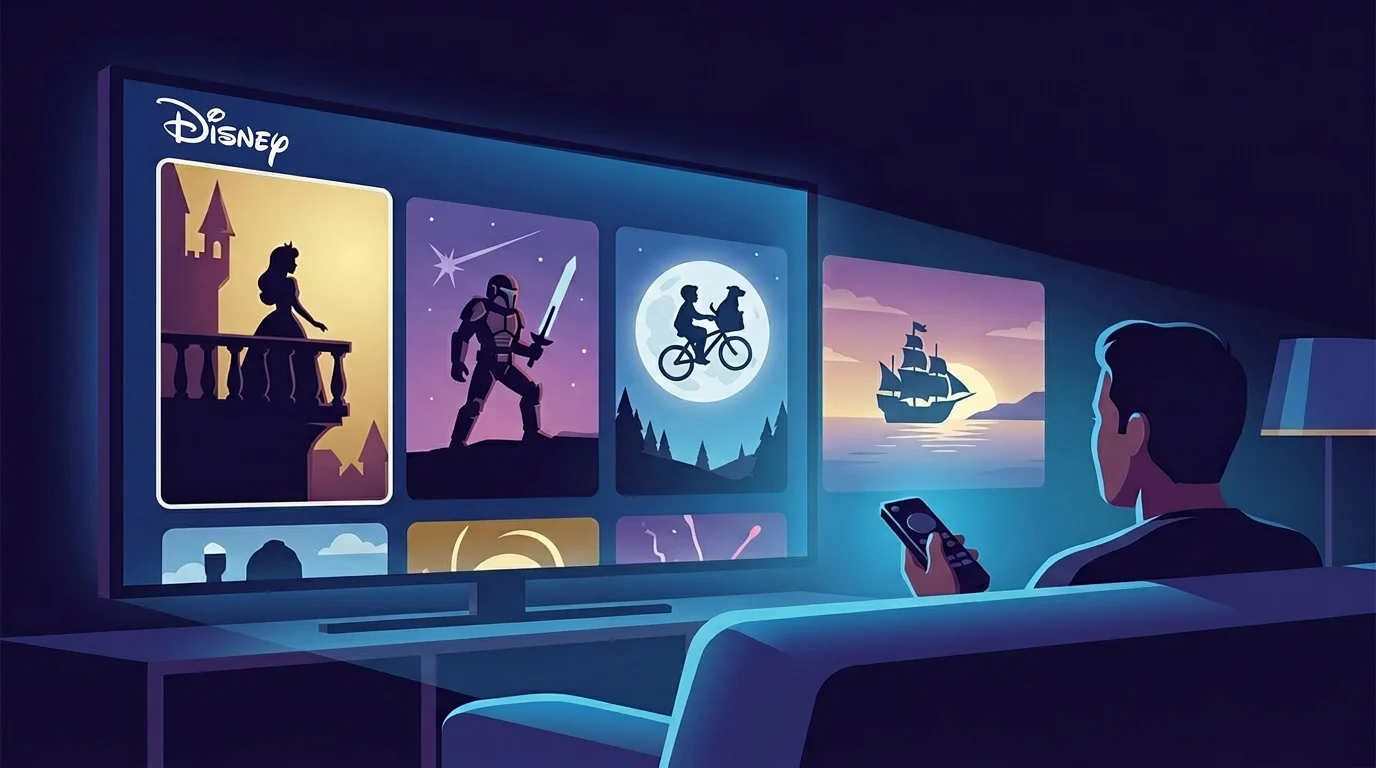
As the clock strikes midnight, a millennial is now old enough to remember rewinding VHS tapes and debating which Sanderson sister stole each of their scenes. They had pressed play on Hocus Pocus 2. Upon hearing the theme play, seeing the witches return made me feel like I was watching a Halloween movie, just as I did when I was a child. This was more of an experience; the TV's light made the whole thing feel powerful, almost religious, even though it was in the context of a billion-dollar content strategy.
Along with their children, parents at another home also share their introduction to The Proud Family: Louder and Prouder. They are laughing at the same jokes they laughed at after school during the early 2000's. While this looks like a simple bonding experience between parents and their children, it is also serving as a retention strategy, within the same timeframe as when it was done.
When Disney+ launched in 2019, it did not present itself as a disruptor chasing the next viral original; instead, it leaned confidently into its past, building its identity around the enormous vault of The Walt Disney Company and positioning itself as the digital keeper of collective memory. The question, then, lingers beneath every reboot and revival: is this creative renewal, or calculated recycling in a ruthless streaming economy?
The Vault as a Business Weapon
Disney is the preeminent producer of nostalgia because it creates and preserves films and other forms of entertainment (live-action TV shows/series, theme parks, merchandising, etc.). Through their many media outlets — including the internet — Disney can repurpose any of these forms whenever needed to satisfy the marketplace; they have created a source of stability that allows them to remain successful even in an otherwise fluid economy.
Disney's so-called "vault," originally conceived as a marketing strategy to leverage its classic animated films, has become a strategic advantage in the digital world. With Disney+, Disney can access decades' worth of intellectual property without the risks associated with creating anything new from an unproven brand.
For example, Hocus Pocus 2 was released almost 30 years after the original film became a Halloween classic. Yet the film does not require an elaborate marketing campaign to promote itself or its availability, because it is already a beloved product that has been pre-sold to the marketplace (i.e., there is enough affection for this property that the marketplace will accept it as a viable film). The same concept holds for The Proud Family; this series was created for the most nostalgic generation ever (millennials), while updating its social commentary for the youngest generation.
These projects are not random acts of creative revision but deliberate choices that transform dormant IP into subscription incentives, and in a streaming landscape where user acquisition costs are steep and attention spans are fragmented across countless platforms, familiarity becomes a powerful algorithmic advantage.
Launching an entirely new franchise demands years of development, marketing budgets that can stretch into the hundreds of millions, and no guarantee that audiences will show up, whereas reviving a known title comes with built-in awareness, preexisting fan communities, and searchable brand recognition that platforms can surface prominently on homepages and recommendation feeds.
In a subscription-based business model, continued profitability depends on retention rates. This can be aided by recognising brands as providers of consistent, dependable, and comforting experiences for viewers, which is significantly more important than any other attribute when viewers can cancel at the push of a button.
Analysts in the industry have frequently remarked that a sequel-dominant slate is not an accident but a calculated response to data. Streaming services have detailed engagement data and analyse completion rates, re-watches and time spent in franchise ecosystems on an extremely granular level, meaning that existing branded IP will outdraw experimental works. Therefore, the Disney vault functions primarily as a renewable resource that can be strategically deployed during periods of lower growth or increased competitive pressure.
Streaming Economics: Risk, Reward, and the Franchise Ecosystem
As streaming has become the main competition for audience engagement, the economics of entertainment have changed significantly, with success no longer determined by opening-weekend box-office performance but by long-term subscriber growth, reduced churn (subscription cancellations), and ongoing engagement across all digital channels.
In a theatrical environment, a film could either make enough money from ticket sales to pay back its cost of production or not, but streaming allows the ability to provide value to content in terms of keeping an audience engaged with it and allows for a long-term build-up of value, since audiences may take months or years to create nostalgia for a franchise.
For example, in the case of The Lion King, it has expanded into an entire universe with the 2019 photorealistic remake of the original film, numerous spin-off shows, multiple merchandising lines, Broadway plays, and theme park attractions, all of which work together to create brand visibility and revenue generation in a continuing cycle.
A child who watches the animated classic on Disney+ may later stream the remake, buy character-themed merchandise, visit a theme park attraction inspired by the same world, and eventually introduce the property to their own children, creating a cyclical pattern of monetisation that stretches far beyond a single subscription fee.
The same ecosystem thinking underpins the ongoing expansion of Star Wars, particularly through streaming series like The Mandalorian, which bridge the gap between theatrical instalments while keeping audiences emotionally invested in the galaxy far, far away.
Disney+ does more than just bring back old movies; it creates new universes that foster a bond between films and viewers, making it easy for viewers to remain part of the Disney brand without leaving not competitors. By doing this, Disney+ is not only creating a way for viewers to be nostalgic but also keeping them engaged in the future.
Streaming shows connected to already popular franchises will be used to tie into the openings of major films in the future and keep viewers interested in these movies and talking about them, while also generating new characters, storylines, and merchandise. This shows that on Disney+, nostalgia is not a passive way to look back on what has happened, but rather an active way to grow an IP's value throughout its entire existence.
When investors evaluate these strategies, they see data-backed predictability rather than creative stagnation, because sequels and spin-offs come with historical performance metrics that reduce uncertainty in budget allocation. In this context, nostalgia is not merely emotional storytelling; it is market logic expressed through beloved characters and familiar melodies, and the line between creative continuation and corporate consolidation becomes increasingly difficult to separate.
Multi-Generational Memory: Selling Childhood Twice
Disney+'s nostalgia strategy rests on an emotional connection to the past by catering to audiences across generations; essentially, it sells the same childhood experience to two physically distinct audiences who share similar memories through visuals, music, and common character types.
Those who grew up during the Disney Renaissance of the 1990s (Millennials) now have disposable income and children of their own, so revisiting those classic animated films or early 2000s TV shows feels like a cultural inheritance, one in which the experience can be preserved and passed on.
Gen Z will often view these older titles through a "retro" lens. They discover these older titles through "curated" playlists, seasonal collections, and algorithm-based recommendations, thereby framing them as both "timeless" and "relevant."
Disney+ has been particularly adept at packaging nostalgia through themed collections, such as holiday bundles or anniversary spotlights, that subtly encourage rewatching as a form of comfort viewing, reinforcing the idea that certain stories function as emotional safe havens during uncertain times.
Disagreement around this situation has led some cultural critics to state that Disney's use of familiar emotional memories represents a business opportunity for them to gain from the psychological appeal of familiarity at a time when everyone needs some sort of certainty/stability; there is truth in those critiques but they also represent a larger human desire to relive significant experiences as a mechanism of reaffirming one's own identity.
Both remakes and sequels provide consumers with a designated space to consume from, as these products represent known entities; this is an important fact because many of the products within these designated categories (e.g., remakes/sequels) will also contain an updated representation and form of that type of product in comparison to what consumers may have experienced previously.
Therefore, through its content delivery, Disney+ has created a "temporal machine" that allows subscribers to toggle between the present and the past with a remote control. Thus, by effectively presenting a significant aspect of this marketplace (i.e., Disney's ability to leverage Part 1 time as an advantage in a marketplace where many competitors rely solely on creating new product forms), Disney creates a unique advantage over its competitors.
The question, however, lingers beneath the sentimentality: does this cycle of rediscovery enrich storytelling, or does it gradually narrow the imaginative horizon by prioritising what is already proven over what might be possible?
The Criticism: Franchise Fatigue and Creative Risk
While there are plenty of fans who love to go back and revisit a nostalgic title, there are also a great number of people who are worried that the entertainment industry’s current obsession with reboots and sequels is a sign of a decline in creative risk-taking. Many critics from opinion columns, campus newspapers, online forums and business publications have expressed similar concerns that we are entering an era of oversaturation with recycled ideas at the expense of new and original narratives.
The term “franchise fatigue” appears frequently in these discussions and refers to the idea that, over time, what once was a source of comfort slowly becomes a source of exhaustion, as the audience has to keep investing in very similar stories.
The live-action remake of classic animated films, such as Snow White, has received a lot of scrutiny. Many viewers feel that these projects don’t have the same emotional honesty as the originals and have attracted controversies as well as over-inflated budgets. Detractors of these projects believe they provide much more evidence of a preference for brand safety than for imagination and creativity.
The backlash does not necessarily stem from hostility toward the original stories, but from a perception that the industry is defaulting to established IP out of fear of failure in a crowded marketplace.
At the same time, defenders of Disney’s strategy argue that audience demand drives these decisions, citing box-office performance and streaming viewership metrics as evidence that familiarity remains commercially viable. They suggest that reboots coexist alongside original projects rather than replacing them entirely.
The tension existing between these perspectives draws attention to a more meaningful structural reality. When there’s a lot of shareholder preference and short-term quarterly earnings information driving executive behaviour, those same executive leaders are more likely to place value on predictability vs experimentation. This is particularly true given that content budgets can be as large as those of traditional theatre-based releases in today’s streaming space.
The real question becomes not only whether Disney is reacting to audience appetite for nostalgia, but whether, by continually marketing and using algorithms to amplify these nostalgic properties, we may be creating an environment where the cycle of revival ultimately inhibits the creative ecosystem by making it hard to take risks on new or different concepts that do not have established or recurring brand recognition.
Therefore, there are substantial narratives that are currently being deferred or delayed as a direct result of nostalgia, from market logic and magic perspectives.
Corporate Overhaul and Strategic Consolidation
For Disney+ to truly comprehend why the company is continually investing fears in legacy content, one must look at the entire classification of corporate pressures that streaming divisions are currently putting on the entertainment industry as a whole, where profitability has been placed at the forefront after years of expanding subscriber base and a significant amount of money spent on content.
As growth is reaching a plateau, pressure from investors on companies to show more clearly how they are achieving long-term margins has led companies to evaluate and reduce the size of their portfolios and reallocate resources to successful brands.
Nostalgic franchises provide an incredibly compelling case for putting dollars to work, given the historical data that accompanies each franchise's audience recognition and the ability to monetise across multiple channels and platforms, all of which can support a $1 billion investment in content production and marketing.
The known (or existing) basis of intellectual property provides a dependable level of predictability to shareholders, who would otherwise be hesitant to invest their funds in speculative investments that cannot be measured against prior periods of performance; it enables Disney to create sequels or derivative products ipredictably by having a point of reference that they can use to model and predict audience participation and potential revenue.
While Disney’s consolidation approach would not suggest a lack of creativity from the creative divisions at Disney, it demonstrates a corporate calculation where historical or established properties serve as a foundation for providing stability when evaluating their financial condition; nostalgia has built-in fan bases and merchandising systems, and this relates well to the need for sustainable profitability in the streaming world through controlled spending and measurable return on investment.
From this perspective, the resurgence of legacy products over a new legacy title is less about artistic decisions and more about making logical choices in the current economic environment, which favours caution over bold new ideas. Although there will be debate over the cultural effects of this change, it is harder to deny that there are reasonable financial arguments for this change in corporate behaviour.
The Takeaway
Nostalgia is a tool used not only by Disney but by many studios in the film and television industry. With the number of entertainment options available today via the digital marketplace, studios are attempting to capitalise on memories of older shows, mostly from the late nineties and early aughts, in hopes of attracting an audience with dwindling attention spans.
Because of the intense competition among streaming services, as well as between them and other forms of entertainment (e.g., social media, gaming), using recognisable brands creates a sense of security for consumers.
The question remains whether original stories can exist in a world increasingly revolving around pre-existing intellectual property, with pre-existing franchises becoming the foundation for entertainment and thus influencing audience expectations in ways that limit the diversity of projects that receive funding and promotion.
In its early years, Disney grew from original concepts to an empire of creativity and innovation. As they look toward building their future through streaming services, many will find that it has become a collection of memories assembled through carefully selected processes.
That irony is not necessarily tragic, but it is revealing. In the streaming era, nostalgia is not a fallback plan but a financial strategy, and Disney+ is doubling down on it not because it lacks ideas, but because in a hyper-competitive economy defined by churn and uncertainty, memory may be the most dependable asset of all.
2022 © Milestone 101. All Rights Reserved.